Key Takeaways
- Eighty percent of serious preventable adverse events in healthcare involve miscommunication during handoffs, and residential care settings face unique risks because informal, relationship-based handoffs routinely omit critical clinical details.
- The SBAR-RC framework (Situation, Background, Assessment, Recommendation, plus Residential Care additions) provides a structured, repeatable handoff format designed specifically for the continuity demands of long-term and community-based care settings.
- Effective handoffs require five non-negotiable components: a standardized format, critical information prioritization, two-way verification, written-plus-verbal redundancy, and protected time — fifteen minutes minimum, not five.
- Handoff protocols must be adapted to each care setting — a two-person group home shift change demands a different approach than a 40-bed long-term care unit, but the underlying structure and information requirements remain consistent.
- Technology amplifies handoff quality through automated shift summaries, critical alert forwarding, and pending task queues, but only when built on top of a well-designed handoff protocol — software cannot fix a process that does not exist.
- Training effective handoff skills requires deliberate practice through simulation exercises, buddy shifts, and competency assessments — telling staff to "communicate better" produces no measurable improvement without structured skill-building.
Introduction
At 7:02 a.m. on a Tuesday, a direct support professional walks into a group home to start the day shift. The overnight staff member is already pulling on a jacket, keys in hand, mentally halfway to the parking lot. The handoff takes ninety seconds: "Everyone had a quiet night. Meds are done. Oh — Mrs. Patterson was up a couple times but went back to bed." Then the overnight staff member is gone.
What the day shift staff member does not learn: Mrs. Patterson was up three times between midnight and 4 a.m. complaining of abdominal pain. She refused her evening PRN acetaminophen. Her daughter called at 9 p.m. and was upset about a bruise she noticed during yesterday's visit — and expects a callback from the site manager this morning. A pharmacy delivery arriving at 10 a.m. includes a new blood thinner that requires a revised medication administration protocol. And the behavioral support plan for Mr. Okafor in Room 3 was updated yesterday afternoon, with new de-escalation steps that the overnight shift never saw.
None of this information was withheld maliciously. The overnight staff member was tired, the details seemed either routine or already documented "somewhere," and the handoff happened the way it always happens — fast, informal, and incomplete.
This scenario is not unusual. It is the norm. Research from the Joint Commission — the primary accrediting body for healthcare organizations in the United States — found that approximately 80% of serious preventable adverse events involve miscommunication during patient handoffs and transitions. The World Health Organization identified communication failures during care transitions as one of the top patient safety priorities globally. And a landmark systematic review published in the BMJ found that standardized handoff protocols reduced preventable adverse events by up to 30%.
In residential care, the stakes are distinct from acute hospital settings but no less serious. Residents live in these facilities. They are not patients passing through an emergency department or a surgical recovery floor. They are people whose daily lives — medications, behavioral patterns, emotional states, family dynamics, dietary needs, appointment schedules — are entrusted to rotating teams of caregivers who must maintain an unbroken chain of awareness across every shift change, every day, for months or years.
When that chain breaks, the consequences are not abstract. A missed medication change leads to a double dose or a missed dose. An unreported behavioral escalation pattern leads to a crisis the next shift is unprepared for. A family member's concern that goes uncommunicated leads to a trust breakdown that takes months to repair. A pending appointment that falls through the cracks leads to a missed specialist visit that delays treatment.
This article provides a comprehensive, evidence-based framework for building shift handoff protocols that prevent these failures. It is written for clinical leaders, directors of nursing, and facility managers in residential care settings — the people responsible for ensuring that critical information travels reliably from one shift to the next, every time, without exception.
Why Residential Care Handoffs Are Different
Hospital handoff literature dominates the research and training landscape. SBAR, I-PASS, and other structured handoff frameworks were developed in acute care environments where the handoff model is physician-to-physician or nurse-to-nurse, the patient population changes daily, and the clinical acuity is high. These frameworks have been extensively validated and their adoption has reduced adverse events in hospital settings.
But residential care is not a hospital. And the differences between hospital handoffs and residential care handoffs are not minor variations — they are fundamental distinctions that require a different approach to protocol design.
Familiarity Breeds Informality
In a hospital, a nurse receiving a patient handoff expects to learn everything about someone they have never met. The handoff is, by definition, a comprehensive information transfer between strangers caring for strangers.
In residential care, staff often know residents by name, personality, preferences, and history. A DSP who has worked at a group home for two years knows that Mrs. Patterson has trouble sleeping, that she does not like to take medication at night, and that her daughter tends to worry. This familiarity is one of the great strengths of residential care. It is also one of the greatest risks to handoff quality.
When staff know residents well, they unconsciously filter handoff information through a lens of assumed shared knowledge. "You know how Mrs. Patterson is" becomes a substitute for specific clinical data. "Mr. Okafor had a rough afternoon" replaces a detailed account of what happened, what interventions were attempted, and what the behavioral support plan recommends for the next shift. The assumption is that the incoming staff member already knows the baseline and only needs the delta — the change from normal.
This assumption fails in at least four common scenarios: when agency or float staff are covering the shift, when a staff member has been on vacation and missed several days of context, when the "normal" has actually been shifting gradually and the outgoing staff member has normalized a deteriorating pattern, and when the detail that matters most is a subtle change that experienced staff might dismiss as unremarkable but that a structured handoff would capture.
Small Teams, Large Information Burden
In a hospital unit with 30 nurses, the handoff system can absorb individual variation. If one nurse gives a subpar handoff, the charge nurse, the unit clerk, and the electronic health record provide redundancy. The information exists in multiple places and multiple people hold pieces of it.
In a group home with two staff members per shift, the handoff is the entire information transfer system. There is no charge nurse. There is no unit clerk reviewing documentation in real time. There is often no electronic health record with automated alerts. When the outgoing staff member walks out the door, everything they know that is not documented walks out with them.
This means that handoff protocol design for small residential settings must account for zero redundancy. The handoff itself must be comprehensive because there is no backup system to catch what it misses. In a two-person shift, the handoff is not one information channel among many — it is the only channel.
Scope of Information Is Broader
A hospital handoff focuses primarily on clinical status: vital signs, medication changes, lab results, pending procedures, pain management, and discharge planning. The scope is clinical because the hospital's role is clinical.
A residential care handoff must cover clinical information and much more. Residents' lives encompass behavioral health, emotional wellbeing, dietary needs, activity participation, family dynamics, community appointments, personal preferences, religious observances, social interactions, and the dozens of small details that constitute a person's daily life. A handoff that covers medication changes but omits the fact that a resident's family member passed away yesterday — and the resident has been withdrawn and refusing meals — has failed at its most basic purpose.
The breadth of information that residential care handoffs must convey is one reason that informal, unstructured handoffs fail so consistently. Without a framework that prompts staff to address each category of information, the handoff defaults to whatever the outgoing staff member happens to remember as most important — which is often the most dramatic event of the shift, not the most clinically significant one.
Continuity Is Measured in Months and Years, Not Days
Hospital handoffs manage transitions for patients who will typically be discharged within days. The tolerance for information gaps is low but the duration of exposure is short. If something is missed in a hospital handoff, the patient is likely to be reassessed by a physician within hours.
In residential care, a handoff failure can compound over days, weeks, or months. A subtle change in a resident's behavior that goes unreported at one handoff may not be noticed again until it escalates into a crisis. A medication change that is poorly communicated may result in incorrect administration not for one dose but for an entire weekend, until the next supervisor reviews the MAR on Monday. A family concern that drops from the handoff chain may fester into a formal complaint or a regulatory report.
The long-duration nature of residential care means that handoff errors have a compounding effect. Each missed piece of information does not just affect the next eight hours — it can affect the next eight days if no subsequent handoff catches it. This makes the reliability of every single handoff interaction critically important.
Workforce Realities Increase Vulnerability
Residential care operates with higher staff turnover than almost any other healthcare sector. In the United States, annual turnover among direct support professionals in IDD settings exceeds 45% in many states. Long-term care facilities report similar figures for CNAs. Agency and temporary staff fill shifts regularly.
Every shift staffed by someone unfamiliar with the residents — whether a new hire, an agency worker, or a staff member floating from another site — is a shift where handoff quality matters most and is most likely to be inadequate. The outgoing staff member may abbreviate the handoff because "you'll figure it out" or because they assume the incoming person has received adequate orientation. The incoming staff member may not know what questions to ask because they do not yet know what they do not know.
Handoff protocols must be designed for the weakest link in the staffing chain, not the strongest. A protocol that works when two experienced, familiar staff members exchange information is insufficient if it fails when an agency worker receives a handoff from someone who has been on the job for three weeks.
The SBAR-RC Framework
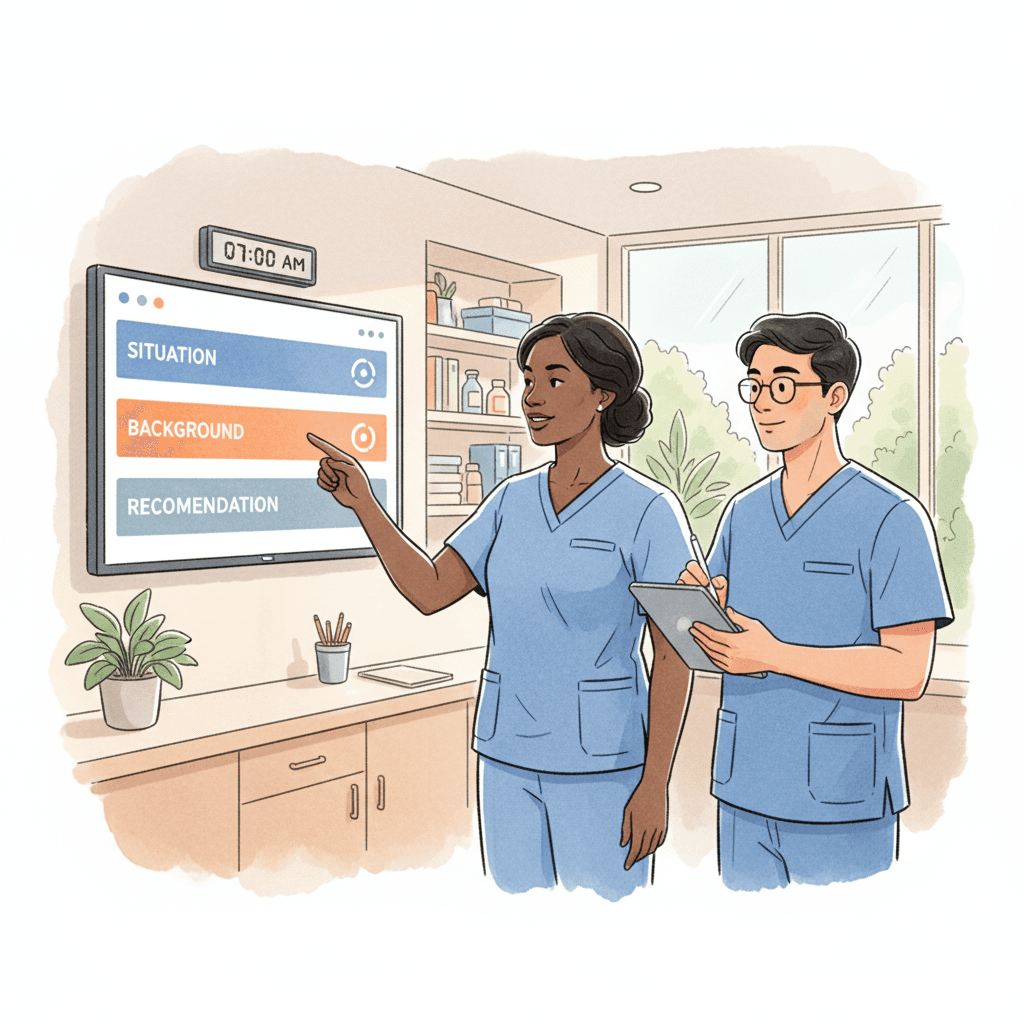
SBAR — Situation, Background, Assessment, Recommendation — is the most widely adopted structured communication framework in healthcare. Originally developed by the U.S. Navy for nuclear submarine operations and adapted for healthcare by Kaiser Permanente, SBAR provides a predictable sequence for conveying critical information quickly and completely.
However, standard SBAR was designed for acute clinical communication: a nurse calling a physician about a patient's deteriorating condition, or a surgeon briefing the recovery team after a procedure. Applied directly to residential care shift handoffs, SBAR misses categories of information that are essential in long-term care, group home, and assisted living settings.
SBAR-RC — SBAR for Residential Care — extends the framework with five additional categories that address the unique information needs of residential care handoffs. The core SBAR structure provides the clinical backbone. The RC additions ensure that the handoff captures the full scope of a resident's daily life.
S — Situation
The Situation component answers a single question: What is happening right now that the incoming shift needs to know?
This is the opening of the handoff and it should lead with the most time-sensitive information. It is not a summary of the entire shift — it is a focused statement of current status and immediate concerns.
For each resident who requires specific handoff attention (not every resident will need a detailed handoff every shift), the Situation statement includes: the resident's name and location, their current clinical status if it deviates from baseline, any immediate needs or tasks that require attention in the next two hours, and any safety concerns that are active right now.
Example: "Mrs. Patterson in Room 2 — she was up three times overnight with abdominal pain, rated it 5 out of 10 at 3 a.m. She refused acetaminophen at 11 p.m. and again at 3 a.m. She's resting now but said the pain was still present at 5 a.m. when I last checked."
B — Background
The Background component provides the clinical and personal context that makes the Situation meaningful. It answers: What does the incoming shift need to know about recent history to understand the current situation?
Background includes: relevant medical history that relates to the current situation, recent changes in condition or care plan, medication changes within the past 72 hours, recent provider visits or consultations and their outcomes, and any diagnostic results or pending diagnostics.
Example: "Mrs. Patterson has a history of diverticulitis. She had a flare-up six months ago that required hospitalization. Her PCP increased her fiber supplement last week. No fever — her temp at 4 a.m. was 98.4. Last bowel movement was three days ago per her tracking sheet."
A — Assessment
The Assessment component is where the outgoing staff member provides their clinical judgment about what they believe is happening. This is not a diagnosis — it is an informed observation from someone who has been with the resident for the past eight to twelve hours.
Assessment includes: the outgoing staff member's interpretation of the resident's condition, whether the condition is stable, improving, or deteriorating, any patterns observed during the shift, and the staff member's level of concern (low, moderate, high).
Example: "I'm moderately concerned. The pattern looks similar to how her last diverticulitis episode started — the pain location is the same, lower left. Three days without a bowel movement is unusual for her. I think she needs to be assessed by the nurse this morning, and if the pain continues or worsens, her PCP should be contacted."
R — Recommendation
The Recommendation component specifies what the outgoing staff member believes the incoming shift should do. It converts the Assessment into actionable steps.
Recommendation includes: specific monitoring or assessment tasks, medication-related actions, provider notifications needed, comfort measures or interventions to continue, and escalation triggers — what conditions should prompt the incoming shift to escalate further.
Example: "I'd recommend the nurse assess her by 9 a.m. Monitor pain level every two hours and document. If pain increases above 6 out of 10, or if she develops fever, nausea, or vomiting, call Dr. Mendes — his number is on the contact sheet. Encourage fluids and light breakfast if she's willing."
RC — Residential Care Additions
The RC additions address the categories of information that standard SBAR does not cover but that are essential for residential care continuity. These five additions should be addressed for every resident who requires handoff attention, and a summary should be provided for all other residents.
Behavioral Status. Current behavioral presentation, any incidents or escalations during the shift, interventions used and their effectiveness, and any changes to behavioral support plans. For residents with behavioral health needs, this category is often more critical than the clinical SBAR components.
Example: "Mr. Okafor in Room 3 — his behavioral support plan was updated yesterday. The new plan adds a 10-minute quiet-room option before physical redirection. He had one escalation at 8 p.m., verbal aggression toward another resident during dinner. I used verbal de-escalation and offered the quiet room, and he calmed within 15 minutes. No physical intervention needed. The updated plan is in his binder and in the system."
Family Communication. Any family contact during the shift — calls, visits, concerns raised, information shared, and any follow-up commitments made. This includes the emotional tone of the interaction, not just the content.
Example: "Mrs. Patterson's daughter Sarah called at 9 p.m. She noticed a bruise on her mother's left forearm during yesterday's visit and was upset. I explained it's documented — she bumped the doorframe on Monday and it was witnessed by two staff. Sarah wants the site manager to call her back today. Her tone was concerned but not hostile. I logged the call and the bruise documentation reference."
Pending Appointments and External Coordination. Any appointments, deliveries, or external contacts expected during the incoming shift. This includes transportation arrangements, documents that need to accompany the resident, and any preparation required.
Example: "Mrs. Patterson has a podiatry appointment at 2 p.m. — transport is arranged through MetroCare, pickup at 1:15. She needs her insurance card and the referral form from Dr. Mendes, both are in her file in the top drawer. Also, the pharmacy delivery is expected at 10 a.m. and includes a new prescription — warfarin 2 mg — that requires the nurse to review and update the MAR before administration."
Medication Changes. Any new medications, dosage changes, discontinued medications, or medication-related events during the shift. This overlaps slightly with the Background component but deserves its own explicit mention because medication errors during shift transitions are among the most common handoff failures in residential care.
Example: "The warfarin is new as of yesterday — ordered by Dr. Mendes after her last bloodwork showed elevated clotting risk. The nurse needs to add it to the MAR and set up the INR monitoring schedule. No other medication changes this shift."
Environmental and Operational Notes. Any facility-level information that affects all residents or operations: maintenance issues, supply shortages, equipment malfunctions, staffing changes for the next shift, visitor expectations, or regulatory visits expected.
Example: "The hot water heater in the west wing is being repaired — maintenance is coming between 9 and 11 a.m. Residents in Rooms 3 and 4 won't have hot water until it's fixed. The state survey team called yesterday and said they'll be visiting sometime this week for an unannounced inspection — make sure all binders are current."
SBAR-RC Quick Reference Template
The following template can be printed, laminated, and posted at every handoff station. Each category includes prompt questions to guide the outgoing staff member through a complete handoff.
| Component | Prompt Questions |
|---|---|
| Situation | What is happening right now? What needs immediate attention? Any safety concerns? |
| Background | What recent history is relevant? Any condition changes in the past 72 hours? Recent provider visits? |
| Assessment | What do you think is going on? Is the resident stable, improving, or declining? How concerned are you? |
| Recommendation | What should the incoming shift do? What triggers should prompt escalation? Who should be called if things change? |
| Behavioral Status | Any behavioral incidents? What interventions worked? Any plan changes? |
| Family Communication | Any family contact? What was discussed? Any follow-up needed? What was the emotional tone? |
| Pending Items | Appointments? Deliveries? External contacts expected? Transportation arranged? Documents needed? |
| Medication Changes | New meds? Dose changes? Discontinued meds? Refusals? Errors? Pharmacy deliveries? |
| Environment/Operations | Facility issues? Supply needs? Equipment status? Staffing notes? Expected visitors or inspections? |
Five Components of an Effective Handoff
The SBAR-RC framework provides the content structure for a handoff. But structure alone does not guarantee effectiveness. Research on handoff quality consistently identifies five components that must be present for a handoff to reliably prevent information loss. Remove any one of these components and handoff failure rates increase measurably.
1. Standardized Format
Every handoff must follow the same format, every time, regardless of who is giving it or receiving it. This is the single most important factor in handoff reliability. The Agency for Healthcare Research and Quality (AHRQ) found that standardized handoff formats reduced information omissions by 50% compared to unstructured, narrative-style handoffs.
Standardization means that the handoff follows a predictable sequence. The outgoing staff member covers the same categories in the same order for every resident. The incoming staff member knows what to expect and can recognize when a category has been skipped. The format becomes a cognitive checklist that prevents the outgoing staff member from relying solely on memory — which, after an eight- or twelve-hour shift, is the least reliable information source available.
The format does not need to be rigid to the point of inflexibility. Within the SBAR-RC structure, the depth of coverage for each category will vary by resident and by shift. A quiet night for a stable resident may require only a brief Situation statement and a note that no changes occurred across the other categories. A complex night for an acutely changing resident may require detailed coverage of every component. The key is that the structure is consistent — the categories are always addressed, even if the answer is "no change."
2. Critical Information Prioritization
Not all handoff information carries equal weight. Effective handoffs prioritize information by its time-sensitivity and safety implications, ensuring that the most critical items are communicated first and with the greatest emphasis.
A useful prioritization framework uses three tiers:
Tier 1 — Immediate (communicate first, verify understanding). Active safety concerns, new or changed medication orders not yet administered, escalation triggers in effect, any resident requiring assessment within the first two hours of the incoming shift, and any pending external contacts with deadlines (a physician expecting a callback, a family member waiting for information).
Tier 2 — Shift-Critical (communicate during handoff, document in writing). Behavioral incidents and intervention outcomes, family communications requiring follow-up, pending appointments and logistics, care plan changes that affect this shift's activities, and any monitoring tasks with specific time intervals.
Tier 3 — Awareness (document in writing, verbal mention as time allows). Environmental and facility notes, routine observations consistent with baseline, general mood and activity participation, supply or equipment notes, and information relevant to future shifts rather than the immediate one.
This tiered approach prevents a common handoff failure: the "data dump," where the outgoing staff member recites every event of the shift in chronological order, burying critical information among routine observations. By leading with Tier 1 items, the handoff ensures that even if it is cut short — if the phone rings, if a resident needs attention, if time runs out — the most important information has already been communicated.
3. Two-Way Verification
A handoff is not a monologue. It is a structured dialogue. The incoming staff member is not a passive recipient of information — they are an active participant whose role is to verify understanding, ask clarifying questions, and confirm that they have received the information they need to provide safe care.
Two-way verification includes three specific practices:
Read-back of critical information. For Tier 1 items — medication changes, escalation triggers, immediate assessment needs — the incoming staff member repeats the information back to the outgoing staff member. "So Mrs. Patterson has a new warfarin order, the nurse needs to update the MAR before it's administered, and I should call Dr. Mendes if her pain goes above 6 out of 10. Is that correct?" This practice, borrowed from aviation and adapted for healthcare by the Joint Commission, catches misunderstandings before they become errors.
Clarifying questions. The incoming staff member is expected and encouraged to ask questions when anything is unclear, incomplete, or inconsistent. "You mentioned Mr. Okafor's behavioral plan was updated — can you show me the new de-escalation steps?" or "You said the pharmacy delivery includes warfarin — is that a new medication or a dosage change?" Training staff to ask questions during handoff requires creating a culture where questions are seen as professionalism, not as a sign of incompetence.
Explicit acknowledgment of pending tasks. Before the outgoing staff member leaves, both parties should verbally confirm the list of pending tasks that the incoming shift is accepting responsibility for. "Just to confirm — I'm picking up the nurse assessment for Mrs. Patterson, the callback to Sarah, the pharmacy delivery review, and the podiatry transport at 1:15. Anything else?" This explicit transfer of responsibility prevents the assumption gap, where the outgoing staff member believes they have communicated a task and the incoming staff member does not realize they have received one.
4. Written-Plus-Verbal Redundancy
Verbal handoffs alone are insufficient. Written handoffs alone are insufficient. Effective handoff protocols use both channels, with each serving a distinct purpose.
The verbal handoff provides nuance, emphasis, and context that written documentation cannot fully convey. Tone of voice communicates concern. The ability to ask and answer questions in real time resolves ambiguity. The face-to-face (or voice-to-voice) interaction creates a moment of shared accountability that a written note does not.
The written handoff provides permanence, precision, and accessibility. It can be referenced throughout the shift. It captures details that verbal communication may abbreviate. It creates a record that can be reviewed by supervisors, used in incident investigations, and accessed by staff who arrive after the verbal handoff has occurred (late arrivals, staff returning from break).
The two channels should reinforce each other but are not identical. The verbal handoff should emphasize Tier 1 items and provide context that written documentation captures poorly — the worry in a family member's voice, the gut feeling that something is off with a resident, the observation that a behavioral pattern is emerging. The written handoff should capture all tiers comprehensively, using the standardized SBAR-RC format, with enough detail that a staff member who missed the verbal handoff could still provide safe care.
The written component can take various forms: a handwritten shift report using a standardized template, a typed summary in an electronic documentation system, or a structured digital handoff tool. The format matters less than the discipline of completing it every shift and the availability of it to all incoming staff.
5. Time Allocation
This is the component that organizations most consistently fail to protect. Effective handoffs take time. Not five minutes while someone is putting on their jacket. Not a hurried exchange in the hallway while a resident is asking for breakfast. Fifteen minutes minimum, in a designated location, with both the outgoing and incoming staff present and focused.
Research supports this directly. A study published in the Journal of Patient Safety found that facilities that allocated 15 or more minutes for structured handoffs had 42% fewer handoff-related adverse events than facilities where handoffs averaged less than 8 minutes. The I-PASS study, one of the largest handoff intervention trials, built 20-minute protected handoff periods into its protocol and achieved a 30% reduction in preventable adverse events.
Time allocation means three things operationally:
Overlap scheduling. Shifts must overlap by enough time to accommodate a structured handoff. If shifts are scheduled back-to-back with zero overlap, the handoff happens on someone's unpaid time — which means it happens quickly, resentfully, and incompletely. Schedule a minimum 15-minute overlap. For larger facilities with unit-based handoffs, 20 to 30 minutes is appropriate.
Protected time. During the handoff, the staff members involved should not be simultaneously responsible for direct care. Someone else must cover the floor — a supervisor, a third staff member, or a planned break in direct-care tasks. If the handoff is constantly interrupted by resident needs, its quality degrades to the point of uselessness.
Designated location. The handoff should occur in a consistent location that is conducive to focused communication — a nursing station, an office, a break room. Not in the hallway. Not in a resident's room. Not in the parking lot. A consistent location signals that the handoff is a formal process, not a casual conversation, and it ensures access to documentation, care plans, and the written handoff form.
Handoff Protocols by Care Setting
The five components and the SBAR-RC framework apply across all residential care settings. But the operational context of the handoff — how many staff are involved, how many residents are covered, and what information takes priority — varies meaningfully between care settings. A handoff protocol that works for a 6-bed group home will not function unchanged in a 120-bed long-term care facility, and vice versa.
Group Homes (2 to 3 Staff per Shift)
Group homes are the setting where handoff quality matters most and is most fragile. With only two or three staff members per shift, there is no informational redundancy. The handoff is the sole mechanism for information transfer.
In group homes, the handoff should be a face-to-face exchange between the full outgoing shift and the full incoming shift. Every staff member on both sides participates. The handoff covers every resident individually — in a 6-bed home, this is feasible within 15 minutes. The SBAR-RC structure applies in full, with particular emphasis on Behavioral Status (group homes frequently serve individuals with behavioral health needs), Family Communication (families of group home residents often have daily contact with staff), and Pending Items (group home staff often coordinate transportation, appointments, and community activities directly).
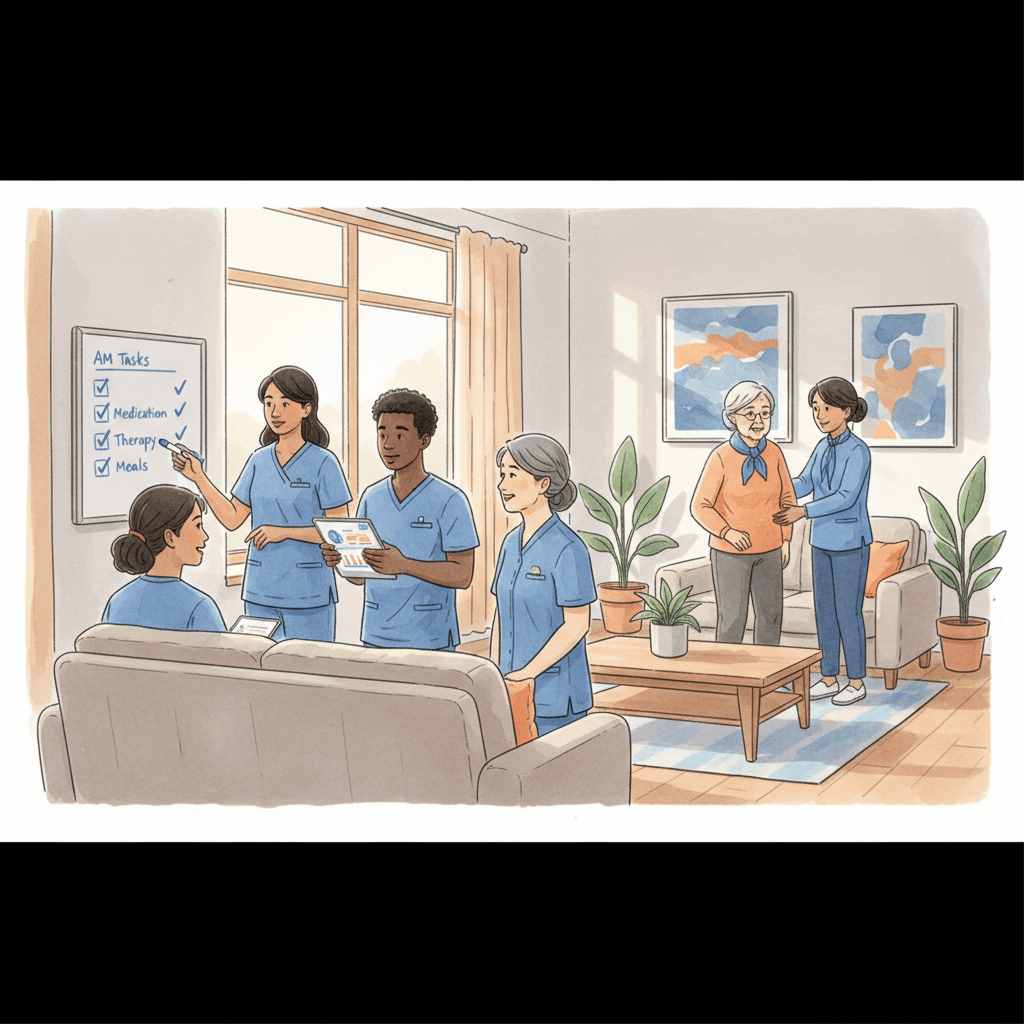
The written handoff in a group home should be a single-page shift summary that lives in a central, accessible location — a binder at the kitchen table, a clipboard at the staff station, or a shared digital document. The summary is completed by the outgoing shift before the verbal handoff begins, so the incoming shift can reference it during the exchange.
Group home handoffs face a unique risk: the "nothing happened" handoff. Because group homes often have quiet shifts — residents sleeping through the night, a calm afternoon — outgoing staff may abbreviate the handoff to "everything's fine." The protocol must require that the standardized format be followed even when the shift was uneventful. "No changes" is valid only when every SBAR-RC category has been explicitly considered and the answer for each is genuinely "no change."
Long-Term Care (Unit-Based, 20 to 40 Residents)
Long-term care facilities require a layered handoff approach because no single staff member can meaningfully hand off information on 40 residents in 15 minutes.
The first layer is the unit-level handoff, led by the outgoing charge nurse or shift supervisor. This covers unit-wide information — staffing for the incoming shift, any facility-level issues, residents who require specific attention, and any regulatory or administrative matters. This is a group briefing for all incoming unit staff and should take 5 to 7 minutes.
The second layer is the assignment-level handoff, where the outgoing CNA or care aide hands off their specific resident assignments to the incoming CNA or care aide. This is a one-to-one or small-group exchange that covers the 8 to 12 residents the incoming staff member is responsible for. The SBAR-RC framework applies here, with emphasis on clinical status changes, ADL observations, behavioral notes, and pending care tasks.
The third layer — often missed but critically important — is the nurse-to-nurse handoff, where the outgoing licensed nurse hands off to the incoming licensed nurse. This covers medication changes, provider orders, clinical assessments that need follow-up, pending labs or diagnostics, and any residents whose condition requires clinical monitoring during the incoming shift.
Each layer uses the same SBAR-RC structure but at different levels of detail. The unit-level briefing is broad and logistical. The assignment-level handoff is resident-specific and task-oriented. The nurse-to-nurse handoff is clinically focused and decision-oriented.
Assisted Living (Wellness-Focused)
Assisted living handoffs differ from LTC handoffs in their emphasis. Residents in assisted living are generally more independent, and the care model is oriented toward wellness, social engagement, and supportive services rather than skilled nursing.
Handoffs in assisted living should prioritize: changes in functional independence (a resident who needed more assistance than usual today), wellness observations (appetite changes, sleep disruptions, mood shifts, social withdrawal), medication self-administration concerns (a resident who forgot their medications or appeared confused about their regimen), and community and social information (visitors expected, activities scheduled, outings planned).
The SBAR-RC framework applies with a wellness lens. The Situation focuses on deviations from the resident's typical independence level. The Assessment focuses on whether observed changes suggest a need for reassessment of the service plan. The Residential Care additions emphasize social, emotional, and community factors that affect quality of life.
Assisted living facilities should not underestimate the importance of structured handoffs simply because their residents are more independent. Changes in cognitive or functional status often present subtly in assisted living settings, and informal handoffs that focus only on task completion ("meds were done, meals were served") miss the observational data that identifies emerging problems before they escalate to the point of transfer to a higher level of care.
IDD and Behavioral Health (Behavioral Emphasis)
Settings serving individuals with intellectual and developmental disabilities or behavioral health conditions require handoff protocols that give equal or greater weight to behavioral information as to clinical information.
The Behavioral Status component of SBAR-RC becomes the lead item in IDD/behavioral health handoffs. Each individual's behavioral presentation during the shift should be documented and verbally communicated: specific behaviors observed, antecedents identified, interventions used, outcomes of those interventions, and any patterns emerging across shifts. If a behavioral support plan was activated, the handoff should include exactly what steps were followed and whether the plan was effective.
Skill acquisition and habilitation data are unique to IDD settings and should be added to the handoff as a routine component. If a resident is working on specific goals — independent meal preparation, community navigation, self-care tasks — the handoff should note any practice opportunities, successes, or barriers observed during the shift.
Sensory and environmental factors that affect behavior should also be communicated: noise levels, visitor disruptions, schedule changes, peer conflicts, and any environmental modifications made during the shift. In IDD settings, these contextual factors are often more relevant to the incoming shift's preparation than clinical vital signs.
Technology for Better Handoffs
Technology does not replace the human elements of an effective handoff — the face-to-face exchange, the read-back of critical information, the clarifying questions, the shared moment of responsibility transfer. But technology can dramatically improve the consistency, completeness, and accessibility of handoff information, particularly in settings where staffing pressures, shift patterns, and information volume challenge even the most disciplined manual processes.
Automated Shift Summaries
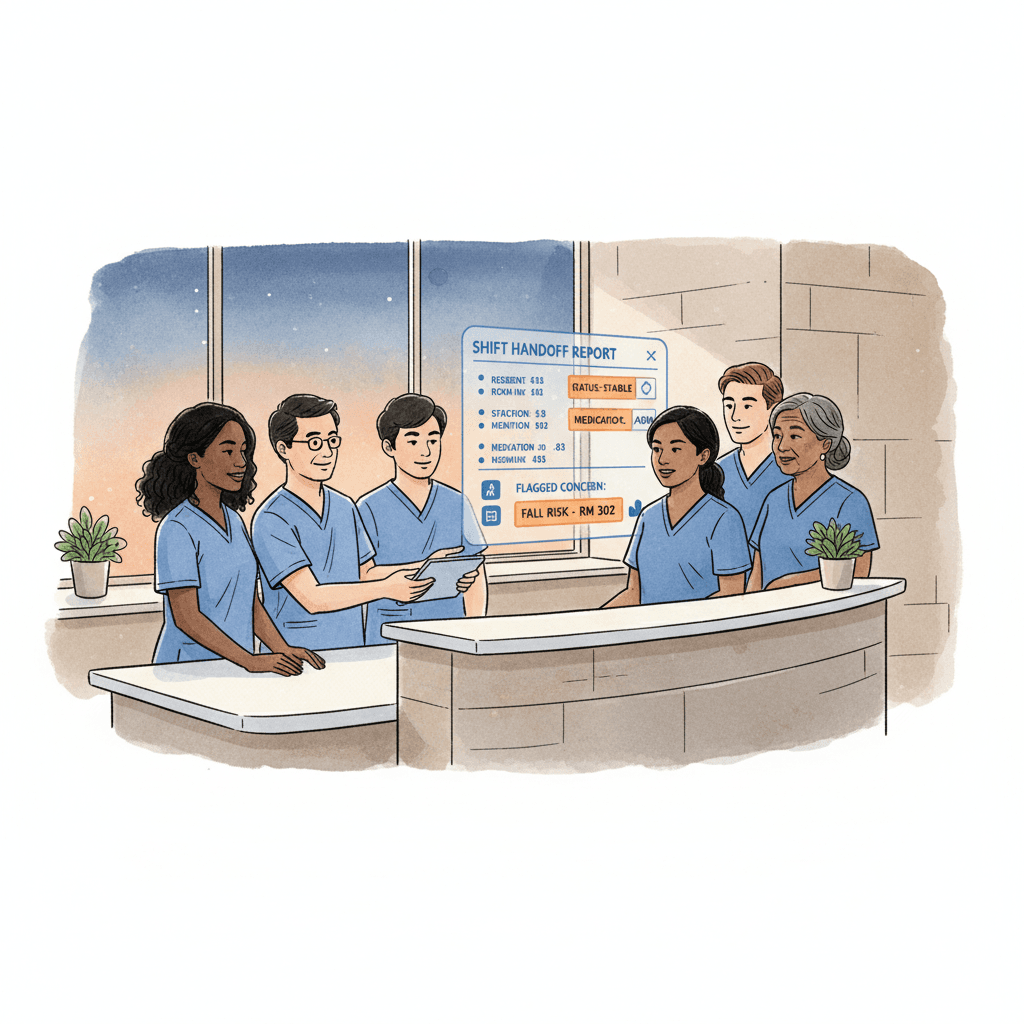
The most immediate technology improvement to handoff quality is the automated shift summary — a system-generated document that compiles all documented events, observations, medication administrations, and care activities from the outgoing shift into a structured summary aligned with the handoff format.
Instead of relying on the outgoing staff member to remember everything that happened during an eight-hour shift, the system pulls data from documentation entered throughout the shift: progress notes, medication administration records, incident reports, behavioral tracking logs, vital signs, and task completion records. The result is a pre-populated handoff document that the outgoing staff member reviews, supplements with verbal context, and uses as the backbone of the structured handoff.
This approach addresses one of the most common handoff failures: omission due to memory limitations. Studies on human memory consistently show that people recall approximately 50% of information immediately after an event and less than 25% after 24 hours. An outgoing staff member at the end of a 12-hour shift cannot be expected to recall every clinically relevant event, observation, and communication from the past half-day. The automated summary provides the factual backbone; the staff member adds the judgment, context, and emphasis.
Critical Alert Forwarding
Some information cannot wait for the next scheduled handoff. A new provider order, a significant change in condition, a family communication that requires immediate action, or an escalation trigger that activates mid-shift — these events need to reach the incoming shift (or the on-call supervisor) in real time.
Critical alert forwarding systems automatically route high-priority events to designated recipients. When a nurse documents a new medication order at 2 a.m., the system flags it for the day shift nurse and includes it prominently in the next handoff summary. When an incident report is filed with a severity level above a defined threshold, the system notifies the site manager and the on-call clinical lead immediately, regardless of the time.
This technology ensures that critical information does not depend on a single person's memory or a single handoff event. It creates a parallel notification channel that reinforces the structured handoff without replacing it.
Pending Task Queues
One of the most common handoff failures is the lost pending task — a follow-up that the outgoing shift intended to communicate but forgot, or that was communicated but not captured in a way the incoming shift could track.
Digital pending task queues solve this by maintaining a running list of incomplete items that automatically carry forward from shift to shift until they are explicitly completed or resolved. When a staff member notes "callback needed to Mrs. Patterson's daughter," the task enters the queue and remains visible to every subsequent shift until someone marks it complete. When a pharmacy delivery is expected, the task appears on the incoming shift's queue with the expected time and any preparation required.
Pending task queues transform handoff from a purely informational exchange into a responsibility transfer with tracking. The incoming shift can see exactly what they are inheriting. The outgoing shift can see that their pending items have been captured. And supervisors can monitor the queue to ensure that tasks are not aging without resolution.
What Harmony Offers
Harmony's clinical documentation platform includes several features specifically designed to support structured handoffs in residential care settings. Automated shift summaries compile documentation from the outgoing shift into SBAR-aligned reports. Configurable alert routing ensures that critical events reach the right people at the right time, across shift boundaries. Pending task queues maintain continuity of follow-up items from shift to shift. And the platform's handoff documentation templates enforce the SBAR-RC structure as the default format, ensuring that every handoff follows the same categories in the same order.
For multi-site operators, these features are configured at the organizational level, meaning every facility uses the same handoff format, the same alert thresholds, and the same documentation standards. Staff who float between sites encounter a familiar handoff process regardless of location — one of the highest-leverage benefits of technology-supported standardization.
Case Scenario: Harbor House Reduces Handoff-Related Incidents by 65%
Harbor House is a fictional residential care provider operating four group homes serving adults with intellectual and developmental disabilities in a mid-Atlantic state. Each home has six residents and runs three shifts: day (7 a.m. to 3 p.m.), evening (3 p.m. to 11 p.m.), and overnight (11 p.m. to 7 a.m.). Each shift has two direct support professionals.
Before implementing a structured handoff protocol, Harbor House's handoffs were informal and inconsistent. Staff exchanged information verbally, usually in two to four minutes, with no written component and no standardized format. The content of the handoff depended entirely on what the outgoing staff member thought to mention.
Over a six-month period, Harbor House tracked 23 incidents that were directly attributable to handoff failures. These included: seven missed or delayed medication administrations due to unreported medication changes, five behavioral escalations where the incoming shift was unaware of triggers or updated support plans, four missed appointments because transportation or preparation requirements were not communicated, three family complaints resulting from unreturned calls or uncommunicated concerns, two falls that occurred when incoming staff were unaware of recently identified environmental hazards, and two incidents where PRN medications were administered without awareness that the same medication had been given on the previous shift.
Harbor House's clinical director implemented the following changes over an eight-week period:
First, the organization adopted the SBAR-RC framework as the required handoff format across all four homes. Each handoff station received a laminated quick-reference card with the framework components and prompt questions.
Second, shift schedules were adjusted to create a 15-minute overlap between outgoing and incoming shifts. This cost an additional 45 minutes of staff time per home per day but was non-negotiable.
Third, a written handoff template — a single-page form aligned with SBAR-RC — was introduced as a mandatory companion to the verbal exchange. The outgoing shift completed the form before the verbal handoff began.
Fourth, all staff completed a two-hour training on the new protocol, which included three practice handoff scenarios with feedback from supervisors.
Fifth, the clinical director conducted weekly audits for the first three months, reviewing completed handoff forms for completeness and observing live handoffs at each home at least twice per month.
Six months after full implementation, Harbor House measured the results:
- Handoff-related incidents: decreased from 23 to 8 over the same six-month period — a 65% reduction.
- Medication-related handoff errors: decreased from 7 to 1.
- Missed appointments: decreased from 4 to 0.
- Family complaints related to communication gaps: decreased from 3 to 1.
- Staff satisfaction with handoff quality: in a survey, 89% of staff agreed or strongly agreed that the new protocol improved their ability to provide safe care. Before the change, only 34% of staff rated handoff quality as "adequate."
The most significant qualitative change: agency and float staff reported that they felt significantly more prepared for shifts at homes they were unfamiliar with. The structured handoff gave them the information they needed to provide safe care from the first hour of their shift, rather than spending the first two hours figuring out what was going on.
Training Staff for Effective Handoffs
Implementing a handoff protocol is a structural change. But a protocol on paper is only as good as the staff members executing it. Training for effective handoffs requires more than distributing a template and explaining the categories. It requires deliberate practice of a communication skill that most care workers have never been formally taught.
The Handoff Skill Gap
Most residential care staff receive no formal training in structured clinical communication. They learn to give handoffs by watching their peers — which means they learn whatever habits, shortcuts, and omissions their peers have adopted. If the organizational norm is a two-minute verbal exchange with no written component, new staff absorb that norm within their first week. Training must replace an informal learned behavior with a structured one, which requires more than a single orientation session.
Simulation Exercises
The most effective handoff training method is simulation: practice handoffs using realistic scenarios, with feedback from a trainer or supervisor. Simulation exercises should include:
Scenario cards. Each card describes a shift's events for a set of residents — clinical changes, behavioral incidents, family communications, pending tasks, medication updates, and environmental notes. The trainee must deliver a complete SBAR-RC handoff based on the card, as if they had lived the shift.
Information complexity variation. Some scenarios are straightforward (quiet night, minimal changes). Others are complex (multiple residents with active issues, a behavioral crisis mid-shift, a medication error, and two family calls). Staff must practice both extremes because the temptation to abbreviate the handoff is greatest when the shift was quiet and the difficulty of delivering a complete handoff is greatest when the shift was chaotic.
Deliberate omission scenarios. In these exercises, the trainer deliberately omits a critical piece of information during a practice handoff. The trainee's task is to identify the gap and ask the clarifying question. This trains the receiving skill — the ability to recognize when the handoff is incomplete and to intervene before the outgoing staff member leaves.
Buddy Shifts
New staff members — whether new hires, agency workers on their first shift at a facility, or experienced staff transitioning to a new site — should complete at least one buddy shift where they observe and participate in a structured handoff with an experienced staff member before they are expected to give or receive a handoff independently.
During the buddy shift, the experienced staff member models the full SBAR-RC handoff and then debriefs with the new staff member: What did you notice about the structure? What would you have missed without the template? What questions would you have asked? This guided observation accelerates the adoption of the structured handoff far more effectively than reading a policy document.
Competency Assessments
Handoff competency should be assessed formally, not assumed. Within the first 30 days of hire (or the first three shifts at a new site for agency staff), each staff member should demonstrate the ability to deliver and receive a complete SBAR-RC handoff. The assessment uses a simple competency checklist: Did the staff member address each SBAR-RC component? Did they prioritize critical information? Did they complete the written handoff form? Did they use read-back for critical items? Did they ask clarifying questions during the receiving portion?
Staff who do not meet competency on the first assessment receive additional coaching and a repeat assessment within two weeks. This is not punitive — it is a safety standard, no different from verifying that a medication aide can demonstrate accurate medication administration before working independently.
Sustaining the Skill
One-time training decays. Within three months of initial handoff training, staff begin to drift toward their old habits unless the new behavior is reinforced. Sustainability requires three ongoing mechanisms: periodic observation by supervisors (at least monthly during the first year, quarterly thereafter), handoff form audits that check for completeness and quality, and regular refresher exercises during staff meetings — a 10-minute simulation scenario once per month keeps the skill sharp without consuming excessive training time.
Conclusion
Shift handoffs are the single most frequent point of vulnerability in residential care operations. They happen every day, at every shift change, in every facility. Each one is an opportunity for critical information to transfer reliably — or to be lost. The research is unambiguous: unstructured, informal handoffs cause preventable harm. Structured, standardized handoff protocols reduce that harm by 30% or more.
The path to effective handoffs is not complex, but it requires commitment. Adopt a structured framework — SBAR-RC provides a residential-care-specific model that addresses the full scope of information that must travel between shifts. Ensure that every handoff includes the five non-negotiable components: standardized format, critical information prioritization, two-way verification, written-plus-verbal redundancy, and protected time. Adapt the protocol to your care setting's operational reality while maintaining the underlying structure and information standards. Use technology to automate the routine and enforce the consistent, not to replace the human judgment and dialogue that make handoffs meaningful. And train your staff deliberately — simulation, buddy shifts, competency assessments, and ongoing reinforcement.
The organizations that get handoffs right gain something that no amount of heroic individual effort can provide: reliability. Not the reliability that depends on one experienced staff member who always gives great handoffs, but the systemic reliability that ensures every handoff, at every shift change, at every site, meets a minimum standard of completeness and quality. That systemic reliability is what protects residents when the agency worker covers the overnight, when the new hire starts on a busy evening shift, and when the experienced staff member is tired at the end of a long week.
Eighty percent of serious preventable events involve miscommunication during handoffs. That statistic is not a fixed reality. It is the consequence of handoff processes that were never designed, never standardized, and never trained. It is a problem that every residential care organization has the power to solve.
FAQ
How long should a shift handoff take in a residential care facility?
A structured shift handoff should take a minimum of 15 minutes for small settings like group homes (6 to 8 residents with 2 to 3 staff per shift). For larger long-term care units with 20 to 40 residents, the full layered handoff process — including the unit-level briefing, assignment-level handoffs, and nurse-to-nurse handoff — typically requires 20 to 30 minutes. These times assume that shifts are scheduled with an appropriate overlap period. The cost of this overlap is consistently offset by reductions in handoff-related errors, missed tasks, and adverse events. Organizations that attempt to compress handoffs into 5 minutes or less see significantly higher rates of information loss and downstream incidents.
What is the SBAR-RC framework and how does it differ from standard SBAR?
SBAR-RC extends the traditional SBAR (Situation, Background, Assessment, Recommendation) framework with five Residential Care-specific additions: Behavioral Status, Family Communication, Pending Appointments and External Coordination, Medication Changes, and Environmental and Operational Notes. Standard SBAR was designed for acute clinical communication — a nurse calling a physician about a deteriorating patient. It works well for clinical information but misses the broader categories that residential care handoffs require: behavioral health, family dynamics, community appointments, and facility operations. SBAR-RC preserves the clinical rigor of SBAR while addressing the full scope of information that residential care staff need to maintain continuity of care across shifts.
How do we handle handoffs when agency or float staff are involved?
Agency and float staff represent the highest-risk handoff scenario because they lack the contextual knowledge that regular staff take for granted. Effective organizations address this by ensuring that the structured handoff protocol provides all the information a person without prior knowledge would need — which is why the SBAR-RC framework includes Background and contextual information that familiar staff might consider obvious. Additional measures include providing agency staff with a brief resident summary sheet (one page per resident, updated weekly, covering baseline status, key diagnoses, behavioral support plans, and emergency contacts), conducting the first handoff of an agency worker's shift with the site supervisor present, and using the two-way verification component to explicitly confirm that the agency worker has received and understood all critical information. The handoff protocol should be designed for the person who knows the least, not the person who knows the most.
Can technology replace verbal handoffs?
No. Technology supports and enhances handoffs but cannot replace the verbal component. Written and digital handoffs provide permanence, completeness, and accessibility. Automated shift summaries ensure that no documented event is omitted from the handoff. Alert forwarding catches critical events in real time. But only the verbal exchange provides the nuance, emphasis, clinical judgment, and real-time question-and-answer dialogue that prevent misunderstanding. A staff member reading a written handoff cannot ask "how concerned are you, really?" or hear the hesitation in a colleague's voice that signals something is not quite right. The evidence-based standard is written-plus-verbal redundancy: both channels, every shift, reinforcing each other. Organizations that eliminate verbal handoffs in favor of read-only digital reports consistently see increases in information misinterpretation and missed clinical nuances.
What metrics should we track to measure handoff quality?
Track handoff quality using a combination of process metrics and outcome metrics. Process metrics include: handoff documentation completion rate (percentage of shifts with a completed written handoff form), handoff timeliness (percentage of handoffs completed within the scheduled overlap period), and handoff completeness scores (based on periodic audits of written handoff forms against the SBAR-RC checklist — are all required components addressed?). Outcome metrics include: handoff-related incident rate (incidents directly attributable to information not communicated during handoff, tracked per 1,000 shift changes), missed or delayed medication administrations following shift change, family complaints related to communication gaps across shifts, and missed appointments or follow-up tasks that were not successfully transferred between shifts. Review both metric categories monthly. Process metrics tell you whether the handoff protocol is being followed. Outcome metrics tell you whether it is working. A facility with high process compliance but persistent outcome problems needs to re-examine the protocol's content or the training quality, not just the adherence rate.