Key Takeaways
- Workflow inconsistency across sites increases regulatory risk, staff confusion during float shifts, and the likelihood of missed incidents falling through documentation gaps.
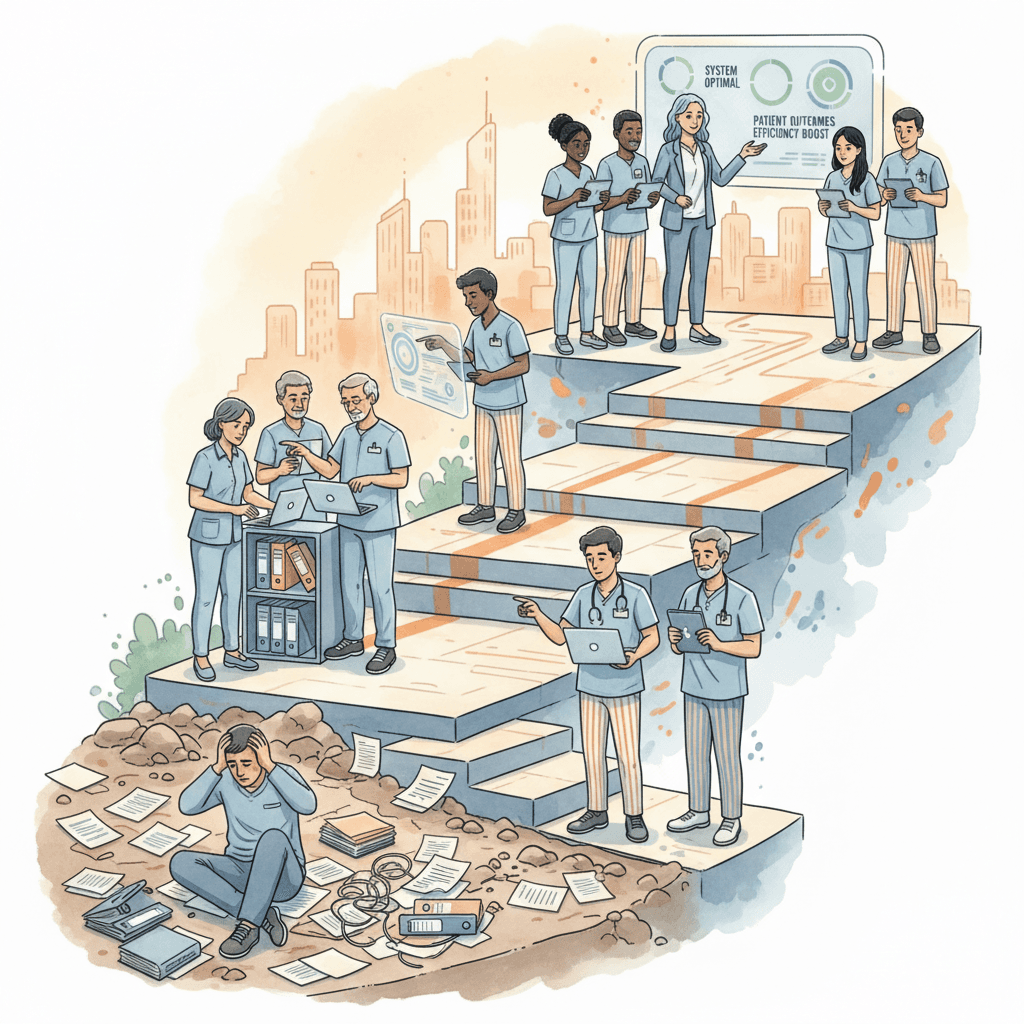
- Effective standardization follows a five-step framework: Audit current state, Prioritize by risk, Design collaboratively, Pilot at representative sites, and Scale with feedback loops.
- Not everything should be standardized — core safety and compliance workflows demand consistency, while scheduling, activity programming, and community engagement should remain locally adaptive.
- Multi-jurisdictional operators must build a layered workflow architecture: a universal core that meets the strictest standard, with jurisdiction-specific modules layered on top.
- Technology enforces standardization at scale through template libraries, required fields, automated escalation paths, and real-time compliance dashboards — but only if configured after workflow design is complete.
- Standardization is a continuous discipline, not a one-time project — plan for quarterly reviews, frontline feedback channels, and formal change-management processes from the start.
Introduction
Imagine this: a regional director covering eight residential care sites sits down on Monday morning to review the weekend's incident reports. Three sites submitted their reports through the digital platform, using the organization's approved template. Two sites emailed PDF scans of handwritten forms. One site used a Word document someone created locally three years ago. One site filed nothing at all, citing "nothing happened." And the eighth site submitted a report so vague — "resident fell, staff responded" — that it is functionally useless for quality review.
This is not an exaggeration. For multi-site residential care operators — those managing group homes, IDD facilities, assisted living communities, or long-term care homes across a region or state — workflow inconsistency is one of the most persistent and costly operational problems. It is also one of the most solvable.
The challenge is not that care teams lack dedication. Frontline staff at every one of those eight sites are showing up, delivering care, and doing their best with the processes they have been given — or, more often, the processes they have improvised in the absence of clear organizational guidance. The problem is structural. When each site develops its own documentation habits, its own interpretation of incident severity, its own approach to medication administration records, and its own handoff protocol, the result is an organization that cannot reliably answer basic questions: Are we safe? Are we compliant? Are we improving?
Standardization matters more now than it has at any point in the past decade. Regulatory expectations are increasing across every jurisdiction. CMS is tightening survey processes in the United States. CQC in the United Kingdom has moved to a single assessment framework that expects evidence of consistent quality management. Provincial licensing bodies across Canada are requiring more granular reporting. And the Aged Care Quality Standards in Australia demand that organizations demonstrate systematic approaches to clinical governance across all services.
At the same time, the workforce reality makes standardization urgent for a different reason. Staff turnover in residential care remains high. Agency and float staff move between sites regularly. When every facility runs its own version of core workflows, each transition — whether a permanent hire starting at a new location or a temporary staff member covering a weekend shift — becomes a retraining event. That is expensive, time-consuming, and dangerous.
This article provides a practical framework for multi-site operators who are ready to move beyond site-by-site improvisation and build operational consistency that improves safety, reduces compliance risk, and makes staff transitions easier. It is written for operations leaders, regional directors, and COOs who are responsible for the performance of multiple facilities and who understand that standardization is not about control — it is about creating the conditions for consistently good care.
The Cost of Inconsistency
Before investing in a standardization initiative, operations leaders need a clear picture of what inconsistency actually costs. The consequences extend far beyond administrative inconvenience. They touch compliance risk, clinical outcomes, financial performance, and workforce stability.
Regulatory and Survey Risk
When workflow processes vary from site to site, an organization cannot reliably prepare for regulatory surveys. A site that documents medication administration in a paper binder with free-text notes will present very differently during a state survey than a site using a structured electronic MAR. If a surveyor identifies a deficiency at one site, the organization's leadership faces an uncomfortable question: do the same gaps exist at other sites? Without standardized processes, the honest answer is "we do not know."
This uncertainty compounds. In the United States, CMS survey findings at one facility can trigger increased scrutiny across a provider's portfolio — particularly if the findings suggest systemic issues rather than isolated incidents. A pattern of inconsistency across sites is, by definition, a systemic issue. State licensing agencies take the same view. When an organization operates eight homes and each one handles incident classification differently, a surveyor at any single site is looking at a systemic documentation failure, not a local one.
In England, CQC's "well-led" key question specifically examines whether governance systems operate consistently across services. An organization that cannot demonstrate uniform quality monitoring processes across sites will struggle to achieve a "Good" rating, let alone "Outstanding." The same principle applies under Australia's Aged Care Quality Standards, where Standard 8 (Organisational Governance) requires evidence that clinical governance systems are applied across all services a provider delivers.
Missed Incidents and Delayed Response
Inconsistent incident reporting is not just a documentation problem. It is a safety problem. When sites use different definitions of what constitutes a reportable incident, events that should trigger investigation and corrective action are either missed entirely or classified at a severity level that does not prompt the appropriate organizational response.
Consider a practical example. A resident in a group home slips on a wet floor, catches themselves on a handrail, and does not fall. At one site, this is documented as a near-miss and triggers a review of the environmental hazard. At another site in the same organization, this event is not documented at all because "the resident didn't fall." At a third site, it is mentioned in the shift notes but not entered into the incident reporting system because the staff member was unsure whether it qualified.
The organizational consequence: leadership has no visibility into a pattern of environmental hazards across sites. The wet floor issue might exist at multiple locations, but because each site applies its own threshold for reporting, the data never aggregates into a recognizable pattern. A fall that could have been prevented becomes a fall that was inevitable because the early warning signals were lost in inconsistent processes.
Staff Confusion During Float Shifts and Transfers
Multi-site operators depend on workforce flexibility. Staff members cover shifts at other locations when census fluctuates, when colleagues are sick, or when a site is short-staffed. Agency staff rotate between sites regularly. In organizations without standardized workflows, every one of these transitions creates friction and risk.
A medication aide who floats from Site A to Site B discovers that the medication administration process is different. The MAR format is different. The count procedure at shift change is different. The protocol for PRN medications requires a different approval chain. The staff member must learn a new system in real time while simultaneously delivering care. This is not a hypothetical scenario — it is the daily reality for thousands of care workers in multi-site organizations.
The training burden is significant. Instead of training staff once on organizational processes, multi-site operators without standardization must effectively train every floating or transferring staff member on each site's local variations. This multiplies onboarding time, increases the probability of errors during transitions, and frustrates experienced staff who feel they should be able to walk into any site in the organization and know how things work.
Aggregate Reporting Failures
Operations leaders need organization-wide data to make informed decisions. They need to know incident rates across the portfolio, medication error trends, documentation compliance percentages, and staffing adequacy metrics — not site by site, but in aggregate, with the ability to drill down.
When workflows are inconsistent, this data does not aggregate cleanly. If Site A categorizes falls into three severity levels and Site B uses five, the organization cannot produce a meaningful fall rate comparison. If three sites track behavior incidents in one system and two sites use a different system — or no system — the organization's behavior incident data is incomplete by design. If handoff documentation follows different templates at each location, no one at the regional level can assess whether critical information is being communicated reliably during shift changes across the portfolio.
The result is that leadership makes decisions based on incomplete, inconsistent, or incomparable data. Capital allocation, staffing models, training investments, and quality improvement priorities are all shaped by data that does not accurately represent organizational reality.
Financial Consequences
Inconsistency carries direct financial costs that are easy to underestimate. Regulatory citations result in fines, remediation expenses, and increased insurance premiums. Staff retraining due to site-specific processes consumes supervisor time that could be spent on direct quality improvement. Documentation gaps lead to billing errors, particularly in Medicaid waiver programs and Medicare skilled services where reimbursement depends on accurate, timely documentation.
In organizations where inconsistency leads to adverse events — a missed medication, an unreported fall resulting in injury, a failed emergency response due to unclear protocols — the financial exposure extends to liability claims, legal defense costs, and reputational damage that affects census and referral volume across the entire organization.
The Standardization Framework
Effective workflow standardization is not achieved by writing a policy manual at headquarters and distributing it to all sites. That approach has been tried by hundreds of organizations and fails reliably, because it treats standardization as a communication problem when it is actually a design and implementation problem.
The following five-step framework provides a structured path from current-state inconsistency to sustainable, organization-wide workflow consistency.
Step 1: Audit the Current State
Before designing standardized workflows, you must understand what actually exists. This means conducting a detailed audit of how core processes are performed at each site — not how they are documented in policy binders, but how they actually function in practice.
The audit should cover, at minimum: incident reporting (process, forms, classification systems, and escalation paths), medication administration (MAR format, count procedures, PRN protocols, error reporting), shift handoff (format, content, timing, and documentation), care plan documentation (templates, update frequency, who contributes), and emergency response (protocols, communication chains, post-event documentation).
For each process, document the following at every site: what tool or template is used, who is responsible for each step, what triggers the process, where the output is stored, and how exceptions are handled. The goal is a side-by-side comparison that reveals both the variation across sites and the reasons behind that variation. Some differences exist because sites serve different populations or operate under different local regulations. Others exist because someone at a site improvised a solution five years ago and it became the default.
Conduct the audit with site-level leadership and frontline staff, not from headquarters alone. Operations leaders who audit by reading policy documents will miss the gap between written policy and actual practice — and that gap is where risk lives.
Step 2: Prioritize by Risk and Impact
No organization can standardize every workflow simultaneously. Attempting to do so overwhelms frontline staff, consumes management bandwidth, and usually results in superficial adoption of many changes rather than deep adoption of a few.
Prioritize workflows for standardization based on two criteria: regulatory risk and operational frequency. Workflows that carry direct regulatory implications (incident reporting, medication administration, restraint documentation) and workflows that occur at high frequency across every site (shift handoff, daily documentation, care plan updates) should be standardized first.
Create a simple matrix. The horizontal axis is regulatory risk (low to high). The vertical axis is operational frequency (low to high). Workflows in the high-risk, high-frequency quadrant are the first priority. Those in the low-risk, low-frequency quadrant can wait.
For most multi-site residential care operators, incident reporting and medication administration will be the top priorities. These are high-frequency, high-risk processes where inconsistency creates the most immediate danger and regulatory exposure.
Step 3: Design Collaboratively
Standardized workflows must be designed with input from the people who will execute them. This does not mean designing by committee — it means selecting representatives from multiple sites to participate in the design process, testing proposed workflows against the realities of different care settings, and incorporating frontline knowledge that headquarters may not have.
Assemble a working group that includes at least one site manager and one direct-care staff member from each of three to four representative sites. Include sites that differ in size, population served, and regulatory jurisdiction if applicable. The working group's task is to design a single standard workflow for each prioritized process that meets the needs of all sites.
The design process should produce: a step-by-step workflow document, the template or form to be used, clear definitions (what constitutes an incident, what severity levels mean, what information is required at each step), roles and responsibilities at each step, exception-handling procedures, and escalation paths.
Where regulatory requirements differ across jurisdictions, design a core workflow that meets the strictest applicable standard, then add jurisdiction-specific supplemental steps as needed. This layered approach avoids maintaining entirely separate workflows for each state or province.
Step 4: Pilot at Representative Sites
Before rolling out a standardized workflow to all sites, pilot it at two or three locations that represent the range of your portfolio. Choose a large site and a small one. Choose one that has been performing well and one that has been struggling. If you operate across jurisdictions, include sites from different regulatory environments.
The pilot period should last a minimum of four weeks and ideally six to eight weeks. During the pilot, collect structured feedback from staff at every level: direct-care workers, shift supervisors, site managers, and any clinical staff involved in the workflow. Track quantitative metrics where possible — documentation completion rates, time to complete the workflow, error rates — and qualitative feedback on usability, clarity, and pain points.
Expect to revise the workflow based on pilot results. This is not a sign of failure; it is the point of the pilot. A workflow designed in a conference room will always need adjustment once it meets the complexity of real care delivery. The pilot protects the organization from scaling a flawed process across all sites.
Step 5: Scale with Feedback Loops
After the pilot produces a validated workflow, scale it across all remaining sites in a structured rollout. Do not announce the change via email and expect compliance. Instead, plan a phased rollout with dedicated training time at each site, a designated workflow champion at each location, and a defined support period during which staff can ask questions and flag issues without judgment.
Build permanent feedback loops into the standardized workflow from day one. Establish a quarterly review cycle where site-level feedback is collected, metrics are analyzed, and the workflow is updated if needed. Designate a process owner at the organizational level who is responsible for maintaining the standard, reviewing change requests, and ensuring that updates are communicated and implemented consistently.
Standardization without maintenance decays. Within a year of any rollout, individual sites will begin to drift — adding local steps, skipping steps that feel unnecessary, or adapting the process in response to staff changes. The feedback loop and quarterly review cycle exist to catch this drift early and either correct it or, if the local adaptation is genuinely better, incorporate it into the organization-wide standard.
What to Standardize (And What Not To)
One of the most common mistakes in multi-site standardization is attempting to make every process identical across every location. This approach fails because it ignores legitimate differences between sites — differences in the populations served, the communities they operate within, and the local regulations they follow. Effective standardization distinguishes between core processes that must be consistent and adaptive processes that should remain locally flexible.
Core Processes: Standardize These
Core processes are those where inconsistency creates direct safety risk, regulatory exposure, or operational dysfunction. These workflows should be performed the same way at every site, using the same tools, templates, and definitions.
Incident reporting is the most critical candidate for standardization. Every site must use the same incident classification system, the same reporting template, the same severity definitions, and the same escalation thresholds. Without this, organizational incident data is meaningless and regulatory risk is impossible to assess at the portfolio level.
Medication administration workflows must be standard across sites. This includes the MAR format, count procedures at shift change, the process for administering PRN medications, the documentation requirements for medication errors, and the protocols for medication refusals. Variation in these processes is one of the most common sources of survey citations in residential care.
Shift handoff protocols determine whether critical information travels reliably from one shift to the next. Standardize the format (structured template, not free-form narrative), the required content fields, the timing, and the documentation expectations. A standardized handoff protocol is one of the simplest and most impactful interventions a multi-site operator can make.
Care plan documentation standards should define the template structure, update frequency, required contributors, and the process for communicating changes to direct-care staff. When care plans follow different formats at different sites, clinical oversight at the organizational level becomes difficult, and staff transferring between sites must learn new documentation systems.
Emergency response protocols — including medical emergencies, elopement, natural disasters, and behavioral crises — must be consistent in their structure, even if specific details (evacuation routes, local emergency numbers) vary by site. Staff who float between sites need to know that the response framework is the same everywhere, even if the building layout differs.
Adaptive Processes: Leave These Locally Flexible
Not every operational process benefits from rigid standardization. Some processes are better when they reflect local context, community relationships, and the preferences of the people receiving care.
Staff scheduling should follow organizational principles (minimum staffing ratios, overtime policies, credentialing requirements) but the specific scheduling mechanics — how shifts are assigned, how staff request time off, how open shifts are filled — can and should adapt to local workforce conditions. A rural site with a small, stable team and an urban site relying on a larger, more transient workforce will need different scheduling approaches.
Activity programming and community engagement should reflect the interests and culture of the residents at each site and the resources available in the surrounding community. Standardizing the requirement to have activity programming is appropriate. Standardizing the specific activities is not.
Housekeeping and maintenance routines can follow organizational cleanliness and safety standards while allowing sites to manage their own schedules and task assignments based on building layout, equipment age, and local vendor relationships.
Family communication practices beyond formal care conferences should remain locally adaptive. Some sites serve populations where family involvement is intensive and frequent; others serve residents with minimal family contact. The required touchpoints (care conferences, admission communication, incident notification) should be standardized, but the day-to-day communication style should reflect the site's community.
Standardization Decision Matrix
| Process | Standardize? | Rationale |
|---|---|---|
| Incident reporting | Yes — fully | Safety, regulatory compliance, aggregate data integrity |
| Medication administration | Yes — fully | Patient safety, survey readiness, staff portability |
| Shift handoff | Yes — fully | Information continuity, float staff support |
| Care plan documentation | Yes — templates and frequency | Clinical oversight, regulatory compliance |
| Emergency response | Yes — framework; localize details | Staff preparedness across sites |
| Staff scheduling | Principles only | Local workforce conditions vary significantly |
| Activity programming | Standards only (must exist, must be person-centered) | Reflects resident preferences and community resources |
| Family communication | Required touchpoints only | Varies by population and family involvement patterns |
| Housekeeping/maintenance | Standards only (cleanliness, safety thresholds) | Building-specific logistics vary |
| Quality improvement projects | Framework only (PDSA cycle, reporting cadence) | Problems differ by site; solutions should be local |
The guiding principle: standardize the what and the why at the organizational level. Leave the how locally flexible when safety and compliance are not at stake.
Implementation Across Jurisdictions
Multi-site operators that span state lines, provincial boundaries, or national borders face an additional layer of complexity: their facilities operate under different regulatory frameworks. A group home operator in the United States with sites in Ohio, Pennsylvania, and West Virginia must comply with three different state licensing standards. A Canadian operator with facilities in Ontario and British Columbia navigates two distinct provincial regulatory regimes. Organizations operating in both the United Kingdom and Australia must reconcile CQC expectations with the Aged Care Quality Standards.
This regulatory variation is often cited as a reason why standardization is impossible across jurisdictions. That reasoning is wrong. It simply means standardization requires a layered architecture.
The Layered Workflow Model
The most effective approach for multi-jurisdictional operators is to build workflows in two layers:
Layer 1: Universal Core. This is the workflow that every site follows, regardless of jurisdiction. It is designed to meet or exceed the strictest regulatory requirement across all jurisdictions where the organization operates. If Ohio requires incident reports to be filed within 24 hours and Pennsylvania requires them within 4 hours, the universal core sets a 4-hour standard for all sites. This eliminates the risk of a staff member trained at the Pennsylvania standard unknowingly violating the Ohio standard when floating between sites.
Layer 2: Jurisdiction-Specific Supplements. These are additions to the universal core that address requirements unique to a particular state, province, or country. They do not replace the core workflow — they extend it. For example, if West Virginia requires a specific state form to be completed for certain incident types, that form is a jurisdictional supplement layered on top of the core incident reporting workflow.
This architecture has three advantages. First, staff learn one core process and only need brief orientation on jurisdiction-specific additions when they work at a site in a different regulatory area. Second, the organization can maintain a single set of training materials for the core process, with supplemental modules for each jurisdiction. Third, when regulations change in one jurisdiction, only the supplemental layer needs updating — the core workflow remains stable.
Practical Considerations by Region
United States (multi-state operators): State licensing requirements for residential care vary significantly, particularly for group homes serving individuals with intellectual and developmental disabilities. Medicaid waiver programs add another layer of variation, as waiver-specific documentation requirements differ by state. Build the universal core around CMS Conditions of Participation where applicable, and layer state-specific licensing and waiver requirements on top. Pay particular attention to incident reporting timelines, which vary from immediate to 72 hours depending on the state and incident type.
Canada (multi-provincial operators): Provincial variation in residential care regulation is substantial. Ontario's Fixing Long-Term Care Act sets prescriptive requirements for documentation, staffing, and incident reporting that differ meaningfully from British Columbia's Community Care and Assisted Living Act. Alberta's continuing care standards represent yet another framework. The universal core should align with the most prescriptive provincial standard in the operator's portfolio, typically Ontario for long-term care or Alberta for continuing care.
United Kingdom: CQC's single assessment framework applies uniformly across England, simplifying standardization for operators within England. However, organizations that also operate in Scotland (Care Inspectorate), Wales (Care Inspectorate Wales), or Northern Ireland (RQIA) must account for distinct regulatory bodies with different inspection frameworks. The "well-led" and "safe" quality statements under CQC map reasonably well to equivalent domains in the devolved nations' frameworks, making a universal core feasible.
Australia: The Aged Care Quality Standards apply nationally, which simplifies standardization for operators with facilities across multiple states and territories. However, state and territory governments retain responsibility for some aspects of residential care regulation, and operators must ensure their standardized workflows account for any state-level supplementary requirements.
Maintaining the Jurisdictional Map
Assign ownership of the jurisdictional supplement layer to a compliance function within the organization. This team is responsible for monitoring regulatory changes in each jurisdiction, updating the supplemental layer when requirements change, and communicating changes to affected sites. Without this dedicated function, jurisdictional supplements become outdated, and the layered architecture collapses back into site-by-site improvisation.
Technology's Role in Workflow Standardization
Technology does not create standardization. Processes, decisions, and organizational commitment create standardization. But technology — when implemented after workflow design is complete — enforces it at a scale that manual oversight cannot match.
Platform-Level Configuration
Modern care management platforms allow organizations to configure workflows at the organizational level and deploy them across all sites simultaneously. This means that when a regional director approves a standardized incident reporting workflow, the platform can enforce it: every site sees the same form, the same required fields, the same classification options, and the same escalation rules.
This enforcement is the critical difference between a standardized workflow documented in a policy manual and a standardized workflow embedded in a technology platform. Policy manuals describe what should happen. Configured platforms make the standardized process the path of least resistance — and in many cases, the only available path.
Template Libraries and Required Fields
Template libraries allow organizations to maintain a central repository of approved documentation templates — incident reports, care plan formats, handoff sheets, behavior tracking forms — and deploy them across all sites from a single source. When a template is updated, the update propagates to every site automatically. There is no need to distribute new forms, collect old ones, or hope that each site manager prints and distributes the updated version.
Required fields prevent incomplete documentation. If the standardized incident reporting workflow requires a severity classification, a description of contributing factors, and a list of immediate actions taken, the platform can make these fields mandatory. Staff cannot submit a report that says "resident fell, staff responded" because the form will not accept a submission without the required detail.
Automated Escalation and Workflow Routing
Standardized escalation paths become enforceable through workflow automation. When a staff member classifies an incident as high severity, the platform can automatically notify the site manager, the regional director, and the compliance team — simultaneously, immediately, and without relying on any individual to remember the escalation protocol. Time-stamped notification logs provide audit evidence that the escalation occurred within regulatory timelines.
Harmony's platform, for example, allows multi-site operators to configure organization-wide escalation rules that apply consistently across all facilities while accommodating jurisdiction-specific notification requirements through the supplemental layer described earlier. The platform handles the routing; staff focus on responding to the incident.
Real-Time Compliance Dashboards
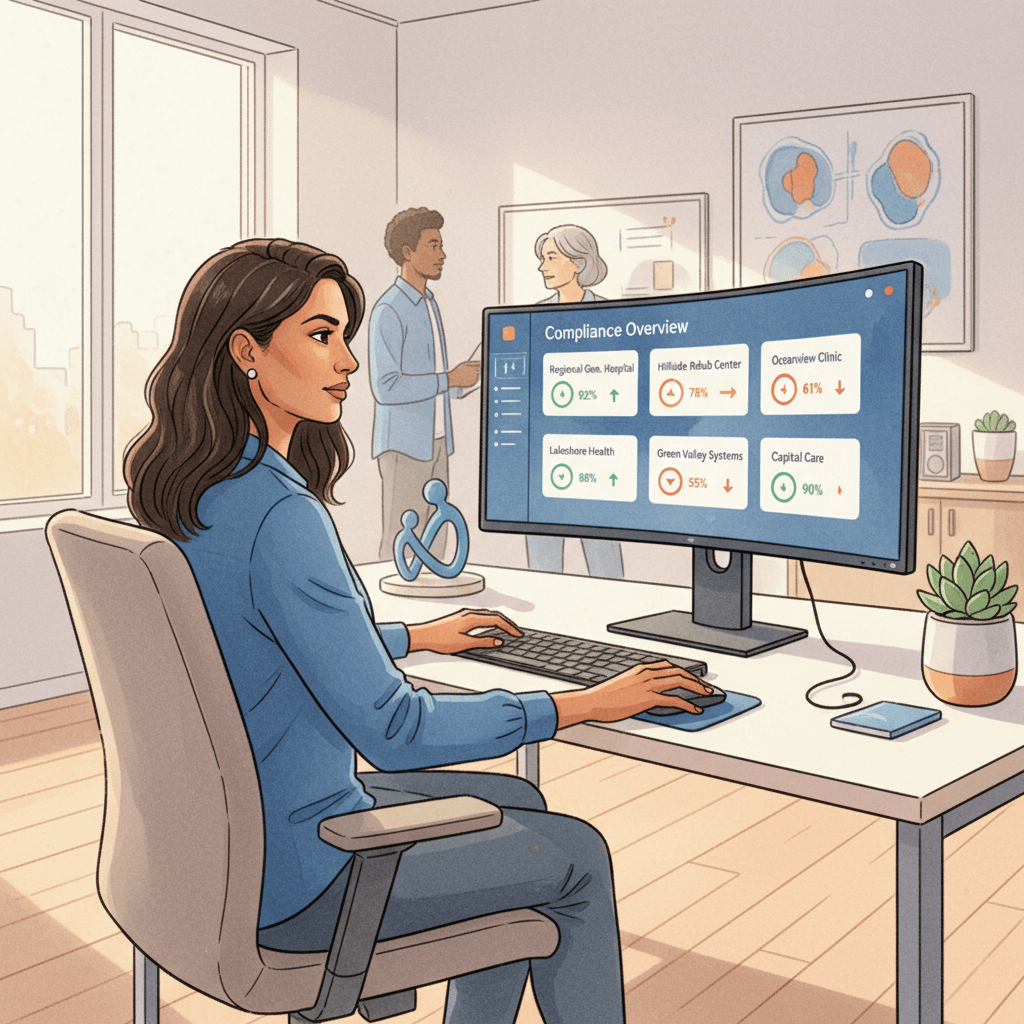
When all sites use standardized workflows within a shared platform, organizational leadership gains access to real-time compliance data that was previously impossible to compile. Dashboard views can show documentation completion rates across all sites, incident trends by type and severity, overdue care plan updates, medication error rates, and any other metric that the standardized workflow generates.
This visibility transforms quality improvement from a retrospective exercise — reviewing last quarter's data in a boardroom — to a proactive discipline. A regional director who sees that one site's incident documentation completion rate dropped from 95% to 72% this week can intervene immediately, before the gap widens or a surveyor arrives.
A Word of Caution
Technology is a powerful enforcement mechanism, but it is not a substitute for the design, piloting, and training work described in the standardization framework. Organizations that purchase a care management platform expecting it to solve workflow inconsistency — without first doing the work of defining what the standard workflow should be — end up digitizing their inconsistency rather than eliminating it. Each site configures the platform differently, uses different fields, and interprets the same features in different ways.
The correct sequence is always: design the workflow first, validate it through piloting, then configure the technology to enforce it.
A Real-World Scenario
To illustrate how the standardization framework works in practice, consider the following scenario. The organization, events, and individuals described are fictional, but the patterns they represent are drawn from common operational realities in multi-site residential care.
Before: Sunrise Care Group's Incident Reporting Problem
Sunrise Care Group operates 12 group homes across three counties in the Midwest, serving adults with intellectual and developmental disabilities. Each home has 6 to 8 residents and is staffed by direct support professionals (DSPs) around the clock. Sunrise's regional director, Maria, has been concerned about incident reporting for over a year.
An internal audit reveals the following: four homes use a digital incident form that was set up when the organization purchased its care management platform three years ago — but each home's form has been customized by local managers, so the four "digital" forms have different fields and classification options. Three homes use a paper form that predates the digital system. Two homes use a hybrid approach — paper for the initial report, then a summary is entered into the platform days later. Two homes file reports only when the site manager determines an event is "serious enough." One home has an exemplary process, but it was designed by a former manager who has since left, and no one else in the organization knows it exists.
The consequences are predictable. Sunrise's quarterly incident report to the board is unreliable — Maria must manually reconcile data from at least four different formats, and she knows the data from the paper-based homes is incomplete. A state surveyor cited one home for incomplete incident documentation last year, and Maria cannot confidently assert that the other 11 homes would pass the same scrutiny. DSPs who float between homes regularly express frustration at having to learn different reporting processes at each location.
The Standardization Process
Maria follows the five-step framework. She audits all 12 homes, spending a half-day at each with the site manager and two DSPs, documenting the actual incident reporting process in use. She maps the variation and presents it to Sunrise's leadership team.
They prioritize incident reporting as the first standardization target — it is high-frequency, high-risk, and the state licensing agency has signaled increased focus on incident documentation in upcoming surveys.
Maria assembles a working group: four site managers representing different home sizes and county locations, three experienced DSPs (including one who regularly floats between homes), and Sunrise's compliance officer. Over three meetings, the group designs a single incident reporting workflow with standardized definitions, a five-level severity classification system, required documentation fields, clear escalation paths, and a 4-hour reporting timeline that exceeds the state's 24-hour requirement.
Sunrise pilots the new workflow at three homes for six weeks. The pilot reveals that the original severity classification descriptions were ambiguous at the boundary between levels 2 and 3, and that DSPs needed a quick-reference card with examples for each level. The working group revises the classification descriptions and creates the reference card.
Sunrise then rolls out the standardized workflow to all 12 homes over a four-week period. Each home receives a two-hour training session, a laminated quick-reference card posted at the nursing station, and a designated "workflow champion" — a DSP at each site who receives additional training and serves as the first point of contact for questions.
After: Measurable Outcomes
Six months after full rollout, Sunrise measures the impact:
- Incident documentation completion rate: increased from 64% to 97% across all 12 homes.
- Average time from incident to report submission: decreased from 38 hours to 3.2 hours.
- State survey readiness: an unannounced survey at one home resulted in zero documentation-related citations — the first clean survey in two years.
- Float staff onboarding time for incident reporting: reduced from an average of 45 minutes of site-specific orientation to zero additional training needed.
- Aggregate data quality: Maria now produces a single quarterly incident report using consistent data from all 12 homes. The board can identify trends, compare sites, and make informed decisions about resource allocation.
The total investment: approximately 120 hours of working group and leadership time over four months, plus training time at each site. The return: reduced regulatory risk, improved safety data, faster reporting, and a foundation for standardizing additional workflows.
Common Pitfalls
Even with a sound framework, workflow standardization initiatives fail more often than they succeed. The following five mistakes account for the majority of these failures. Each is avoidable with awareness and intentional planning.
1. Trying to Standardize Everything at Once
The most common pitfall is scope overload. An ambitious operations leader identifies 15 workflows that need standardization and attempts to redesign all of them simultaneously. The result: frontline staff are overwhelmed by the volume of change, site managers cannot prioritize implementation, training becomes a marathon that no one retains, and the entire initiative stalls.
Standardize one or two high-priority workflows at a time. Demonstrate success, build organizational confidence, and then expand. A 12-month roadmap that delivers four well-implemented standardized workflows is worth more than a 3-month effort that attempts 15 and achieves none.
2. Ignoring Frontline Input
Standardized workflows designed entirely by corporate leadership — without input from the people who will execute them every shift — fail for predictable reasons. They do not account for time constraints. They assume resources that do not exist at every site. They use language that does not match how staff actually describe their work. And they miss practical obstacles that are obvious to anyone who has worked a night shift in a group home.
Including frontline staff in the design working group is not a gesture of inclusivity. It is a quality control measure. DSPs, medication aides, and shift supervisors possess knowledge about workflow execution that no policy manual captures. Excluding them produces workflows that look correct on paper and fail in practice.
3. Not Accounting for Regulatory Variation
Multi-jurisdictional operators that design a single workflow without mapping it against all applicable regulatory requirements will discover the gaps during a survey — the worst possible time to learn that your standardized process does not meet a specific state's requirements.
Before finalizing any standardized workflow, map it against every jurisdiction where it will be deployed. Identify the strictest requirement for each element and design the universal core to meet it. Document the jurisdiction-specific supplements and integrate them into the workflow before rollout, not after a citation forces the issue.
4. Skipping the Pilot Phase
The temptation to move directly from design to full rollout is strong, especially when leadership is eager for results. Resist it. Every standardized workflow contains assumptions that can only be tested in real care delivery environments. Piloting reveals ambiguities in definitions, steps that take longer than expected, forms that do not capture the right information, and edge cases that the design team did not anticipate.
A six-week pilot at two or three sites costs very little compared to a failed rollout across the entire organization. The pilot is not a delay — it is insurance against a much larger failure.
5. Treating Standardization as a One-Time Project
Perhaps the most damaging misconception is that standardization is something you do once and then move on to the next initiative. In reality, standardized workflows require ongoing maintenance. Regulations change. Staff turn over. New care models emerge. Sites encounter situations the original workflow did not anticipate. Without a maintenance structure — a designated process owner, a quarterly review cycle, a mechanism for staff to submit change requests — standardized workflows decay within 12 to 18 months.
Build the maintenance plan into the initial rollout. Assign a process owner. Schedule the first quarterly review before the workflow goes live. Create a channel (even a simple shared email inbox) where frontline staff can flag issues. Standardization is a discipline, not a project.
Sustainability Check
Before declaring any workflow standardization initiative complete, confirm that the following are in place: a named process owner, a scheduled quarterly review, a documented change-request process, and a mechanism for frontline staff feedback. If any of these are missing, the standardization will erode within a year.
Conclusion
Workflow inconsistency across multiple care sites is not a minor administrative nuisance. It is a structural risk that affects regulatory compliance, clinical safety, staff competency, data quality, and organizational decision-making. For multi-site residential care operators — whether managing three group homes or thirty assisted living communities — standardization of core workflows is one of the highest-leverage investments an operations leader can make.
The path to standardization is methodical, not dramatic. Audit the current state honestly. Prioritize by risk and frequency. Design workflows collaboratively with frontline staff. Pilot before scaling. Build feedback loops and maintenance structures from the beginning. Distinguish between processes that must be standardized for safety and compliance and those that should remain locally adaptive. Account for regulatory variation with a layered architecture rather than separate workflows for each jurisdiction.
Technology accelerates and enforces standardization, but it does not replace the design work. A platform configured after thoughtful workflow design becomes a powerful consistency engine. A platform implemented without that design work simply digitizes existing inconsistency.
The organizations that do this well — that build true operational consistency across their sites — gain advantages that compound over time. Their survey results improve. Their incident data becomes trustworthy. Their staff can move between sites without retraining. Their quality improvement initiatives produce measurable results because the underlying data is reliable. And their leadership teams can answer the questions that matter: Are we safe? Are we compliant? Are we improving?
Those questions deserve honest, evidence-based answers. Standardized workflows are how you get them.
FAQ
How long does workflow standardization take for a multi-site provider?
For most multi-site residential care operators, standardizing a single core workflow — from initial audit through full rollout — takes three to five months. The audit and design phases typically require four to six weeks each. Piloting adds another four to six weeks. Phased rollout to remaining sites takes two to four weeks depending on the number of locations. Organizations that attempt to compress this timeline by skipping the pilot or rushing training typically pay for it in poor adoption and rework. A realistic first-year plan should target two to three fully standardized workflows, with additional workflows addressed in subsequent years.
Should we standardize workflows before or after implementing new software?
Before. Always before. Implementing a care management platform before defining standardized workflows results in each site configuring the system differently, which digitizes your inconsistency rather than eliminating it. Design the workflow first, validate it through piloting, document every step and decision point, and then configure the technology to enforce the validated workflow. If you have already implemented software without standardization, the work is not wasted — use the platform's current configuration at each site as an input to the audit phase, then reconfigure the system to enforce the new standard once it is designed and validated.
How do we get frontline staff buy-in for standardized workflows?
Three actions matter most. First, include frontline staff in the design process — not as token participants, but as genuine contributors whose knowledge of workflow execution shapes the final design. When staff see their input reflected in the standardized workflow, resistance drops significantly. Second, explain the practical benefits in terms that matter to frontline workers: fewer confusing transitions when floating between sites, clearer expectations, and less time spent figuring out how things work at each location. Third, provide adequate training time — not a 15-minute overview during a shift change, but a dedicated session with hands-on practice and the opportunity to ask questions. Staff resist standardization when it feels imposed and when the training is insufficient.
Can workflows be standardized across different care settings (IDD + LTC)?
Yes, but with important distinctions. The framework and principles of workflows — incident classification systems, documentation completion standards, escalation path structures, handoff formats — can and should be consistent across care settings within the same organization. However, the clinical content within those frameworks will differ. An incident report template can use the same structure and required fields for both IDD group homes and long-term care facilities, but the severity definitions, common incident types, and clinical response protocols will reflect each setting's population. Design a universal workflow framework with setting-specific content modules, similar to the jurisdictional layering approach described for multi-state operations.
What's the difference between workflow standardization and policy standardization?
Policies define what an organization requires — "all incidents must be reported within four hours." Workflows define how that requirement is fulfilled — the specific steps, forms, tools, responsibilities, and decision points involved in creating, reviewing, escalating, and closing an incident report. An organization can have perfectly standardized policies and completely inconsistent workflows if the policies do not specify the operational details of execution. Workflow standardization addresses the execution layer: the actual processes staff follow every shift. Policy standardization is necessary but not sufficient. Most multi-site operators have more policy consistency than workflow consistency, which is why policy exists on paper but practice varies by site.