Key Takeaways
- Accountability and blame are not the same thing. Blame culture asks "who did this?" and drives underreporting, fear, and staff turnover. Accountability culture asks "what system allowed this?" and drives learning, transparency, and continuous improvement.
- The five pillars of operational accountability — clear ownership, transparent expectations, real-time visibility, timely follow-through, and learning from outcomes — form an integrated system where removing any single pillar undermines the others.
- Incident reporting rates that increase after implementing accountability practices are a sign of cultural health, not operational failure. Organizations with high voluntary reporting rates catch problems earlier and resolve them faster than organizations where staff fear consequences for surfacing issues.
- Technology serves accountability best when it creates clarity rather than surveillance — audit trails, task ownership records, automated reminders, and transparent dashboards help staff do the right thing rather than monitoring them for doing the wrong thing.
- Leadership behavior is the single most powerful lever for building or destroying accountability culture. How leaders respond to the first reported mistake after declaring a commitment to accountability will define whether staff believe the commitment is real.
- Measuring accountability requires leading indicators — incident reporting frequency, task completion rates, voluntary disclosure rates, and staff satisfaction scores — not just lagging indicators like regulatory citations and family complaints.
Introduction
When something goes wrong in a residential care facility — a medication error, a missed behavioral intervention, an incident that was not documented on time — organizations face a choice that reveals more about their culture than any mission statement or policy manual ever could. That choice is simple in structure and profound in consequence: Do we ask "who did this?" or do we ask "what allowed this to happen?"
The first question leads to blame. It identifies a person, assigns fault, and moves on. The medication error was the DSP's mistake. The missed intervention was the shift supervisor's failure to follow protocol. The documentation gap was the house manager's negligence. Case closed. Consequences assigned. The organization feels like it has acted decisively.
The second question leads somewhere more uncomfortable and far more productive. It asks what system, process, or structural condition created an environment where a competent, well-intentioned staff member made an error. Was the medication administration process designed in a way that made the error likely? Was the behavioral intervention protocol clear enough that any staff member — including someone new, tired, or covering an unfamiliar home — could follow it reliably? Was the documentation expectation realistic given the staffing levels and competing demands of the shift?
This distinction between blame and accountability is not semantic. It is operational. It determines whether an organization gets better after every incident or simply gets better at hiding them.
Residential care leaders who have managed operations long enough have seen both cultures. They have seen organizations where staff hide errors, delay reporting, and develop workarounds to avoid documentation that might expose a mistake. They have also seen — more rarely — organizations where staff report errors voluntarily, flag near-misses without prompting, and treat every incident as information that makes the next shift safer. The difference between these two organizations is not the quality of their staff. It is the accountability system those staff work within.
This article lays out a practical framework for building genuine accountability in care operations. It is written for CEOs, COOs, operations directors, and regional leaders who understand that accountability is essential to quality care — and who want to build it in a way that improves safety, retains staff, and strengthens the organization rather than creating a culture of fear that drives the best people out the door.
The goal is not to excuse poor performance or eliminate consequences for genuine negligence. It is to build systems where accountability is structural, transparent, and focused on outcomes — where doing the right thing is the easiest thing, and where the organization learns from every failure rather than simply punishing it.
Accountability vs. Blame: The Critical Distinction
The Anatomy of Blame Culture
Blame culture does not announce itself. No residential care operator publishes a policy that says "we will find someone to punish when things go wrong." Blame culture develops incrementally, through a pattern of small signals that accumulate into a pervasive organizational reality.
It begins with how leadership responds to incidents. A direct support professional administers a medication thirty minutes late. The house manager's first question is not "what was happening during the shift that delayed the administration?" but "why didn't you follow the schedule?" The DSP explains that a behavioral episode with another resident required immediate attention, and the medication was delayed while managing the safety situation. The house manager's response: "You still need to give meds on time. I'm noting this in your file."
That interaction — which might take three minutes — sends a signal that reverberates through the organization for months. Every staff member who hears about it, or who has experienced a similar interaction, receives the same message: when competing priorities create an impossible situation, you will be held responsible for whichever priority you did not choose. The rational response, from the staff member's perspective, is to avoid situations where the conflict becomes visible. Do not report the late medication. Document it as on time. Or, if that feels too dishonest, simply do not flag it to anyone and hope it does not surface.
This is how underreporting begins. Not with a deliberate decision to hide information, but with a rational calculation that transparency carries more risk than silence. Research published in the Journal of Patient Safety found that organizations with punitive responses to error reporting had incident reporting rates 40 to 60 percent lower than organizations with non-punitive approaches. The errors still occurred at the same rate. The difference was in whether the organization could see them.
What Blame Culture Costs
The costs of blame culture are both direct and systemic. The direct costs are measurable: higher staff turnover, increased agency spending to fill shifts vacated by demoralized employees, regulatory citations for issues that could have been caught early if staff felt safe reporting them, and litigation exposure from incidents that were not addressed because the information never reached leadership.
The systemic costs are harder to quantify but more damaging. Blame culture destroys the feedback loops that allow organizations to learn. When a medication error occurs in an accountability culture, the organization gains information: about the medication administration workflow, about the staffing conditions during that shift, about the training adequacy of the staff member, about the design of the medication administration record. Each piece of information is an opportunity to improve a system. When the same error occurs in a blame culture, the organization gains nothing except a disciplinary record. The system that produced the error remains unchanged, waiting to produce the same error with the next staff member.
Dr. Amy Edmondson, the Harvard Business School professor whose research on psychological safety has shaped how organizations worldwide think about error and learning, summarized this dynamic precisely: "In organizations where people fear blame, the silence that results is far more dangerous than the mistakes they are hiding." Her research across healthcare settings found that units with higher psychological safety reported more errors — not because they made more errors, but because they reported more of them. The units that appeared safest on paper were often the most dangerous in practice, because their low error-reporting rates reflected suppression, not excellence.
The Psychological Safety Connection
Accountability culture and psychological safety are not opposites. They are complements. Psychological safety means that a staff member can raise a concern, report an error, or ask a question without fear of punishment or humiliation. Accountability means that there are clear expectations, transparent ownership, and consequences when those expectations are not met.
The critical insight is that accountability without psychological safety produces compliance theater — staff do the minimum to avoid being caught, rather than the maximum to ensure quality. And psychological safety without accountability produces a pleasant but ineffective workplace — everyone is comfortable, but standards are not maintained and performance does not improve.
The organizations that achieve the best outcomes in residential care combine both. Staff feel safe reporting errors and raising concerns. And staff understand that they are expected to meet defined standards, that their work is visible, and that consistent failure to meet expectations will be addressed. The difference from blame culture is not the absence of consequences — it is the nature of consequences. In a blame culture, the consequence of reporting an error is punishment. In an accountability culture, the consequence of not meeting a standard is coaching, support, and if necessary, a structured performance improvement process. But the consequence of hiding an error — of compromising the organization's ability to learn and protect residents — is treated as far more serious than the error itself.
Research Evidence
The evidence base for accountability culture over blame culture is substantial and consistent across healthcare settings.
A 2019 systematic review published in BMJ Quality & Safety examined 33 studies of organizational culture and patient safety outcomes. The review found that organizations scoring highest on non-punitive response to error had significantly better safety outcomes, including lower rates of falls, medication errors, and healthcare-associated infections. The effect was independent of staffing levels, patient acuity, and organizational size.
The Agency for Healthcare Research and Quality (AHRQ) Hospital Survey on Patient Safety Culture — which has been adapted for long-term care settings — consistently finds that "non-punitive response to error" is the lowest-scoring dimension across healthcare organizations. More than half of respondents in long-term care surveys report that staff feel their mistakes are held against them. This represents an enormous opportunity: improving on this single dimension has a measurable impact on incident reporting, error correction, and resident safety.
In residential care specifically, a study of group homes serving individuals with intellectual and developmental disabilities found that facilities with documented non-punitive error reporting policies had 2.3 times higher voluntary incident reporting rates and 34 percent fewer repeat incidents of the same type compared to facilities without such policies. The higher reporting rates led to earlier pattern identification, which in turn led to system-level corrections that prevented recurrence.
The evidence is clear: blame suppresses information. Accountability generates it. And in residential care, where the margin between a safe environment and a dangerous one is often a single piece of information reaching the right person at the right time, the choice between these two cultures is not philosophical. It is operational.
The Five Pillars of Operational Accountability
Accountability culture is not a sentiment. It is a system. And like any system, it has structural components that must be present and connected for the system to function. Remove any single pillar, and the structure weakens. Remove two, and the concept of accountability becomes a slogan without substance.
Pillar 1: Clear Ownership
Every task, every process, and every outcome in a care operation must have a named owner. Not a team. Not a department. A specific person who is responsible for ensuring that the thing gets done.
Clear ownership does not mean that one person does everything. It means that one person is accountable for the outcome — for tracking progress, escalating blockers, and ensuring completion. In residential care, the most common accountability failures occur precisely where ownership is ambiguous. Consider a resident's annual care plan review. The house manager knows it is due. The clinical coordinator has the clinical data. The program specialist has the behavioral data. The scheduler needs to arrange the meeting with the family. Without a single named owner who is responsible for ensuring that all of these components come together by the deadline, the review drifts. Each person assumes someone else is coordinating. The deadline passes. A surveyor finds an expired care plan.
Practical application: For every recurring process in your operation — incident follow-up, care plan reviews, training compliance, medication reconciliation, family communication — document who owns it. Not which role is involved, but which specific person at each facility is accountable for the outcome. When the owner is on vacation, designate a temporary owner explicitly. Ownership that lapses during PTO is not ownership at all.
Pillar 2: Transparent Expectations
Accountability requires a standard against which performance can be measured. Staff cannot be accountable for meeting expectations they do not know exist or that change without notice.
Transparent expectations means that every process has documented standards that answer four questions: What must be done? When must it be done? How must it be done? And what does "done well" look like? In residential care, the failure mode is typically not the absence of expectations but the inconsistency of their communication. A house manager at one site expects incident reports within two hours. A house manager at another site expects them by end of shift. A third house manager has not explicitly stated a timeline, so staff submit reports when they can. All three sites are in the same organization, governed by the same policy. The policy says "timely." The interpretation varies by site.
Practical application: Conduct an expectations audit. For your ten most critical operational processes, ask staff at each site to write down what they believe the standard is — without looking it up. Compare the answers across sites. The gap between what you intend and what staff believe is the accountability gap. Close it by converting every "timely," "appropriate," and "as needed" in your policies into specific, measurable expectations: "within two hours of the incident," "before the end of the shift in which it occurred," "within 24 hours of the family's request."
Pillar 3: Real-Time Visibility
Accountability requires that work — and the absence of work — be visible to the people who need to see it. If a task is overdue and no one knows, accountability is theoretical. If documentation is incomplete and the gap is not surfaced until a weekly review, the organization has traded accountability for retrospective discovery.
Real-time visibility does not mean constant surveillance. It means that the systems staff use to do their work also make the status of that work visible to supervisors and peers. When a DSP completes a wellness check, that completion is logged in a way that the shift supervisor can see. When a medication administration is overdue, the system surfaces the gap — not to punish, but to enable a response. When an incident report is filed, it appears in a queue visible to the house manager without requiring a phone call or email.
Practical application: Map your critical operational processes and identify where visibility breaks down. For each process, ask: "If this task is not completed on time, how long would it take for someone other than the assigned staff member to know?" If the answer is "hours" or "days" or "until someone asks," you have a visibility gap. Addressing these gaps — through shared task boards, automated alerts, or daily operational dashboards — is one of the highest-leverage investments an organization can make in accountability.
Pillar 4: Timely Follow-Through
Accountability dies when follow-through is slow. An incident occurs, an investigation is promised, and three weeks later nothing has changed. A staff member raises a concern, a meeting is scheduled, and the meeting is canceled twice. A pattern is identified in incident data, an action plan is drafted, and the action plan sits in a shared drive untouched.
Every instance of delayed follow-through sends the same message as blame: your input does not matter. The staff member who reported the incident learns that reporting produces no result. The staff member who raised the concern learns that concern-raising is performative. The organization's commitment to accountability is measured not by its stated values but by the speed and consistency with which it acts on the information those values generate.
Practical application: Establish explicit follow-through timelines for every accountability-generating event. Incident reports receive initial review within four hours. Incident investigations are completed within five business days. Action items from investigations have assigned owners and deadlines. Staff who report concerns receive a response — even if only an acknowledgment — within 24 hours. Track these timelines and treat missed follow-through deadlines with the same seriousness as the underlying incidents they are meant to address.
Pillar 5: Learning from Outcomes
The final pillar is what separates accountability from mere monitoring. Learning from outcomes means that the organization systematically converts information from incidents, errors, near-misses, and performance patterns into structural improvements that reduce the likelihood of recurrence.
In blame culture, an incident ends with a disciplinary action. In monitoring culture, an incident ends with a documented investigation. In accountability culture, an incident ends with a change — to a process, a training program, a staffing model, an environmental condition, or a policy — that makes the same incident less likely to happen again. And that change is communicated back to the staff member who reported the original incident, closing the feedback loop.
Practical application: Implement a structured learning review for every serious incident and for patterns of minor incidents. The review should answer four questions: (1) What happened? (2) What systemic factors contributed? (3) What specific change will we make to reduce recurrence? (4) How will we verify that the change was effective? Assign an owner and a timeline to the change. Six weeks later, review whether the change was implemented and whether the targeted outcome improved. Share the results — including the original reporter's contribution — with the team.
Building Accountability Into Daily Operations
Accountability culture is not built in annual trainings or leadership retreats. It is built — or eroded — in the daily rhythms of care operations. Every shift, every handoff, every huddle, every response to an incident either reinforces the expectation that work is owned, visible, and followed through, or it signals that accountability is aspirational rather than operational.
Morning Huddles: Setting the Accountability Tone
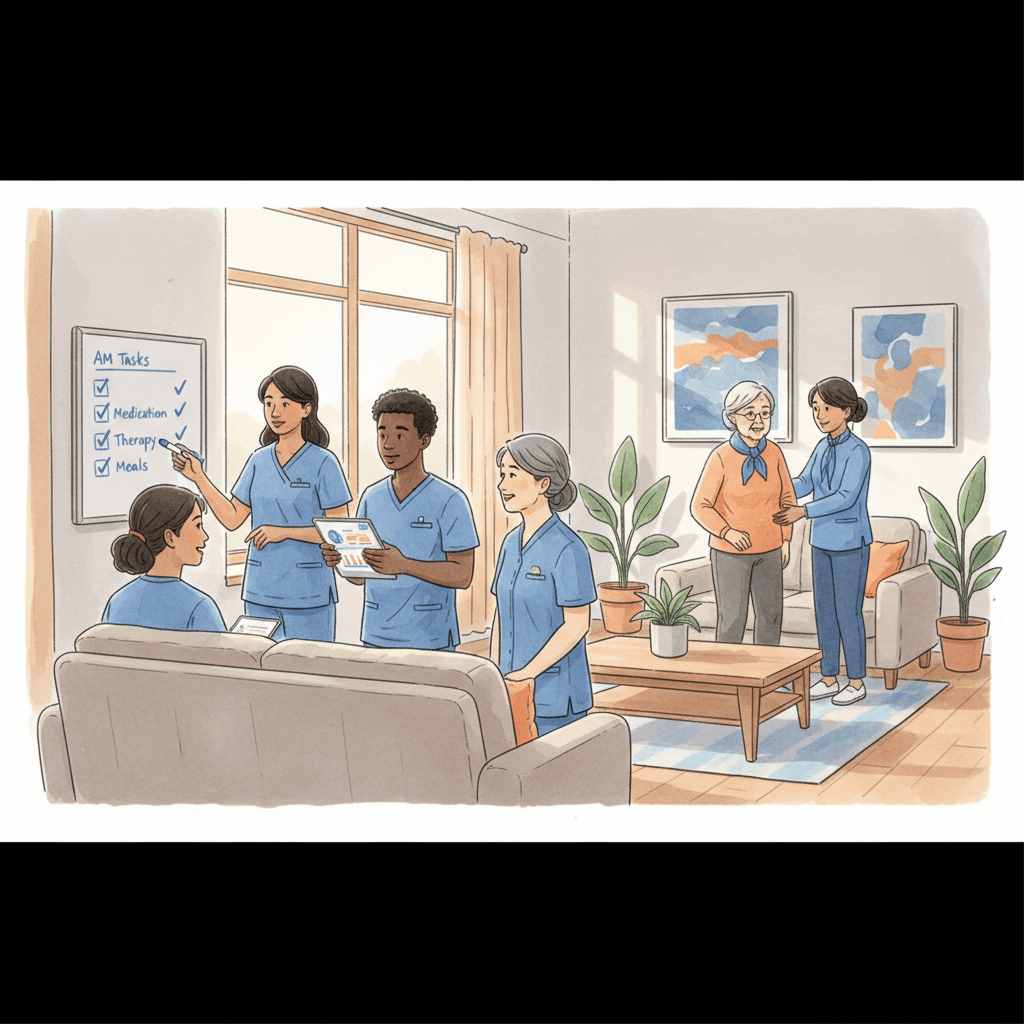
The most effective residential care operators begin every shift with a structured huddle that serves as both an information transfer and an accountability-setting exercise. The huddle is short — ten to fifteen minutes — and it follows a consistent structure that staff can anticipate.
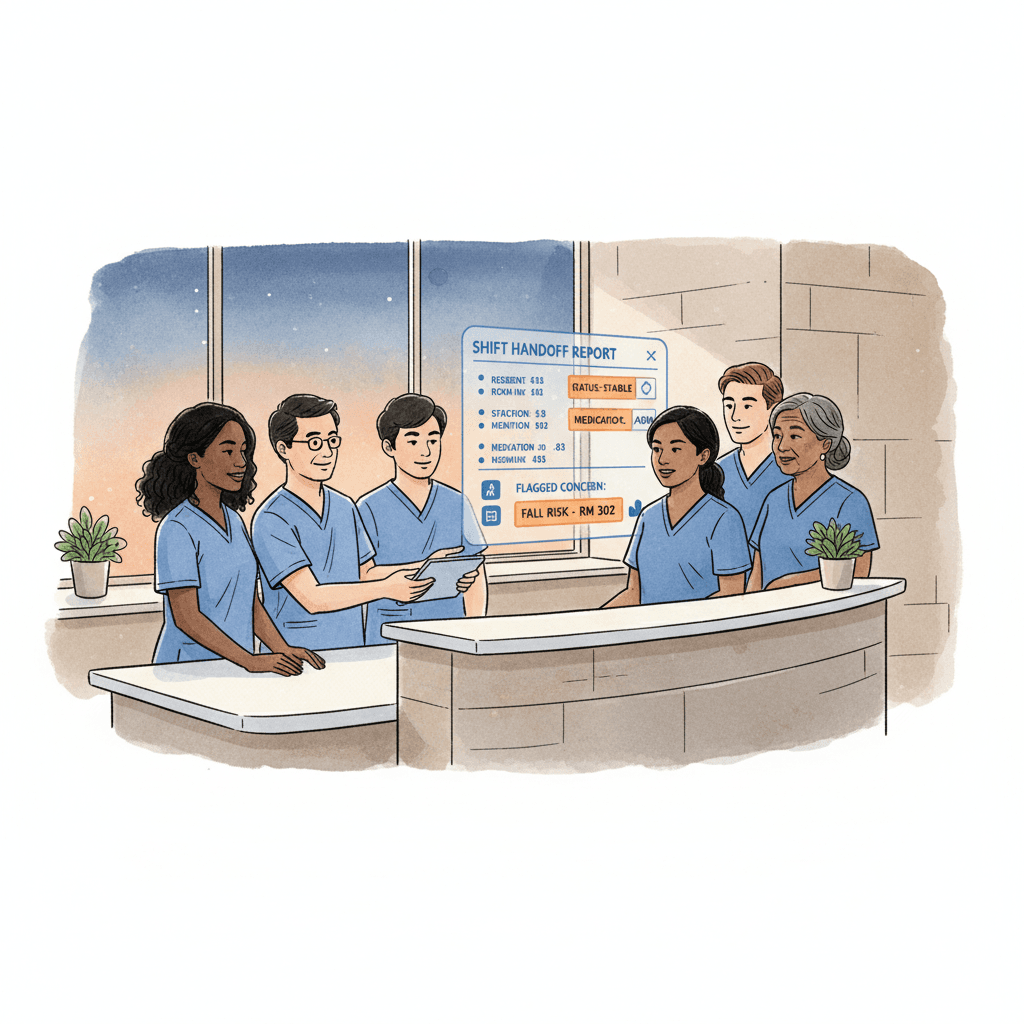
A high-accountability huddle covers four elements. First, it reviews carry-over items from the previous shift: what was left incomplete, what requires follow-up, and who is now responsible for each item. This is not a handoff — it is an explicit reassignment of ownership. The previous shift owned these tasks. Now the current shift owns them. The transfer is documented.
Second, the huddle reviews the current shift's priorities: scheduled appointments, medication changes, resident-specific concerns, and any tasks that have hard deadlines. For each priority, there is a named owner. Not "we need to make sure Mrs. Patterson's daughter gets called back" but "James, you are responsible for calling Mrs. Patterson's daughter by 11 a.m. — here is the context."
Third, the huddle surfaces concerns and questions. Staff are explicitly invited to raise anything that feels uncertain, unclear, or potentially problematic. This is where psychological safety becomes operational. If a staff member says "I'm not comfortable with the new behavioral protocol for Mr. Okafor — I'm not sure I understand the quiet-room procedure," the huddle is the place where that concern is addressed before it becomes an incident. The response to that concern — whether it is taken seriously, brushed off, or met with impatience — sets the tone for the entire shift.
Fourth, the huddle confirms resource status: staffing levels, supply needs, equipment issues, and anything that could affect the shift's ability to execute. If staffing is short, the huddle is where priorities are triaged explicitly rather than leaving individual staff members to make impossible choices silently.
Task Ownership and Escalation
Every task that matters should have a documented owner, a deadline, and a defined escalation path. This sounds elementary. In practice, most residential care operations leave a significant portion of important work in an ambiguous state where everyone assumes someone is handling it.
Effective task ownership systems share three characteristics. First, assignment is explicit: the task is assigned to a specific person in a system that both the assignee and the supervisor can see. Not mentioned in a meeting. Not included in an email thread. Assigned in a tracking system with a due date. Second, status is visible: the system shows whether the task is in progress, completed, or overdue without requiring anyone to ask. Third, escalation is automatic: when a task passes its deadline without completion, the system notifies the next level of responsibility. The shift supervisor should not need to remember to check on the DSP's medication reconciliation. The system should surface the gap.
Escalation protocols deserve special attention because they are where accountability culture is most visibly tested. In many organizations, escalation is perceived as tattling — going over someone's head. In an accountability culture, escalation is reframed as a responsibility. If you are aware of a situation that exceeds your authority or capability to resolve, escalating it is not optional. Not escalating is the failure, because it leaves the resident, the organization, and the colleague who needs support exposed to unnecessary risk.
To build this reframe, escalation protocols must be defined and documented for every common scenario. When should a DSP escalate to a shift supervisor? When should a shift supervisor escalate to a house manager? When should a house manager escalate to a regional director? For each transition, define the trigger, the timeline, and the expected response. Then train on it, practice it, and — critically — respond to escalations with gratitude rather than irritation.
Shift Documentation as Accountability Infrastructure
Shift documentation in residential care serves two audiences: the clinical record, which must be accurate for regulatory and care continuity purposes, and the accountability record, which tracks what was assigned, what was completed, and what remains open.
Most documentation systems are designed primarily for the clinical record. They capture what happened to the resident — vital signs, medications administered, incidents observed, care activities completed. This is necessary but insufficient for accountability. What the documentation often does not capture is what was assigned and not completed, what was deferred and why, what concerns were raised and how they were addressed, and what decisions were made during the shift about prioritization when resources were insufficient.
Adding these accountability dimensions to shift documentation does not require massive system changes. It requires a structured end-of-shift summary that includes: (1) tasks completed as assigned, (2) tasks not completed and the reason, (3) tasks deferred to the next shift with context, (4) concerns raised during the shift and their disposition, and (5) decisions made about resource allocation or prioritization. This summary creates a record that supports learning, enables pattern recognition across shifts, and provides evidence of thoughtful decision-making rather than negligence when things do not go as planned.
Incident Follow-Up Timelines
One of the most common accountability failures in residential care is the gap between when an incident is reported and when the resulting investigation, communication, and corrective action are completed. An incident occurs. The initial report is filed. And then — depending on the organization — days, weeks, or sometimes months pass before the follow-up is complete.
This gap is corrosive to accountability culture for two reasons. First, it signals to the reporting staff member that their report did not matter enough to warrant timely action. If you report an incident on Monday and no one acknowledges it until Thursday's supervisory meeting, you receive a clear message about the organization's actual priorities. Second, it allows the conditions that produced the incident to persist uncorrected. If a medication administration process flaw caused an error, every shift between the error and the process correction is a shift where the same error is possible.
Effective incident follow-up protocols define timelines at each stage. Within two hours of the report: the supervisor acknowledges receipt and confirms that immediate safety needs are addressed. Within 24 hours: the initial review is completed, and the reporting staff member is informed that their report has been received and is being investigated. Within five business days: the investigation is completed, root causes are identified, and corrective actions are documented with owners and deadlines. Within 30 days: corrective actions are verified as implemented, and the reporting staff member is informed of the outcome. These are not aspirational targets. They are operational standards that should be tracked with the same rigor as medication administration schedules or documentation completion rates.
The Feedback Loop: Closing the Circle
The most important — and most frequently omitted — element of daily accountability is the feedback loop to the person who raised the issue. When a staff member reports an incident, raises a concern, or identifies a problem, they have invested trust in the system. They have accepted the risk of visibility. If they never learn what happened as a result of their report, the investment produces no return, and the likelihood that they will invest again decreases with each unanswered report.
Closing the feedback loop does not require sharing confidential investigation details or personnel actions. It requires a simple, consistent communication: "You reported X. We investigated. We found Y. We are changing Z as a result. Thank you for reporting it." This communication transforms reporting from a bureaucratic obligation into a meaningful contribution. It tells the staff member — and, through them, the entire team — that information flows upward and change flows back down. That is accountability.
Technology as an Accountability Partner
Technology's role in accountability culture is to make the right behavior easier and the wrong behavior harder — without creating a surveillance environment that undermines the trust accountability requires. This is a meaningful design challenge, because the line between transparency and surveillance is drawn not by the technology itself but by how it is implemented, communicated, and used.
Systems That Create Clarity, Not Surveillance
The distinction between accountability technology and surveillance technology is not about what the technology does. It is about who it serves and how.
Surveillance technology serves management's need to catch staff doing something wrong. It is implemented without input from the people being monitored. Its data flows in one direction — upward. Staff experience it as a threat: a system designed to produce evidence that can be used against them. The predictable response is avoidance, workaround, and resentment.
Accountability technology serves everyone's need to know what is expected, what has been done, and what needs attention. It is implemented with frontline input. Its data flows in multiple directions — staff can see their own task status and completion rates, supervisors can see team performance, and leadership can see organizational patterns. Staff experience it as a tool: a system that helps them stay organized, meet expectations, and demonstrate their work.
The same underlying capability — task tracking, for example — can function as either surveillance or accountability depending on implementation. A task tracking system that only leadership can see, that generates reports used primarily in disciplinary conversations, and that was deployed without staff consultation is surveillance. A task tracking system that staff use to manage their own shift, that surfaces their completions as well as their gaps, that sends them reminders before deadlines rather than alerts after them, and that was designed with frontline input is an accountability tool.
Audit Trails as Protection, Not Prosecution
Audit trails — the automatic records of who did what, when, and in what sequence — are one of the most powerful accountability tools available to care operators. They are also one of the most feared, because staff associate audit trails with "getting caught."
Reframing audit trails requires a simple but consistent message: the audit trail protects you. When a family member claims that a medication was not administered, the audit trail shows that it was. When a surveyor questions whether a wellness check was completed, the audit trail confirms the time and the staff member. When an incident investigation seeks to understand the sequence of events, the audit trail provides an objective record that protects staff from inaccurate recollection or unfair blame.
This reframe is not spin. It is operationally true. In organizations with robust audit trails, staff are exonerated by the record far more often than they are implicated by it. The staff member who documented their actions thoroughly and consistently is protected by that documentation. The absence of documentation — the missing record that creates ambiguity — is where risk lies, both for the resident and for the staff member.
Automated Reminders and Escalation
One of the simplest and most effective uses of technology for accountability is automated reminders — notifications that alert staff when a task is approaching its deadline and escalate to the next level when the deadline passes.
Automated reminders remove one of the most common sources of accountability failure: forgetting. A DSP responsible for completing a behavior tracking form every two hours does not forget because they do not care. They forget because they are managing multiple residents, responding to immediate needs, and operating in an environment where competing demands constantly reprioritize their attention. A reminder that appears at the two-hour mark is not surveillance. It is support. It helps the staff member meet an expectation that they want to meet but that the reality of caregiving makes difficult to track manually.
Automated escalation serves a similar function at the supervisory level. When a reminder goes unacknowledged and a task passes its deadline, the escalation is not a punishment — it is a signal that the assigned staff member may need help. Perhaps they are dealing with an urgent situation and cannot complete the task. Perhaps they are short-staffed. Perhaps they do not have the information they need. The escalation brings the situation to someone who can assess and respond. This is accountability in its most constructive form: a system that makes gaps visible so they can be addressed, not hidden.
Harmony's Approach
The HarmonyCare platform is designed around the principle that accountability technology should make doing the right thing the easiest thing. Task ownership is explicit — every task has a named assignee, a deadline, and a visible status. Audit trails are automatic and comprehensive, creating a record that protects staff and informs leadership without requiring additional documentation effort. Automated reminders keep staff on track during busy shifts. Escalation protocols are built into workflows, so that overdue tasks surface to supervisors without requiring manual follow-up.
Critically, the system provides visibility to staff themselves, not just to management. A DSP can see their own task list, their own completion rate, and their own documentation status. This transforms accountability from something done to staff into something staff do for themselves. The dashboard is a tool for managing their shift, not a scorecard for their performance review.
Leadership Behaviors That Build Accountability
Systems and technology create the infrastructure for accountability. Leadership behavior determines whether that infrastructure produces genuine accountability or sophisticated compliance theater. Every leader in a care organization — from the CEO to the shift supervisor — is constantly teaching the organization what accountability actually means through their actions, not their words.
Leading by Example
The most fundamental leadership behavior in an accountability culture is personal accountability. When a leader makes a mistake — misses a deadline, fails to follow through on a commitment, makes a decision that produces a poor outcome — how they handle that mistake defines the standard for everyone who reports to them.
A leader who acknowledges their own error openly, explains what they learned from it, and describes what they will do differently next time gives every staff member in the organization permission to do the same. A leader who deflects, minimizes, or explains away their mistakes teaches staff that accountability is a standard for the front line, not for leadership.
This is not abstract management theory. It is observable in daily interactions. Does the regional director acknowledge when a policy they championed is not working, or do they blame implementation? Does the house manager admit when they failed to escalate an issue in time, or do they rewrite the narrative? Does the CEO take responsibility when a strategic decision does not produce the expected result, or do they attribute the failure to execution?
Staff watch these moments with extraordinary attention, because leadership's response to its own failures is the most reliable predictor of how the organization will respond to theirs.
Responding to Incidents Constructively
How a leader responds in the first five minutes after learning about an incident determines whether staff will report the next one. This is not an exaggeration. Research on organizational trust consistently shows that trust is established or destroyed in moments of vulnerability, and reporting an error is one of the most vulnerable acts a staff member can perform.
Constructive incident response follows a specific sequence. First, ensure safety: "Is the resident safe? Is the staff member safe? What do we need to do right now?" Second, acknowledge the report: "Thank you for bringing this to me immediately. This is exactly what I need to know." Third, gather information without judgment: "Walk me through what happened, from the beginning." Fourth, identify the system: "What was going on that made this situation possible? Were you short-staffed? Was the process unclear? Was there information you did not have?" Fifth, define next steps: "Here is what we are going to do now. I will keep you informed."
What is notably absent from this sequence: immediate blame assignment, visible frustration, rhetorical questions like "why didn't you just...?", or premature conclusions about what "should have" happened. These responses feel natural in the moment — leadership is often genuinely frustrated or concerned when an incident occurs — but they are the single fastest way to destroy the reporting culture that accountability requires.
Celebrating Transparency
In most organizations, the behaviors that are celebrated and recognized are the behaviors that get repeated. If an organization celebrates perfect shifts — no incidents, no errors, no concerns raised — it inadvertently rewards silence. A shift with no reported incidents is not necessarily a safe shift. It may be a shift where incidents occurred and were not reported.
Accountability culture requires leaders to celebrate a different set of behaviors: the DSP who reported a near-miss that could have resulted in a medication error. The shift supervisor who escalated a staffing concern before it became a crisis. The house manager who brought a pattern of documentation gaps to the regional director's attention rather than quietly correcting them. The staff member who said "I made a mistake, and here is what I think we should do about it."
These behaviors are uncomfortable. They surface problems rather than concealing them. They require leadership to respond to more information, more often, about more issues. That is precisely the point. An organization where problems are visible is an organization that can fix them. An organization where problems are hidden is an organization that discovers them during regulatory surveys, family complaints, and adverse events.
Recognition does not need to be formal or elaborate. A sincere "thank you for flagging this — you may have prevented a serious problem" in front of the team is more powerful than any employee-of-the-month program. What matters is consistency: every time a staff member surfaces an issue, the response reinforces that surfacing issues is valued.
Addressing Patterns, Not Individuals
Accountability culture does not mean that individual performance is never addressed. It means that individual performance is addressed in the context of the systems and conditions the individual works within.
When a single staff member makes an error, the first question is systemic: what about the process, the training, the environment, or the workload contributed to this error? When that investigation is complete and systemic factors have been addressed, individual coaching may still be appropriate — but it is coaching grounded in a genuine understanding of the conditions, not a reflexive attribution of fault.
When a pattern emerges — the same staff member making the same type of error repeatedly, despite adequate training, clear expectations, and appropriate working conditions — then the conversation shifts from system to individual. But even then, the approach is structured and supportive: clear documentation of the pattern, a defined improvement plan with specific milestones, regular check-ins, and a transparent timeline. The goal is to help the person succeed. If they cannot meet the standard despite genuine support, the consequence is fair because the process was fair.
What accountability culture never does is skip the systemic investigation and jump to individual blame. That shortcut feels efficient. It is not. It leaves the systemic issue in place, demoralizes the broader team, and ensures that the next person in the same role will make the same error for the same reason.
Case Scenario: Brookside Group Homes
Brookside Group Homes operates six residences serving adults with intellectual and developmental disabilities in a mid-size metropolitan area. Three years ago, Brookside was in crisis. Annual staff turnover had reached 68 percent. Incident reports were declining — which the previous executive director had celebrated as a sign of improving care quality. A new executive director, hired after the previous one retired, recognized the declining incident reports for what they were: a symptom of a workforce that had stopped reporting.
The evidence was in the details. Exit interviews consistently cited a "blame-focused environment" as a primary reason for departure. Staff who remained described a culture where reporting an incident meant being called into the office for a conversation that felt like an interrogation. Supervisors at two of the six homes were known for responding to incident reports with anger and recrimination. One long-tenured DSP described the prevailing attitude: "If you report it, you own it. And owning it means trouble."
The new executive director made accountability culture the organization's top priority. The transformation unfolded over eighteen months and proceeded through three phases.
Phase One: Redefining the Response (Months 1 through 6). The executive director began by changing how leadership responded to incidents. She implemented a no-blame initial response protocol: the first conversation after any incident report was a "learning conversation" focused on understanding what happened and what systemic factors contributed. Supervisors were trained on the constructive response sequence. Two supervisors who were unable or unwilling to adapt their approach were reassigned to non-supervisory roles. The executive director personally followed up on every incident report for the first three months — not to investigate, but to thank the reporting staff member and provide a brief update on what the report had prompted.
Phase Two: Building the Infrastructure (Months 4 through 12). Brookside implemented a care operations platform with task ownership, automated reminders, and real-time dashboards. Every recurring process — medication administration, behavioral documentation, care plan reviews, training compliance — received a named owner at each home. Expectations were documented in specific, measurable terms and communicated to all staff. Morning huddles became standard across all six homes. Incident follow-up timelines were established and tracked.
Phase Three: Measuring and Reinforcing (Months 10 through 18). Incident reporting rates increased by 300 percent within the first year. The executive director addressed this directly with the board: higher reporting was a sign of cultural health, not operational failure. The organization was now seeing problems it had always had but could never see. More importantly, repeat incidents of the same type declined by 41 percent, because the learning reviews following each incident were producing systemic changes. Staff turnover dropped from 68 percent to 29 percent over two years. Staff satisfaction survey scores on the "non-punitive response to error" dimension improved from the 22nd percentile to the 71st percentile.
The transformation was not painless. Some staff who had benefited from the previous culture's opacity — whose poor performance was hidden by low reporting rates — were surfaced by the new transparency and either improved or left. Two supervisors were replaced. The board required education on why rising incident numbers were positive. But eighteen months after beginning the transformation, Brookside's regional licensing surveyor offered an observation that captured the shift: "This is the first time I've reviewed an organization where the incident data actually matches what I see during on-site visits. Your reports reflect your reality."
Measuring Accountability Culture
Accountability culture is real only if it is measurable. And because culture is a system of behaviors rather than a single outcome, measuring it requires a portfolio of indicators — some leading, some lagging — that together provide a reliable picture of whether accountability is strengthening, stagnating, or eroding.
Leading Indicators
Leading indicators measure the behaviors and conditions that produce accountability outcomes. They are the measures that change first when culture is shifting — either positively or negatively.
Incident reporting rates. This is the single most important leading indicator of accountability culture. An organization where incident reports are increasing — especially voluntary reports, near-miss reports, and reports of minor events — is an organization where staff trust the system. The absolute number matters less than the trend and the composition. Rising reports dominated by minor events and near-misses indicate that staff are reporting small things before they become big things. Declining reports, particularly for minor events, suggest that suppression has resumed.
Task completion rates. In a system where tasks have assigned owners and deadlines, the percentage of tasks completed on time is a direct measure of operational accountability. Track this by role, by facility, and by task type to identify where accountability is strong and where it is eroding. A facility where medication administration documentation is consistently on time but behavioral tracking is chronically late has a targeted training or workload problem, not a cultural one.
Voluntary disclosure rates. Beyond formal incident reports, track how often staff voluntarily disclose errors, near-misses, or concerns outside the formal reporting system — for example, during huddles, in conversations with supervisors, or through suggestion channels. High voluntary disclosure rates indicate that staff do not need a formal mechanism to share information. They trust the culture enough to raise issues informally.
Escalation utilization. Track how often escalation protocols are used. If escalations are rare, it may mean that everything is running smoothly — or it may mean that staff are not comfortable escalating. Cross-reference escalation rates with incident rates: if incidents are occurring but escalations are not, the escalation pathway may be functioning as a barrier rather than a support.
Lagging Indicators
Lagging indicators measure outcomes that result from accountability culture — or its absence. They change more slowly but confirm whether the leading indicators are translating into meaningful results.
Staff turnover. Blame culture is one of the most reliably cited reasons for voluntary departure in residential care. Declining turnover — particularly among high-performing staff — is a lagging confirmation that accountability culture is taking hold.
Regulatory citations. Organizations with strong accountability cultures tend to have fewer preventable citations, because they identify and correct issues before surveyors find them. Track not just the number of citations but the type: citations for issues that should have been caught internally indicate accountability gaps.
Repeat incident rates. This is the ultimate measure of whether the organization is learning from its mistakes. Track the percentage of incidents that are repeats of previously identified issues. In a functioning accountability system, this percentage should decline over time as systemic corrections accumulate.
Staff satisfaction survey scores. Use validated instruments — such as the AHRQ Safety Culture Survey adapted for long-term care — to track specific dimensions of accountability culture over time: non-punitive response to error, communication openness, teamwork, and management support for safety. These scores provide the most direct measure of how staff experience the culture, independent of what leadership believes the culture to be.
Using the Data
The purpose of measuring accountability culture is not to produce a report. It is to identify where intervention is needed and to verify that interventions are working. Review leading indicators monthly. Review lagging indicators quarterly. Present both to the leadership team with the explicit expectation that trends — not snapshots — drive decisions.
When leading indicators deteriorate — incident reporting drops at a specific site, task completion rates decline for a particular role — investigate before the lagging indicators follow. The value of leading indicators is precisely that they give you time to intervene. An organization that waits for turnover to spike or citations to increase before acting has waited too long.
Conclusion
Building a culture of accountability in residential care operations is not a project with a start date and an end date. It is an ongoing commitment to a specific set of principles: that every task has an owner, that expectations are transparent and measurable, that work is visible in real time, that follow-through is timely and consistent, and that every failure is treated as an opportunity to improve a system rather than an occasion to assign blame.
The distinction between accountability and blame is not a soft concept or a human resources talking point. It is the single most consequential cultural decision a care operator makes, because it determines the quality and quantity of information that flows through the organization. In residential care, where resident safety depends on staff willingness to report problems, communicate changes, and flag concerns, the free flow of information is not a nice-to-have. It is the infrastructure on which safe care is built.
The organizations that get this right — that build genuine accountability through clear ownership, transparent expectations, real-time visibility, timely follow-through, and systematic learning — create an environment where staff want to stay, where residents are safer, and where leadership can see what is actually happening across their operations. These organizations are not perfect. They still have incidents, errors, and gaps. The difference is that they know about them, they learn from them, and they get better.
The organizations that default to blame — that punish transparency, reward silence, and treat every error as a personal failure rather than a system signal — create an environment where the best staff leave, the remaining staff hide, and leadership operates on the comfortable fiction that declining incident reports mean improving care. These organizations are not just less effective. They are less safe. And they will not know it until a surveyor, a family member, or a crisis reveals what the silence was concealing.
Accountability is not about being harder on people. It is about being honest about systems. The technology, the processes, the leadership behaviors, and the measurement frameworks described in this article are tools for building that honesty into the daily operations of residential care. The organizations that adopt them will not eliminate every error. But they will see every error, learn from every error, and build an operation that is measurably, demonstrably, and sustainably better at protecting the people in its care.
FAQ
How do we start building accountability culture without it feeling like another top-down initiative?
The most effective starting point is changing leadership's response to incidents — which costs nothing and requires no new technology, policy, or program. Begin with a single commitment: for the next 90 days, every incident conversation starts with "thank you for reporting this" and continues with "walk me through what happened." No immediate blame. No rhetorical questions. No visible frustration. This behavioral shift at the leadership level signals cultural change more credibly than any announcement or initiative. Once staff begin to experience a different response to their reports — and once reporting rates begin to increase as a result — you have the credibility and the evidence to introduce more structured accountability practices. Starting with behavior rather than programs avoids the cynicism that accompanies top-down initiatives and builds trust through demonstrated action.
Is it possible to hold individuals accountable without creating a blame culture?
Yes, and this is one of the most important distinctions in accountability culture. Individual accountability and blame culture are not the same thing. In an accountability culture, when a pattern of individual underperformance persists after systemic factors have been investigated and addressed — after the process has been clarified, the training has been provided, the workload has been assessed, and the support has been offered — then a structured performance conversation is both appropriate and necessary. The difference from blame culture is the sequence: system first, individual second. In blame culture, the individual is the first and only explanation considered. In accountability culture, the individual is addressed only after systemic factors have been examined and ruled out or corrected. This sequence protects the organization from misattributing systemic failures to individual staff members, and it ensures that when individual accountability is exercised, it is fair, documented, and defensible.
How long does it take to shift from blame culture to accountability culture?
Most organizations begin to see measurable changes in leading indicators — incident reporting rates, staff satisfaction scores, voluntary disclosure — within three to six months of consistent leadership behavior change. Lagging indicators — turnover, repeat incident rates, regulatory performance — typically require twelve to eighteen months to shift meaningfully. The critical variable is consistency. Organizations that sustain the new behaviors through leadership transitions, busy periods, and the inevitable moments when reverting to blame feels easier are the ones that achieve durable culture change. Organizations that implement accountability practices during a period of focus and then revert to old patterns during the next crisis will see temporary improvements that evaporate, leaving staff more cynical than before.
What role does technology play in accountability — can we build accountability culture without a platform?
Technology accelerates and sustains accountability culture, but it does not create it. An organization can build meaningful accountability with paper-based systems if the leadership behaviors, expectations, and follow-through practices are in place. However, technology makes several critical accountability functions dramatically easier: task ownership tracking, deadline management, automated reminders, audit trail creation, real-time visibility dashboards, and escalation routing. Without technology, these functions depend on human memory, manual processes, and supervisory diligence — all of which are unreliable at scale. For a single facility with a strong house manager, manual accountability systems can work. For a multi-site operator managing dozens of staff across multiple locations, technology is a practical necessity — not because accountability requires software, but because the scale of the operation requires systems that do not depend on individual memory and attention.
Our incident reporting went up after implementing these practices — should we be concerned?
No. Increased incident reporting after implementing accountability practices is one of the most reliable indicators that the culture change is working. It means staff trust the system enough to report events they previously would have handled silently or omitted from documentation. The correct interpretation of rising incident reports is not "more things are going wrong" but "more things that were always going wrong are now visible." The metrics that should concern you are repeat incidents of the same type — which indicate that the learning and correction systems are not functioning — and reporting rates that plateau or decline after an initial increase, which may indicate that trust is eroding. Track the composition of reports as well as the volume: a healthy reporting culture shows increasing proportions of near-misses and minor events, which means staff are reporting early, before small issues become serious incidents.