Key Takeaways
- Care staff spend an average of 2.5 hours per 8-hour shift on documentation — time that could be spent with residents if workflows were structured differently.
- Exception-based documentation, where staff record deviations from the care plan rather than restating routine tasks, can cut note volume by 40-60% while preserving clinical defensibility.
- Point-of-care documentation completed during or immediately after an interaction is more accurate, more timely, and takes less total time than end-of-shift catch-up entries.
- Pre-populated fields drawn from resident profiles, care plans, and recent observations eliminate redundant data entry and reduce transcription errors.
- Reducing documentation burden does not mean reducing documentation quality — it means eliminating the waste that dilutes the signal in clinical records.
- Technology should remove clicks and screens from the documentation process, not add them — the right system adapts to how care staff actually work, not the other way around.
Introduction
Picture this: a registered nurse arrives for the morning shift at a 24-bed residential care home. She has eight hours to assess residents, coordinate with the care team, administer medications, respond to emergencies, comfort a resident's family, mentor a new aide, and deliver the kind of attentive, person-centered care that drew her to the profession in the first place. But first, she needs to spend the next two and a half hours catching up on documentation from the previous shift, reconciling duplicate entries across three different systems, and filling in fields that the software requires but no clinician has ever found useful.
Two and a half hours. That is not an outlier. Studies from the American Health Care Association and the National Association of Long Term Care Administrator Boards consistently place documentation time at 25-35% of a typical nursing shift in residential care settings. In group homes and assisted living communities with leaner staffing models, the proportion can run even higher because the same staff members juggle direct care, documentation, household management, and family communication.
The result is a paradox that clinical directors and directors of nursing confront every day. More documentation does not automatically produce better care outcomes, but less documentation does not automatically produce safer care either. The volume of clinical records has swelled over the past two decades — driven by regulatory expansion, litigation anxiety, accreditation requirements, and well-intentioned quality initiatives — without a proportional improvement in the information that actually guides clinical decisions at the bedside.
What gets lost in the noise is the purpose of documentation itself. Clinical records exist to communicate the resident's current status to the next caregiver, to track how the care plan is working, to flag risks before they become incidents, and to provide an auditable trail for regulators and families. When documentation becomes a compliance exercise divorced from these goals, it consumes time without producing value.
This article lays out a practical roadmap for operations leaders, clinical directors, and directors of nursing who want to reduce documentation burden in their residential care settings without sacrificing the quality, completeness, or defensibility that their organizations depend on. The strategies that follow are drawn from frontline implementation experience across long-term care, group homes, and assisted living communities. They do not require a seven-figure technology investment or a top-to-bottom process redesign. They require clarity about what documentation is actually for, a willingness to challenge inherited practices, and a systematic approach to eliminating waste.
The Documentation Time Audit
Before you can reduce documentation burden, you need to understand where the time actually goes. Most organizations have a general sense that "documentation takes too long," but few have mapped the specific activities that consume clinical hours. Without that map, efficiency initiatives tend to produce marginal improvements or, worse, cut the wrong things.
Conducting a Shift-Level Time Study
A documentation time audit does not need to be a formal research project. The goal is to capture a representative sample of how care staff spend their documentation-related time across a typical week. Ask staff to track their documentation activities in 15-minute increments over five to seven shifts, covering both day and night shifts, weekdays and weekends. Use simple categories: initial entry, searching for information, correcting or updating previous entries, duplicate entry across systems, waiting for system access, and supervisory review or sign-off.
What emerges from this exercise is remarkably consistent across organizations. The following table represents a composite time breakdown drawn from time studies across residential care settings ranging from 12-bed group homes to 120-bed skilled nursing facilities.
| Documentation Activity | Average Time per 8-Hour Shift | Percentage of Total Documentation Time |
|---|---|---|
| Initial clinical entry (assessments, progress notes, vitals) | 42 minutes | 28% |
| Searching for resident information across screens or systems | 25 minutes | 17% |
| Duplicate data entry (re-entering the same information in multiple places) | 22 minutes | 15% |
| End-of-shift catch-up (documenting events well after they occurred) | 20 minutes | 13% |
| Correcting errors or updating incomplete records from prior shifts | 18 minutes | 12% |
| Waiting for system access (login, loading screens, timeouts) | 12 minutes | 8% |
| Supervisory review and co-signatures | 11 minutes | 7% |
| Total documentation time | 150 minutes (2.5 hours) | 100% |
What the Numbers Reveal
The single most important finding in this breakdown is that initial clinical entry — the part of documentation that actually captures new clinical information — accounts for only 28% of total documentation time. The remaining 72% is overhead: searching, duplicating, correcting, waiting, and reviewing.
That ratio is the key to the documentation burden problem. Staff are not spending too much time documenting clinical observations. They are spending too much time on everything that surrounds the act of documentation.
Searching for information consumes 17% of documentation time because clinical data is often scattered across multiple screens, modules, or systems. A nurse documenting a medication administration may need to check the medication administration record in one module, the care plan in another, the physician's orders in a third, and the most recent progress notes in a fourth. Each context switch carries a cognitive cost and a time cost.
Duplicate data entry at 15% reflects the reality that many care organizations still maintain parallel documentation streams — a paper medication administration record alongside an electronic one, a shift communication log that duplicates information already in progress notes, or a quality metrics dashboard that requires manual data entry from records that already exist in the clinical system. Every duplicate entry is a source of potential inconsistency and a direct tax on care staff time.
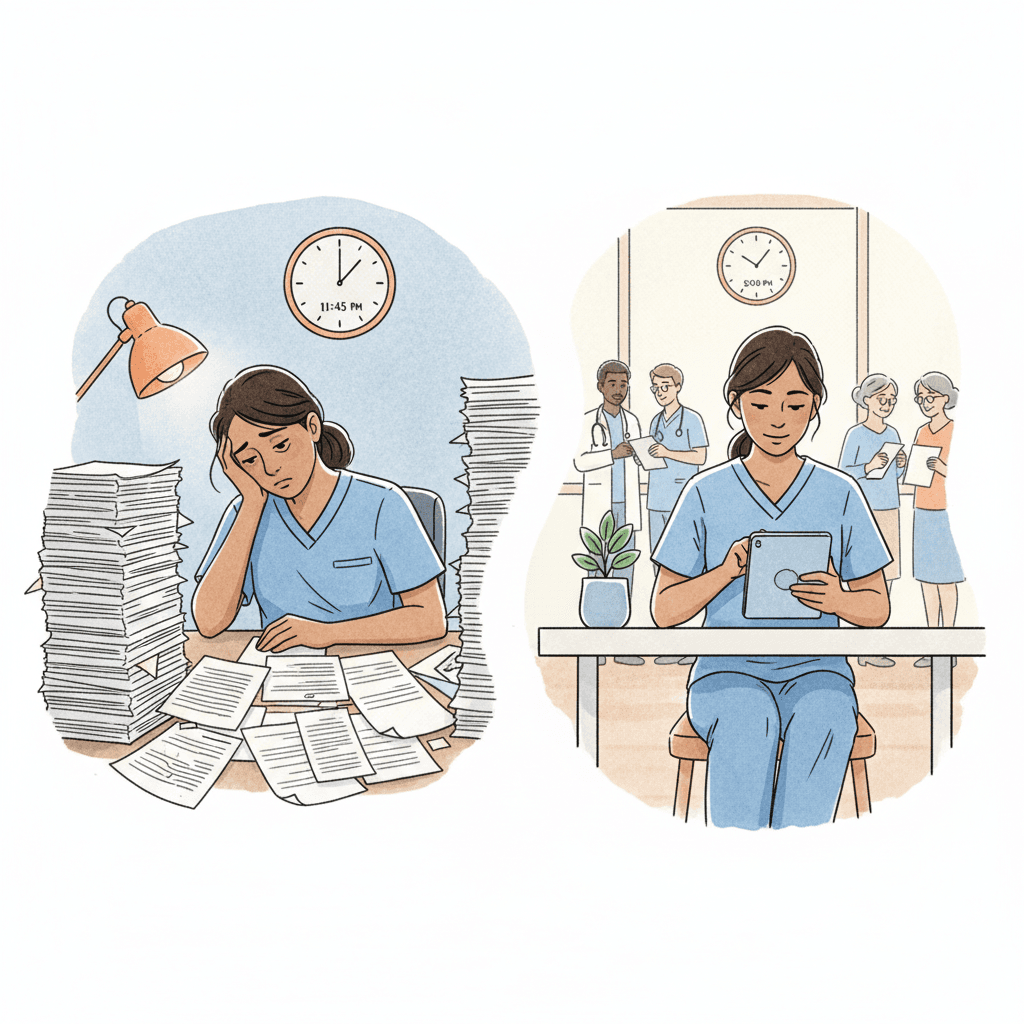
End-of-shift catch-up at 13% represents the cumulative penalty of deferred documentation. When staff cannot document at the point of care — because the system is inaccessible, the process is cumbersome, or the culture treats documentation as something you do "when you get a chance" — they accumulate a backlog that must be cleared before the shift ends. These retrospective entries are less accurate than real-time documentation, take longer to complete because details have faded, and frequently result in the kind of generic, templated notes that add volume without adding value.
Error correction at 12% is the hidden cost of systems and processes that make it easy to enter bad data. Free-text fields without validation, drop-down menus with ambiguous options, auto-populated fields that pull stale information — all of these create errors that someone downstream must identify and fix.
From Audit to Action
The time audit gives you a baseline and a target. If 72% of documentation time is overhead, even a 50% reduction in overhead translates to saving approximately 54 minutes per shift per care worker. Scale that across a team of 12 staff members and you recover nearly 11 hours of care time per day — without anyone documenting less.
The strategies in the next section target each of these overhead categories directly. But the time audit serves another purpose: it builds organizational consensus. When clinical directors can show their teams — and their leadership — exactly where documentation time goes, the case for change becomes concrete rather than abstract. "We need to fix documentation" is a vague aspiration. "We are spending 22 minutes per shift re-entering data that already exists in the system" is a solvable problem.
Run your own time audit
You do not need specialized tools. A simple spreadsheet with the six categories above, distributed to staff for one week, will produce actionable data. The key is including both direct care staff and supervisors, because their documentation burdens have different profiles.
Seven Strategies That Actually Work
The following strategies are ordered from highest impact and lowest implementation complexity to those that require more technology investment or organizational change. Most organizations will find the greatest return by starting with strategies one through four and layering in the rest as infrastructure and culture allow.
Strategy 1: Structured Templates with Smart Defaults
The fastest way to reduce documentation time is to stop asking staff to compose narratives from scratch. Structured templates with pre-defined fields, standardized response options, and clinically appropriate default values let staff document by confirmation and exception rather than by composition.
A well-designed shift assessment template, for example, might pre-populate a resident's typical vital sign ranges, current medications, diet order, mobility status, and behavioral baseline. The staff member reviews each field, confirms that the resident's status matches the expected baseline, and only writes a narrative note when something deviates. This approach cuts documentation time for routine assessments by 50-70% while producing records that are more consistent, more searchable, and easier to audit than free-text narratives.
The key to effective templates is clinical relevance. Templates designed by compliance officers or IT departments without frontline input tend to include too many fields and too few clinically meaningful defaults. The best templates are built by asking experienced care staff a simple question: "For this type of documentation, what information does the next caregiver actually need to know?"
Smart defaults must be accurate and current. A default value that reflects a resident's status from three months ago is worse than no default at all because it creates a path to silent error — a staff member clicks "confirm" without noticing that the resident's condition has changed. Defaults should pull from the most recent clinical data and flag when the underlying source data is more than a defined threshold (such as 72 hours) old.
Strategy 2: Point-of-Care Documentation
End-of-shift documentation catch-up is a symptom, not a root cause. The root cause is that staff cannot easily document at or near the time of care delivery. Solving this requires addressing three barriers: device access, workflow design, and organizational culture.
Device access means ensuring that care staff have a way to enter documentation at the point of care — a mobile device, a tablet on a medication cart, or a workstation in the common area. The device does not need to support full documentation; even a quick-entry mode that captures the essential facts (what happened, when, to whom, any concerns) and allows completion later is far more effective than batching everything to the end of the shift.
Workflow design means building documentation into the care process rather than treating it as a separate activity. When a care aide assists a resident with morning care, the documentation for that interaction should flow from the same workflow — not require the aide to finish the task, walk to a computer, log in, navigate to the right screen, and recreate the interaction from memory.
Cultural change is the hardest piece. In many care organizations, the implicit message to staff is that direct care comes first and documentation comes second. That prioritization is understandable but counterproductive, because it guarantees that documentation will be done retrospectively, inaccurately, and at higher total time cost. Leaders who want to shift to point-of-care documentation need to explicitly communicate that documenting during or immediately after care is not "being on the computer instead of with the resident" — it is part of delivering safe, continuous care.
Strategy 3: Exception-Based Documentation
Exception-based documentation is the single highest-impact change most residential care organizations can make. The principle is straightforward: when care is delivered according to the plan, document that the plan was followed. When care deviates from the plan, document the deviation in detail.
In practice, this means replacing lengthy narrative notes that restate routine care ("Resident was assisted with morning hygiene per care plan. No issues noted. Skin intact. Resident tolerated activity well.") with a simple confirmation that the care plan was followed, paired with a structured exception note when something is different ("Resident refused morning shower — stated feeling dizzy. Vitals taken: BP 102/68, HR 88, standing. Notified charge nurse. Bed bath provided instead. Care plan updated to monitor orthostatic symptoms.").
The exception note contains far more clinically useful information than the routine narrative it replaces. It tells the next caregiver what happened, why it happened, what was done about it, and what to watch for. The routine narrative tells them nothing they did not already know from reading the care plan.
Exception-based documentation typically reduces note volume by 40-60% while improving the signal-to-noise ratio in clinical records. Audit readiness actually improves because regulators and surveyors can quickly identify where deviations occurred and how they were managed, rather than wading through pages of routine confirmations to find the clinically significant entries.
The implementation risk is that staff may interpret "exception-based" as "optional." Clear guidelines must define what constitutes a documentable exception, and supervisory review must verify that exceptions are being captured consistently. The documentation standard is not "less" — it is "less routine, more meaningful."
Strategy 4: Pre-Populated Fields from Resident Profiles
Every piece of information that staff must manually look up and re-enter is a tax on their time and a source of potential error. Pre-populated fields address this by automatically pulling current data from the resident's profile, care plan, medication record, and recent clinical history into documentation forms.
When a nurse opens a new progress note, the system should already know the resident's name, date of birth, allergies, current diagnoses, active medications, care plan goals, and recent relevant observations. The nurse should not have to enter or verify any of this information unless it has changed. When a medication administration record is opened, the medications, doses, routes, and times should be pre-filled from the current physician orders.
The data integrity requirement here is non-negotiable. Pre-populated fields must draw from a single source of truth that is updated in real time. If the medication list in progress notes pulls from a different data source than the medication administration record, you are not solving the problem — you are hiding it behind an automated facade that will eventually produce a discrepancy.
Strategy 5: Voice-to-Text for Narrative Notes
When narrative documentation is clinically necessary — and there are situations where it is, particularly for complex incidents, significant changes in condition, and family communication — voice-to-text technology can reduce the time required by 60-75% compared to keyboard entry.
Modern speech recognition engines, particularly those trained on medical vocabulary, have achieved accuracy rates above 95% in clinical documentation contexts. Staff speak their notes into a mobile device or headset, and the transcription appears in the documentation system for review and submission.
The productivity gain is substantial. Most people speak at 130-150 words per minute but type at 30-50 words per minute. A detailed incident note that takes 8-10 minutes to type can be dictated in 2-3 minutes. Multiply that across multiple narrative entries per shift and the time savings are material.
The adoption barrier is not accuracy — it is environment. Residential care settings are noisy, staff move between rooms and common areas, and privacy considerations limit where voice documentation is appropriate. Successful implementations typically designate quiet zones or provide noise-canceling headsets, and train staff to use voice-to-text for specific documentation types (incident reports, change-of-condition notes, family communication summaries) rather than for all documentation.
Strategy 6: Eliminating Duplicate Entry Across Systems
Duplicate entry is one of the most straightforward documentation inefficiencies to identify and one of the most organizationally difficult to eliminate. It persists because different systems were purchased at different times to solve different problems, and no one has mapped the data flows between them.
Start by inventorying every system that care staff interact with during a shift: the electronic health record, the medication administration system, the shift communication log, the incident reporting system, the quality metrics dashboard, the billing system, the scheduling system. For each system, map which data fields are entered and which of those fields duplicate information that already exists in another system.
The solutions are, in order of preference: (1) integrate systems so data flows automatically, (2) consolidate systems so duplicate entry becomes impossible, or (3) designate a single system of record for each data element and eliminate the requirement to enter it elsewhere. The third option is always available immediately and requires no technology investment — only a policy decision about which system is authoritative for which data.
Strategy 7: Streamlined Approval Workflows
Supervisory review and co-signature requirements consume 7% of documentation time in the composite time study, but their real cost is higher because they create bottlenecks that delay record completion and force staff to revisit entries they thought were finished.
Review the approval workflows in your documentation system and ask three questions for each one: (1) Is this approval required by regulation, or by internal policy? (2) Does the approval add clinical value, or is it a rubber-stamp exercise? (3) Can the approval be completed asynchronously, or does it require the supervisor and staff member to be present simultaneously?
Many organizations discover that their approval workflows exceed regulatory requirements. A co-signature requirement that was added after a specific incident ten years ago may still be in place long after the underlying problem was resolved. Streamlining does not mean eliminating oversight — it means focusing oversight where it adds value. High-risk documentation (medication errors, restraint use, significant changes in condition) warrants rigorous supervisory review. Routine shift notes do not.
Compounding gains
These seven strategies are not independent — they compound. Structured templates (Strategy 1) enable exception-based documentation (Strategy 3). Pre-populated fields (Strategy 4) make point-of-care documentation (Strategy 2) faster. Eliminating duplicate entry (Strategy 6) reduces the error correction burden that consumes 12% of documentation time. Implementing three or four strategies together typically produces 40-60% total time savings rather than the sum of their individual gains.
Maintaining Quality While Reducing Volume
The most common objection to documentation efficiency initiatives is that reducing volume will reduce quality. This objection rests on an assumption that more documentation equals better documentation — an assumption that does not hold up under scrutiny. The goal is not to document less. The goal is to document better in less time.
Defining Documentation Quality
Documentation quality has four measurable dimensions, and none of them correlate positively with document length.
Completeness measures whether the record contains all clinically required information. A complete record captures the resident's status, the care provided, the response to care, and any changes or concerns. A 200-word exception note that documents a fall — including the circumstances, the assessment findings, the interventions, the notifications, and the follow-up plan — is more complete than a 50-word narrative that says "Resident found on floor. Assisted back to wheelchair. No apparent injury. Will monitor."
Timeliness measures how close to the event the documentation was created. Documentation entered within 30 minutes of an event is more reliable than documentation entered six hours later. Point-of-care documentation (Strategy 2) directly improves timeliness. Timeliness also matters for clinical continuity — a note entered at 2:00 PM about a 7:00 AM event is useless to the afternoon shift that started at noon.
Accuracy measures whether the documented information matches what actually happened. Accuracy degrades with time (retrospective documentation), with manual transcription (duplicate entry), and with poorly designed input fields (ambiguous drop-downs, unvalidated free text). Every strategy in the previous section that reduces manual entry and moves documentation closer to the point of care also improves accuracy.
Auditability measures whether the record provides a clear, traceable trail that supports regulatory compliance, clinical decision-making, and, if necessary, legal defense. Auditability requires that entries are attributable to a specific person, timestamped, and internally consistent. It does not require volume. A concise, well-structured record with clear exception documentation is more auditable than a voluminous record filled with templated language and routine confirmations.
Measuring Quality Without Increasing Burden
The challenge is measuring these four dimensions without creating another documentation task. Effective quality measurement programs use sampling and automation rather than universal manual review.
Automated completeness checks flag records that are missing required fields before they are finalized. This is a system design issue, not a staff performance issue. If the system allows an incomplete record to be submitted, the system is the problem.
Timeliness metrics are calculated automatically from timestamps. No manual measurement required. Set a threshold (for example, 90% of progress notes entered within 60 minutes of the documented event) and track it as an organizational metric, not a punitive individual measure.
Accuracy audits use stratified random sampling. Pull a defined sample of records each month (10-15 per unit is typically sufficient for statistical relevance), compare the documented information against available corroborating data (vital sign logs, medication administration records, incident reports), and score accuracy on a standardized rubric.
Auditability reviews are most efficiently conducted as part of existing regulatory readiness programs. Rather than creating a separate documentation audit, integrate documentation quality indicators into the mock survey or quality assurance process that the organization already runs.
The "Defensible Documentation" Standard
Clinical directors often frame documentation quality in terms of defensibility: "Would this record hold up in a survey? In a lawsuit? In a family complaint investigation?" Defensible documentation is documentation that a reasonable clinician, reading the record after the fact, can reconstruct what happened, what was known at the time, what decisions were made and why, and what was communicated to whom.
Defensible documentation is not the same as exhaustive documentation. In fact, excessive documentation can undermine defensibility by burying critical information in a sea of boilerplate, creating internal contradictions between overlapping entries, and suggesting — through sheer volume — that the organization is compensating for deficiencies in care delivery.
The defensible documentation standard has three components:
- What happened and when. The documented facts match the sequence of events. Timestamps are accurate. The who, what, when, and where are clear.
- Clinical reasoning is visible. The record shows not just what was done but why. "Vitals stable, no intervention required" is stronger than "Will continue to monitor" because it connects the observation to the clinical decision.
- Communication is documented. Who was notified, when, and what was their response. This single element — documentation of communication — is the most common gap identified in adverse event reviews and the most important element of a defensible record.
Organizations that adopt exception-based documentation often find that their defensibility improves because the exception notes are more detailed, more specific, and more clinically reasoned than the routine narratives they replaced. When everything is documented in the same flat, generic language, nothing stands out. When routine care is confirmed and exceptions are narrated, the clinically significant events are immediately visible.
Building a Quality Dashboard
A simple documentation quality dashboard that clinical directors can review weekly or monthly might track five metrics:
- Completeness rate: Percentage of records with all required fields populated (target: >95%)
- Timeliness rate: Percentage of notes entered within the defined time window after the event (target: >85%)
- Exception capture rate: Number of exception notes per shift per resident, benchmarked against incident reports and change-of-condition events to detect under-reporting (no single target — trend matters)
- Correction rate: Number of post-submission corrections per 100 records (target: fewer than 5%, trending downward)
- Audit sample score: Composite accuracy score from monthly random sample (target: >90%)
These five metrics provide a more reliable picture of documentation quality than any word count or page count. They also give staff a clear definition of what "good documentation" looks like — which is essential for maintaining quality through a transition from volume-based to efficiency-based documentation practices.
Regulatory Considerations
One of the most persistent barriers to documentation efficiency is the belief that "the regulators require it." In many cases, this belief is correct — regulators do require specific documentation. In many other cases, the belief is a misinterpretation of regulatory intent or an organizational policy that was attributed to a regulation without verification.
What Regulators Actually Require
Regulatory documentation requirements vary by jurisdiction, care setting, and accreditation body, but they share common principles.
Centers for Medicare & Medicaid Services (CMS) requirements for long-term care facilities, codified in the Requirements of Participation (42 CFR Part 483), require comprehensive assessments (MDS), individualized care plans, documentation of care plan implementation, documentation of significant changes in condition, and specific documentation for high-risk areas including restraints, psychotropic medications, and pressure injuries. CMS does not prescribe the format, length, or frequency of routine progress notes. The requirement is that clinical records be "complete" and "accurate" and contain "sufficient information to identify the resident, a record of the resident's assessments, the plan of care and services provided, the results of any pre-admission screening and resident review evaluations and determinations, and progress notes."
The phrase "sufficient information" is key. CMS does not define sufficiency by word count. Sufficiency means that a surveyor can review the record and determine whether the resident received appropriate care consistent with professional standards and the individualized care plan.
Care Quality Commission (CQC) in England evaluates care providers against five key questions: safe, effective, caring, responsive, and well-led. Documentation expectations are embedded within these questions — for example, "safe" requires evidence that risks are assessed and managed, which implies documentation of risk assessments and care plans. The CQC has explicitly stated that providers should not produce documentation for its own sake, and that excessive documentation can be a sign of inefficient processes rather than high-quality care.
Provincial standards in Canadian jurisdictions and state licensing requirements in the United States add specific documentation mandates that vary by location. These are non-negotiable and must be mapped before any efficiency initiative begins. But even jurisdiction-specific requirements typically focus on what must be documented (incidents, medication errors, restraint use, significant changes) rather than how much documentation is required for routine care.
The Over-Documentation Risk
Organizations over-document for understandable reasons. A deficiency citation on a survey is painful. A lawsuit where documentation is found insufficient is catastrophic. The natural response is to document more, document everything, document it twice.
But over-documentation creates its own risks. When records are so voluminous that reviewers cannot find critical information, the organization is functionally under-documented even though the data exists somewhere in the record. When staff spend so much time documenting that they have less time for direct care, the documentation that was supposed to evidence quality care becomes a barrier to delivering it. When templated language is used so extensively that every record looks the same, the clinical value of the record approaches zero because nothing distinguishes a good day from a bad day.
The risk calculus is not "more documentation = less risk." It is "relevant, timely, accurate documentation = less risk." The organization's documentation standard should be defined by what information regulators, clinicians, and legal counsel actually need — not by an anxiety-driven assumption that more is always safer.
Conducting a Regulatory Mapping Exercise
Before implementing documentation efficiency changes, map your current documentation practices against actual regulatory requirements:
- List every documentation type your organization currently produces (progress notes, assessments, care plans, incident reports, medication records, communication logs, quality reports).
- For each type, identify the regulatory source that requires it. If the source is "we've always done it this way" or "corporate policy," flag it for review.
- For each regulatory requirement, identify what is actually mandated — the content, frequency, and format specified by the regulation.
- Compare what you document against what is required. Where you exceed the requirement, evaluate whether the excess serves a clinical purpose. If it does, keep it. If it serves only habit or anxiety, consider reducing it.
This exercise routinely reveals that 20-30% of documentation practices in residential care organizations exceed regulatory requirements without adding corresponding clinical value. That 20-30% is the efficiency opportunity that can be captured without any regulatory risk.
Do not guess at regulatory requirements
Always verify documentation requirements against the current version of the applicable regulation, not a summary, not a training slide from five years ago, and not what the surveyor mentioned during the last visit. Regulations change, and organizational memory is unreliable. When in doubt, consult your state or provincial regulatory body directly.
Technology That Helps (Not Hinders)
Technology is an accelerator, not a strategy. The seven strategies described earlier can be implemented with paper-based systems, though technology makes them dramatically easier to sustain and scale. The question is not whether to use technology for clinical documentation, but which technology characteristics matter most.
Characteristics of Effective Documentation Technology
Mobile-first design. Care staff do not work at desks. They work in resident rooms, dining areas, common spaces, and outdoors. Documentation technology must be fully functional on mobile devices — not a shrunken version of a desktop interface, but a purpose-built mobile experience that accounts for one-handed use, variable lighting, and the reality that staff are often documenting while standing, walking, or holding something.
Offline capability. Residential care settings — particularly group homes and rural facilities — do not always have reliable internet connectivity. Documentation technology must allow staff to enter records offline and sync automatically when connectivity is restored. Any system that becomes unusable when the WiFi drops is a system that pushes documentation to the end of the shift.
Smart defaults and pre-population. As described in Strategy 4, the system should pull current resident data into documentation forms automatically. This requires real-time data integration, not batch updates. If the physician changed a medication order at 10:00 AM, the documentation form opened at 10:15 AM should reflect the new order.
Structured input with narrative escape. The system should default to structured, template-based input for routine documentation but allow free-text or voice-to-text narrative entry when the clinical situation demands it. The worst documentation systems force a choice between rigid structure and blank pages.
Workflow integration. Documentation should be embedded in the care workflow, not a separate destination. When a staff member marks a task as complete on the task list, the documentation for that task should be generated or prompted automatically. When a PRN medication is administered, the system should prompt for the follow-up assessment at the appropriate interval without requiring the nurse to remember and navigate to it separately.
AI-assisted review. Emerging capabilities in clinical documentation include AI-powered completeness checks that flag missing elements before submission, automated identification of inconsistencies between entries (a progress note describes a resident as "ambulatory" while the care plan lists them as "wheelchair-dependent"), and suggested narrative language based on structured data inputs. These capabilities reduce error rates and review burden without requiring staff to learn new workflows.
What to Avoid
Systems that add clicks and screens. If a documentation task that previously required three clicks now requires seven because the new system has more granular fields, the technology is adding burden, not reducing it. Count clicks. Measure time-to-complete for common tasks. If the new system is slower than the old one for routine documentation, something is wrong.
Systems designed for acute care. Hospital-focused electronic health records adapted for residential care tend to carry assumptions that do not translate: 12-hour nursing shifts, physician-driven workflows, diagnosis-centric rather than functional-status-centric documentation models. Residential care documentation has different rhythms, different priorities, and different users.
Systems that require constant connectivity. As noted above, offline capability is non-negotiable for residential care settings.
Platforms like Harmony are purpose-built for residential care documentation workflows — designed around mobile use, offline access, exception-based documentation, and the specific regulatory and clinical requirements of long-term care, group homes, and assisted living settings. The difference between a system designed for your setting and a system adapted from another setting is the difference between a tool that staff adopt readily and one they work around.
Case Scenario: Maplewood Group Homes
Maplewood Group Homes operates four community-based residential settings serving adults with intellectual and developmental disabilities, with a combined census of 28 residents and a care team of 34 direct support professionals, 4 house managers, and 2 registered nurses.
Before their documentation efficiency initiative, Maplewood's direct support professionals spent an average of 2 hours and 35 minutes per 8-hour shift on documentation. The documentation workflow was built around end-of-shift entry into a desktop-based electronic health record system. Staff compiled handwritten notes throughout the shift and transcribed them into the system during the final 90 minutes. House managers spent an additional 45 minutes per shift reviewing and co-signing records.
The problems were predictable: notes were frequently late, retrospective entries were generic and lacked clinical detail, duplicate data appeared across the shift log, progress notes, and the communication book, and house managers reported spending more time chasing incomplete records than reviewing clinical content.
What Changed
Maplewood implemented four of the seven strategies over a 12-week period:
- Structured templates with smart defaults for daily living activities, health monitoring, and behavioral observations. Templates were co-designed with direct support professionals and house managers.
- Point-of-care documentation via mobile tablets in each home, with a simplified quick-entry interface that allowed staff to document during or immediately after an interaction.
- Exception-based documentation for daily living activities. Routine ADL support was documented via care plan confirmation. Narrative notes were reserved for deviations, refusals, incidents, and significant observations.
- Elimination of duplicate entry by retiring the paper communication book and consolidating shift communication into the electronic shift summary.
What Stayed the Same
Maplewood did not reduce documentation for high-risk areas. Medication administration, incident reports, behavioral events, and significant health changes continued to receive full narrative documentation with supervisory review. The care plan documentation schedule remained unchanged. Regulatory-required assessments continued on their existing timeline.
Results After 90 Days
Documentation time dropped to an average of 1 hour and 12 minutes per 8-hour shift — a reduction of 53%. House manager review time dropped from 45 minutes to 20 minutes per shift. More importantly, documentation quality metrics improved across the board:
- Timeliness: Notes entered within 60 minutes of the event rose from 34% to 87%
- Completeness: Required fields populated at submission rose from 78% to 96%
- Exception capture: Exception notes increased by 40%, indicating that staff were documenting clinically significant events more consistently, not less
- Staff satisfaction: Documentation-related complaints in staff surveys dropped from the number-one concern to the number-four concern
The recovered time — roughly 1 hour and 20 minutes per staff member per shift — was reinvested in direct resident engagement, community activities, and skill-building programming. Staff reported feeling less rushed and more present with the people they support.
When Less Documentation Is Actually Dangerous
The strategies in this article are designed to eliminate waste from the documentation process without reducing the clinical substance of records. But there are areas where documentation shortcuts create genuine risk, and no efficiency initiative should touch them.
Medication Documentation
Medication errors are the most common adverse event category in residential care. Documentation of medication administration — including the right resident, right medication, right dose, right route, right time, and the resident's response — is both a regulatory requirement and a clinical safety mechanism. Every dose, every refusal, every PRN administration and its follow-up assessment must be documented completely and on time. Exception-based documentation does not apply to medication records. There is no "routine" medication administration that can be documented by confirmation alone.
Incident and Injury Reporting
Under-reporting of incidents — falls, altercations, unexplained injuries, near-misses — is a persistent risk in residential care. When documentation burden is high, staff may rationalize not documenting a minor incident ("it wasn't a real fall, they just lost their balance") or defer documentation until the end of the shift, by which time the details have blurred. Documentation efficiency initiatives must include an explicit carve-out for incident reporting: incidents are documented immediately, in full, regardless of perceived severity. The time saved on routine documentation should make this standard easier to maintain, not harder.
Care Plan Updates
The care plan is the central document in residential care. It drives all other documentation and all care decisions. When a resident's condition changes — a new diagnosis, a change in functional status, a behavioral pattern, a family concern — the care plan must be updated promptly and the update must be documented with the rationale. Deferred care plan updates create a gap between the care being provided and the care being directed, which is both a clinical risk and a regulatory exposure.
Communication with Physicians and Families
Documentation of outbound communication — calls to physicians, conversations with family members, coordination with specialists — is a frequent audit finding and a common gap in legal defense. When a nurse calls a physician about a change in condition, the documentation should capture what was communicated, the physician's response, and any orders or instructions received. When a family member raises a concern, the documentation should capture the concern, the response, and any follow-up actions. These communications are often time-sensitive and must be documented in real time, not batched to the end of the shift.
The Bright Line
The bright line for documentation efficiency is this: any documentation that relates to a clinical decision, a safety event, a communication with an external party, or a change from the expected baseline should be documented fully, immediately, and with clinical reasoning visible. Everything else — routine confirmations, boilerplate narratives, duplicated data entry, administrative overhead — is fair game for reduction.
When organizations are clear about this distinction, staff can apply documentation efficiency practices with confidence rather than anxiety. They know which documentation demands their full narrative attention and which documentation can be handled through structured confirmation. That clarity, more than any technology or template, is what makes documentation efficiency sustainable.
Conclusion
The documentation burden in residential care is not a technology problem or a staffing problem or a regulatory problem. It is a design problem. Documentation systems and practices have grown through accretion — each new requirement, each new system, each new policy layered on top of the last — without anyone stepping back to ask whether the composite result serves the purpose that documentation is supposed to serve.
That purpose is clinical communication. Documentation exists so that the next caregiver knows what happened, what to expect, and what to do. It exists so that the organization can demonstrate — to regulators, to families, to itself — that care is being delivered safely, consistently, and in accordance with individual care plans. Everything that serves that purpose should be documented. Everything that does not should be questioned.
The strategies in this article — structured templates, point-of-care documentation, exception-based recording, pre-populated fields, voice-to-text, duplicate entry elimination, and streamlined approvals — are not theoretical. They are being implemented today in residential care settings that have cut documentation time by 40-60% while improving the quality, timeliness, and defensibility of their clinical records. The organizations that implement these strategies recover hours of care time every day, reduce staff frustration, improve audit readiness, and — most importantly — give their care teams more time to do what they were trained and motivated to do: care for people.
The first step is the documentation time audit. Find out where the time is going. The answer will tell you where to start.
Frequently Asked Questions
How quickly can we expect to see time savings after implementing documentation changes?
Most organizations see measurable improvements within 30 to 45 days of implementing structured templates and point-of-care documentation, which are the two fastest strategies to deploy. The full benefit of exception-based documentation typically takes 60 to 90 days because staff need time to build confidence in the new approach and supervisors need to calibrate their expectations for what a "complete" record looks like under the new model. Plan for a 12-week implementation window to reach steady-state performance, with interim metrics reviewed weekly to catch adoption issues early.
Will surveyors or regulators push back on exception-based documentation?
Regulatory bodies evaluate whether documentation is complete, accurate, and clinically sufficient — not whether it is voluminous. Exception-based documentation that clearly records deviations from the care plan, with clinical reasoning and follow-up actions, meets or exceeds regulatory expectations. The key is ensuring that the care plan itself is current and detailed enough to serve as the reference standard. If your care plans are vague or outdated, exception-based documentation will expose that gap rather than cover it. Address care plan quality before or alongside the documentation efficiency initiative.
How do we prevent staff from using documentation efficiency as a reason to skip important entries?
Define and communicate the bright line between documentation that can be streamlined (routine care confirmations, administrative entries) and documentation that must remain comprehensive (medication administration, incidents, changes in condition, communications). Build system-level guardrails that require completion of high-risk documentation types before the record can be finalized. Use the exception capture rate metric to monitor whether clinically significant events are being documented consistently. If exception notes decline while incident reports remain constant, staff may be under-documenting.
What role does training play in reducing documentation burden?
Training is essential but often misdirected. Most documentation training focuses on what to document and how to use the system. Effective documentation efficiency training also covers what not to document — helping staff distinguish between information that serves a clinical or regulatory purpose and information that is redundant, excessive, or performative. Pair classroom training with coached practice during the first two to four weeks. Have supervisors review records in real time with staff, providing feedback not on length but on whether the documentation communicates the clinical picture clearly and completely.
Can smaller organizations with limited technology budgets benefit from these strategies?
Yes. Strategies one through four (structured templates, point-of-care documentation, exception-based documentation, and duplicate entry elimination) can be implemented with minimal technology investment. Structured templates can be created in any documentation system, including paper-based forms. Point-of-care documentation can be supported with inexpensive tablets. Exception-based documentation is a practice change, not a technology change. Duplicate entry elimination requires a policy decision, not a system integration. Technology makes these strategies easier to scale and sustain, but the strategies themselves are method-driven, not tool-driven.