Key Takeaways
- A corrective action plan that identifies "retraining" as the primary corrective action for a systemic deficiency is virtually guaranteed to produce a repeat finding — regulators have seen thousands of these plans, and they know that retraining addresses the symptom (staff did not follow the procedure) without addressing the root cause (why staff did not follow the procedure, whether the procedure is workable, and whether the system supports compliance).
- Effective corrective action plans contain six distinct elements — problem statement, root cause analysis, specific corrective actions, responsible parties with deadlines, evidence of completion, and a monitoring plan for sustained compliance — and the absence of any single element will trigger a request for revision from most regulatory bodies.
- Root cause analysis in care settings must go beyond the individual staff member's behavior to examine systemic factors: staffing levels, training adequacy, workflow design, supervision frequency, environmental conditions, policy clarity, and organizational culture — because a deficiency that exists across multiple staff members or multiple shifts is not an individual performance problem.
- The difference between a weak corrective action and a strong one is specificity: "staff will be educated on fall prevention" is weak, while "all nursing staff on second and third shifts will complete a 90-minute competency-based training on the facility's updated post-fall neurological assessment protocol by April 30, with return demonstration observed and documented by the DNS" is strong — because the second version can be verified, audited, and measured.
- The 90-day monitoring period following corrective action implementation is not a formality — it is the mechanism through which the organization demonstrates that the fix actually worked and that compliance is sustained, and regulators evaluate the monitoring data as rigorously as they evaluate the corrective actions themselves.
- Technology that tracks corrective action milestones, sends deadline alerts, stores evidence of completion, and generates monitoring reports transforms CAP management from a reactive document-creation exercise into a proactive quality improvement function that prevents repeat deficiencies rather than merely responding to them.
Introduction
A surveyor walks out of your facility on Friday afternoon. In her briefcase is a list of deficiencies. Some are minor — documentation gaps, a missed signature, a fire extinguisher inspection sticker that expired six days ago. Some are serious — a systemic failure to complete neurological assessments after falls, medication administration without current physician orders, or a pattern of delayed incident reporting. On Monday morning, your compliance officer opens the formal notification and begins drafting the corrective action plan.
What she writes in the next 72 hours will determine whether those deficiencies are resolved once or whether they reappear on the next survey. And the single most reliable predictor of a repeat deficiency is a corrective action plan that says, in some variation, "staff will be retrained."
Staff retraining is the corrective action plan equivalent of treating a fever with ice and ignoring the infection. It addresses the most visible symptom — staff did not follow the procedure — without examining why they did not follow it. Was the procedure unclear? Was the staffing level adequate to perform the procedure? Was the training itself inadequate? Was there a supervision gap that allowed non-compliance to persist? Was the procedure designed by someone who has never worked the overnight shift in a 90-bed facility with 3 CNAs and 1 LPN?
Regulators know this. They have reviewed thousands of corrective action plans that propose retraining as the primary intervention, and they have seen the results: the same deficiency cited on the same unit during the next survey cycle. A 2024 analysis of CMS survey data found that facilities whose corrective action plans relied primarily on staff education as the corrective intervention had a 47% rate of repeat deficiency at the next standard survey, compared to a 19% rate for facilities whose CAPs included systemic interventions — policy revision, workflow redesign, staffing adjustments, supervision enhancements, or technology implementation.
The difference is not complexity. It is depth. A corrective action plan that fixes a problem must first understand the problem — not the surface-level observation that the surveyor documented, but the underlying system failure that allowed the observation to exist. Root cause analysis is the bridge between "what the surveyor found" and "what will actually prevent it from happening again." And the corrective actions that follow the root cause analysis must be specific enough to implement, measurable enough to verify, and sustained long enough to demonstrate that the fix is durable.
This article walks through the complete lifecycle of a corrective action plan: from the moment a deficiency is identified through root cause analysis, corrective action design, implementation tracking, evidence collection, monitoring for sustained compliance, and formal closure. It is written for compliance officers, administrators, directors of nursing, operations leaders, and quality managers in long-term care facilities, group homes, and multi-site organizations who need corrective action plans that do two things simultaneously: satisfy the regulatory body that issued the finding, and actually fix the problem so it does not recur.
The Anatomy of an Effective Corrective Action Plan
An effective corrective action plan is a structured document that connects a regulatory finding to a root cause, translates that root cause into specific interventions, assigns accountability for those interventions, defines evidence that demonstrates completion, and establishes a monitoring framework that proves sustained resolution. Each element serves a distinct function, and the absence of any element creates a gap that regulators will identify and that — more importantly — increases the probability of repeat deficiency.
Problem Statement
The problem statement is not a restatement of the surveyor's finding. The surveyor's finding describes what was observed. The problem statement describes what is wrong in the organization's systems that allowed that observation to occur. This distinction is critical because it shifts the frame from "we were caught doing something wrong" to "here is what we need to fix."
A surveyor's finding might read: "Based on observation and record review, the facility failed to ensure that neurological assessments were completed as ordered following unwitnessed falls for 3 of 5 sampled residents (Residents #12, #18, #31) during the review period." The problem statement in the corrective action plan should not simply parrot this finding. It should contextualize it: "The facility's post-fall neurological assessment process has a systemic compliance gap on second and third shifts, where 60% of unwitnessed falls during the review period did not receive the ordered neurological assessment protocol within the required timeframe. The gap is concentrated among recently hired nursing staff (less than 90 days of employment) and correlates with shifts where the charge nurse was also carrying a patient assignment."
The second version tells the regulator something important: this organization has looked beyond the cited residents and examined the scope of the problem. It has identified not just the deficiency but the conditions under which the deficiency occurs. It has done the work that the surveyor expects to see in a credible corrective action plan.
Root Cause Analysis
Root cause analysis is the most important element of a corrective action plan, and it is the element most frequently performed poorly. A root cause analysis that stops at "staff did not follow the procedure" has not found the root cause. It has identified the proximate cause — the immediate human action (or inaction) that produced the observation. The root cause is the systemic condition that made the proximate cause likely. Staff did not follow the procedure because the procedure was ambiguous, because the training on the procedure was didactic rather than competency-based, because the staffing model did not allow time to perform the procedure, because the supervision structure did not detect non-compliance until a surveyor found it, or because some combination of these factors created conditions in which non-compliance was the path of least resistance.
A root cause analysis section in a credible corrective action plan reads like an investigation report, not a confession. It documents the methodology used (5 Whys, fishbone diagram, failure mode analysis), the data reviewed (incident reports, staffing schedules, training records, audit results, staff interviews), the contributing factors identified (each traced to a systemic condition rather than an individual failure), and the root cause determination — the fundamental system deficiency that, if corrected, would prevent the observed deficiency from recurring.
Corrective Actions
Each corrective action must correspond directly to an identified root cause. A corrective action that does not trace to a root cause is an intervention without a rationale — and regulators will ask why it is in the plan. Conversely, a root cause that does not have a corresponding corrective action is an identified problem without a solution — and regulators will ask what the organization intends to do about it.
Corrective actions must be specific, actionable, and verifiable. They must describe what will be done, not what will be attempted. They must define an outcome that can be objectively measured, not a process that can be subjectively assessed. And they must be feasible within the organization's resources and authority — a corrective action that requires budget authority the compliance officer does not have, or a staffing change that requires board approval, or a technology implementation that takes six months, must be scoped accordingly with interim measures identified.
Responsible Parties
Every corrective action must have a named individual (not a title, not a department) who is accountable for its completion. "Nursing will ensure compliance" is not accountability. "Sarah Chen, RN, Director of Nursing, is responsible for implementation of the revised post-fall neurological assessment protocol, including revision of the policy, delivery of competency-based training, and completion of the first compliance audit" is accountability. The named individual must have the authority to implement the corrective action, the resources to complete it, and the deadline by which it must be accomplished.
Timelines
Every corrective action must have a completion deadline that is specific (not "as soon as possible"), realistic (not "by end of business today" for a systemic process change), and sequenced (recognizing that some corrective actions depend on the completion of others). Timelines should distinguish between the date by which the corrective action will be implemented and the date by which evidence of completion will be available. A policy revision might be implemented in three days, but the evidence that the revised policy is being followed requires audit data collected over 30 to 60 days.
Evidence of Completion
For each corrective action, the plan must specify what evidence will demonstrate that the action has been completed. Evidence is not a statement that the action was taken. Evidence is documentation that proves it was taken, that the intended outcome was achieved, and that the change has been sustained. If the corrective action is a policy revision, the evidence includes the revised policy with tracked changes, the approval date and approving authority, the distribution record showing all affected staff received the revised policy, and the acknowledgment signatures confirming receipt and understanding. If the corrective action is competency-based training, the evidence includes the training curriculum, the attendance records, the competency assessment results with pass/fail determinations, and the return demonstration observations documented by the evaluator.
Monitoring Plan
The monitoring plan is the mechanism through which the organization demonstrates that the corrective action produced sustained change — not just a temporary improvement during the period immediately following the survey. The monitoring plan must specify: what will be measured (the specific compliance metric), how it will be measured (the audit methodology), how often it will be measured (the monitoring frequency), what threshold constitutes compliance (the performance standard), who will conduct the monitoring (the auditor), who will review the results (the oversight authority), and what will happen if the monitoring reveals a recurrence (the escalation protocol).
A monitoring plan that measures compliance once, finds compliance, and closes the corrective action has not demonstrated sustained resolution. It has demonstrated a snapshot. Regulators expect monitoring data collected over a minimum of 90 days following corrective action implementation, with multiple measurement points, to establish a trend that demonstrates sustained compliance.
Root Cause Analysis Methods
Root cause analysis in care settings is not an academic exercise. It is a practical investigation that must identify actionable systemic factors within the time constraints of a corrective action plan submission deadline (typically 10 to 30 days depending on the jurisdiction and the severity of the finding). Three methods have proven effective in care settings: the 5 Whys technique, fishbone (Ishikawa) diagrams, and failure mode analysis. Each method has distinct strengths, and the choice of method depends on the complexity of the deficiency and the time available for analysis.
The 5 Whys
The 5 Whys technique is the simplest and fastest root cause analysis method, and it is well-suited to deficiencies that have a relatively clear causal chain. The method works by asking "why" iteratively until the analysis moves from the proximate cause (what the surveyor observed) to a systemic cause (a condition the organization can change).
Consider a deficiency finding: medication was administered without a current physician's order.
Why 1: Why was the medication administered without a current order? Because the previous order had expired and a renewal order was not in the electronic medication administration record (eMAR) at the time of administration.
Why 2: Why was the renewal order not in the eMAR? Because the physician's office faxed the renewal order on Tuesday, but the order was not transcribed into the eMAR until Thursday — two days after it was received.
Why 3: Why was there a two-day delay in transcription? Because the fax was received by the front desk, placed in the nursing station's incoming paperwork tray, and was not reviewed by nursing staff until the charge nurse processed the tray on Thursday morning.
Why 4: Why was incoming paperwork not reviewed for two days? Because there is no defined process for prioritizing incoming orders — faxed physician orders are mixed with general correspondence, lab results, and administrative documents, and the tray is processed once per day by the charge nurse during first shift.
Why 5: Why is there no process for prioritizing incoming orders? Because the facility transitioned to eMAR 18 months ago but did not redesign the incoming order workflow — the paper-based tray system predates the eMAR and was never updated to account for the fact that orders now need to be transcribed into an electronic system rather than simply filed in a paper chart.
The root cause is not "the nurse did not transcribe the order." The root cause is a workflow design failure: the incoming order process was never redesigned after the eMAR implementation, creating a systematic delay between order receipt and order activation that affects every faxed order, not just the one the surveyor identified. The corrective action must address the workflow, not retrain the nurse.
Fishbone (Ishikawa) Diagram
The fishbone diagram is more structured than the 5 Whys and is better suited to deficiencies that have multiple contributing factors across different domains. The method organizes contributing factors into categories — typically People, Process, Policy, Environment, Equipment, and Measurement — and examines each category for factors that contributed to the deficiency.
For a deficiency involving incomplete post-fall neurological assessments, a fishbone analysis might identify contributing factors across multiple categories:
People: Recently hired nursing staff (less than 90 days) have not completed competency validation on the facility's post-fall neurological assessment protocol. Experienced staff on second and third shifts are carrying patient assignments in addition to charge nurse responsibilities, reducing the time available for direct oversight of newer staff.
Process: The post-fall assessment protocol requires seven neurological checks over 24 hours, but the documentation system does not generate automated reminders for subsequent checks after the initial assessment. Staff must manually track the schedule for each resident on a whiteboard that is not always updated during shift handoff.
Policy: The facility's post-fall policy was last updated in 2022 and does not reflect the current CMS guidance on neurological assessment timing. The policy references a paper assessment form that was replaced by the electronic documentation system in 2023, creating confusion about where and how to document the assessments.
Environment: Second and third shifts operate with 40% fewer nursing staff than first shift. The medication administration rounds on second shift overlap with the peak period for fall events (6:00-8:00 PM), creating a resource conflict that forces nurses to prioritize medication administration over fall assessment follow-up.
Equipment: The electronic health record system does not flag incomplete neurological assessment series — a resident with the first and second checks completed but the third through seventh missing does not generate an alert, and the incomplete series is only discoverable through manual chart review.
Measurement: The facility's quality assurance program does not include a specific audit of post-fall neurological assessment completion. Falls are tracked as incidents, but the completeness of the post-fall assessment protocol is not monitored as a distinct compliance metric.
The fishbone analysis reveals that the deficiency is not a single-cause problem. It has contributing factors across staffing, training, workflow design, policy currency, technology configuration, and quality monitoring. The corrective action plan must address factors in each relevant category — not just the most obvious one.
Failure Mode Analysis
Failure mode analysis (adapted from the FMEA methodology used in healthcare quality improvement) examines each step of the process that failed and identifies where, how, and why the failure occurred. This method is particularly useful for complex, multi-step processes where a deficiency could have been caused by a failure at any of several points.
For the post-fall neurological assessment deficiency, a failure mode analysis would map each step of the process — fall event identification, initial assessment, physician notification, order transcription, subsequent assessment scheduling, assessment completion, documentation, handoff to next shift, trend analysis — and examine each step for potential failure modes. At each step, the analysis assesses the probability of failure, the severity of failure consequences, the likelihood of detection before the failure reaches the resident, and the controls currently in place to prevent or detect the failure.
This granular analysis often identifies failure points that the 5 Whys and fishbone methods miss because they are not the most obvious contributors. For example, the failure mode analysis might reveal that the handoff from first shift to second shift is a critical failure point: the outgoing charge nurse verbally communicates the need for continued neurological checks, but the incoming charge nurse does not always receive the verbal handoff (because handoff occurs during the overlap period when both nurses are managing competing demands), and the written handoff tool does not include a field for active neurological assessment schedules.
Writing SMART Corrective Actions
The difference between a corrective action that satisfies a regulator and one that produces a request for revision often comes down to specificity. SMART corrective actions — Specific, Measurable, Achievable, Relevant, and Time-bound — provide a framework for translating root cause findings into interventions that can be implemented, verified, and audited. The most effective way to illustrate this framework is through direct comparison of weak and strong corrective actions addressing the same root cause.
Specificity: Before and After
Weak: "Staff will be educated on fall prevention protocols."
Strong: "All licensed nursing staff (RNs and LPNs) on second and third shifts at the Main Street facility will complete a 90-minute competency-based training session on the facility's revised Post-Fall Neurological Assessment Protocol (Policy NUR-412, Rev. 4), including hands-on return demonstration of the neurological assessment components, by April 30, 2026. Training will be delivered by the Director of Nursing or the Staff Development Coordinator. Staff who do not pass the competency assessment on the first attempt will receive one-on-one remediation and re-assessment within 7 days."
The strong version specifies who (licensed nursing staff on specific shifts at a specific location), what (competency-based training on a named policy revision with return demonstration), when (by a specific date), how (delivered by named roles, with a remediation pathway), and what constitutes completion (passing a competency assessment with documented return demonstration).
Measurability: Before and After
Weak: "The facility will improve its medication administration process."
Strong: "The pharmacy department will implement a next-business-day order transcription standard, measured by time elapsed between fax receipt timestamp and eMAR activation timestamp, with a target of 100% of faxed orders transcribed within 24 hours of receipt. The Director of Pharmacy will audit a random sample of 20 faxed orders per week for the first 30 days following implementation, then 10 per week for the following 60 days. Any order with a transcription lag exceeding 24 hours will trigger a same-day root cause review by the Director of Pharmacy."
Achievability: Before and After
Weak: "The facility will ensure that all post-fall neurological assessments are completed correctly 100% of the time."
Strong: "The facility will implement an automated neurological assessment reminder system in the EHR that generates a task alert for each scheduled neurological check following an unwitnessed fall, with escalation to the charge nurse if the task is not completed within 30 minutes of the scheduled time. The EHR vendor has confirmed that this configuration is available and can be implemented within 14 days. During the interim period before EHR configuration is complete, the charge nurse on each shift will maintain a whiteboard tracker for active neurological assessment schedules and will verify completion of each scheduled check before end of shift."
This version acknowledges that system changes take time and provides an interim measure to bridge the gap — demonstrating both realism and urgency.
Relevance: Before and After
Weak: "All staff will attend an in-service on resident safety."
Strong: "The corrective action specifically targets the identified root cause — the absence of automated reminders for sequential neurological assessments — by implementing a technology-based solution that eliminates reliance on manual tracking. The secondary corrective action addresses the staffing factor by revising the second-shift charge nurse assignment model to ensure the charge nurse is supernumerary (not carrying a patient assignment) on shifts where three or more residents have active fall risk care plans."
Relevant corrective actions trace directly to identified root causes. An all-staff in-service on resident safety addresses none of the specific root causes identified through analysis and signals to the regulator that the organization is substituting volume of activity for precision of response.
Time-Bound: Before and After
Weak: "These changes will be implemented as soon as possible."
Strong: "Implementation timeline: (1) Policy NUR-412 revision completed and approved by Medical Director — April 5, 2026. (2) EHR configuration request submitted to vendor — April 7, 2026. (3) Whiteboard tracking interim process implemented on all shifts — April 8, 2026. (4) Competency-based training completed for all second and third shift nursing staff — April 30, 2026. (5) EHR automated reminder system activated and tested — April 21, 2026. (6) First compliance audit completed — May 7, 2026. (7) 30-day monitoring report submitted to Administrator — May 21, 2026. (8) 60-day monitoring report — June 21, 2026. (9) 90-day monitoring report and CAP closure recommendation — July 21, 2026."
Implementation and Tracking
A corrective action plan that is well-written but poorly implemented produces the same outcome as a corrective action plan that was poorly written in the first place: a repeat deficiency. Implementation requires the same rigor as the planning phase — milestone tracking, evidence collection, progress reporting, and active stakeholder communication throughout the process.
Milestone Tracking
Each corrective action should be decomposed into discrete milestones with defined completion criteria. For a corrective action that involves policy revision, the milestones might include: draft revision completed, Medical Director review completed, staff input period completed, final revision approved, distribution to all affected staff documented, acknowledgment signatures collected, and first post-implementation audit conducted. Each milestone has a responsible party, a deadline, and a definition of what constitutes completion. Tracking milestones — rather than tracking corrective actions as monolithic items — provides earlier visibility into implementation delays and allows the organization to address blockers before they cause deadline failures.
Evidence Collection
Evidence must be collected contemporaneously with implementation, not reconstructed after the fact. When a training session is conducted, the evidence (attendance roster, curriculum, competency assessment results, return demonstration observations) should be compiled immediately and filed in the corrective action plan evidence package. When a policy is revised, the tracked-changes version, the approval signature, and the distribution record should be captured at the time of each event. Retrospective evidence assembly — gathering documentation weeks or months after the corrective action was implemented — creates gaps, inaccuracies, and credibility concerns that regulators will notice.
Progress Reporting
Regular progress reporting serves two functions: it maintains organizational attention on the corrective action plan (preventing it from being displaced by the urgent demands of daily operations), and it creates a documented record of the implementation process that regulators may request. Progress reports should be brief, structured, and produced at defined intervals — weekly for the first 30 days following CAP submission, biweekly for the next 60 days. Each report should document: milestones completed since the last report, milestones in progress with current status, milestones at risk of deadline failure with mitigation plans, and any barriers to implementation that require escalation.
Stakeholder Communication
Corrective action plans frequently involve staff at multiple levels — frontline caregivers, charge nurses, department managers, medical directors, and administrators. Each stakeholder group needs to understand what is changing, why it is changing, what is expected of them, and by when. Communication that frames corrective actions as punitive responses to survey findings ("we got cited, so now we have to do this") undermines staff engagement. Communication that frames corrective actions as quality improvement ("our analysis found a workflow gap that was setting staff up to fail, and here is how we are fixing it") generates buy-in and increases the probability of sustained compliance.
Monitoring for Sustained Compliance
The 90-day monitoring period following corrective action implementation is the phase where organizations most frequently lose focus. The intensity of the survey response — the root cause analysis, the plan writing, the training sessions, the policy revisions — creates a surge of activity that naturally dissipates once the immediate deadline has passed. Monitoring requires sustained attention after the adrenaline of the survey has worn off, and it is the phase that most directly determines whether the corrective action will hold.
The 90-Day Standard
Most regulatory bodies expect monitoring data covering a minimum of 90 days following implementation of corrective actions. This is not an arbitrary number. It reflects the reality that behavioral and process changes require approximately three months to stabilize — to move from conscious compliance (staff following the new process because they are being watched) to habitual compliance (staff following the new process because it has become the standard way of working). Data collected during the first 30 days may reflect the Hawthorne effect — the temporary improvement that occurs when people know they are being observed. Data collected over 90 days is more likely to reflect the actual state of compliance.
Leading Versus Lagging Indicators
Effective monitoring uses both leading and lagging indicators. A lagging indicator measures outcomes — did the deficiency recur? Lagging indicators are important but insufficient, because by the time a lagging indicator shows a problem, the problem has already happened. Leading indicators measure the conditions that predict outcomes — are audits being conducted on schedule? Are training completions current? Is staff turnover on affected units stable? Are near-miss events being reported and reviewed? Leading indicators provide early warning that compliance may be degrading before the deficiency actually recurs.
For the post-fall neurological assessment example, lagging indicators would include: the percentage of unwitnessed falls with complete neurological assessment series. Leading indicators would include: the percentage of EHR reminder alerts responded to within the 30-minute window, the number of charge nurse shifts where the charge nurse was supernumerary as planned, the percentage of newly hired nursing staff who completed the competency-based training within 30 days of hire, and the number of near-miss events (incomplete assessment series caught by the automated system or by charge nurse review before the assessment window expired).
Re-Audit Requirements
Monitoring must include formal re-audit events — not just passive data collection, but active retrospective review of records using the same methodology the surveyor used. A re-audit at 30 days, 60 days, and 90 days provides three data points that establish a compliance trend. Each re-audit should use a representative sample (typically 10-20 records or observations, depending on the facility census and the frequency of the event being audited), should be conducted by someone who was not directly involved in implementing the corrective action (to reduce bias), and should produce a written report with findings, compliance rate, and any recommended adjustments.
If the 30-day re-audit shows a compliance rate below the target threshold, the organization should not wait for the 60-day re-audit to take action. The monitoring plan should include a predefined escalation protocol: if compliance drops below the target at any monitoring point, what additional interventions will be implemented, by whom, and on what timeline. This escalation protocol demonstrates to regulators that the organization has a plan for the plan — that it anticipated the possibility of incomplete implementation and prepared to respond.
When to Close a CAP
A corrective action plan should be formally closed only when all of the following conditions are met: every corrective action has been implemented and evidence of completion has been documented, the monitoring period has been completed with compliance data at or above the target threshold for the full monitoring duration, the root cause conditions identified in the analysis have been verified as resolved (not just the surface-level compliance metric, but the systemic conditions that produced the deficiency), and the monitoring results have been reviewed and approved by the organization's quality assurance or compliance committee.
Premature closure — closing a CAP after a single satisfactory audit before the monitoring period is complete — is a common error that increases the risk of repeat deficiency. The corrective action may be in place, but without sustained monitoring data, the organization cannot demonstrate that the change has been embedded into routine practice.
Technology for CAP Management
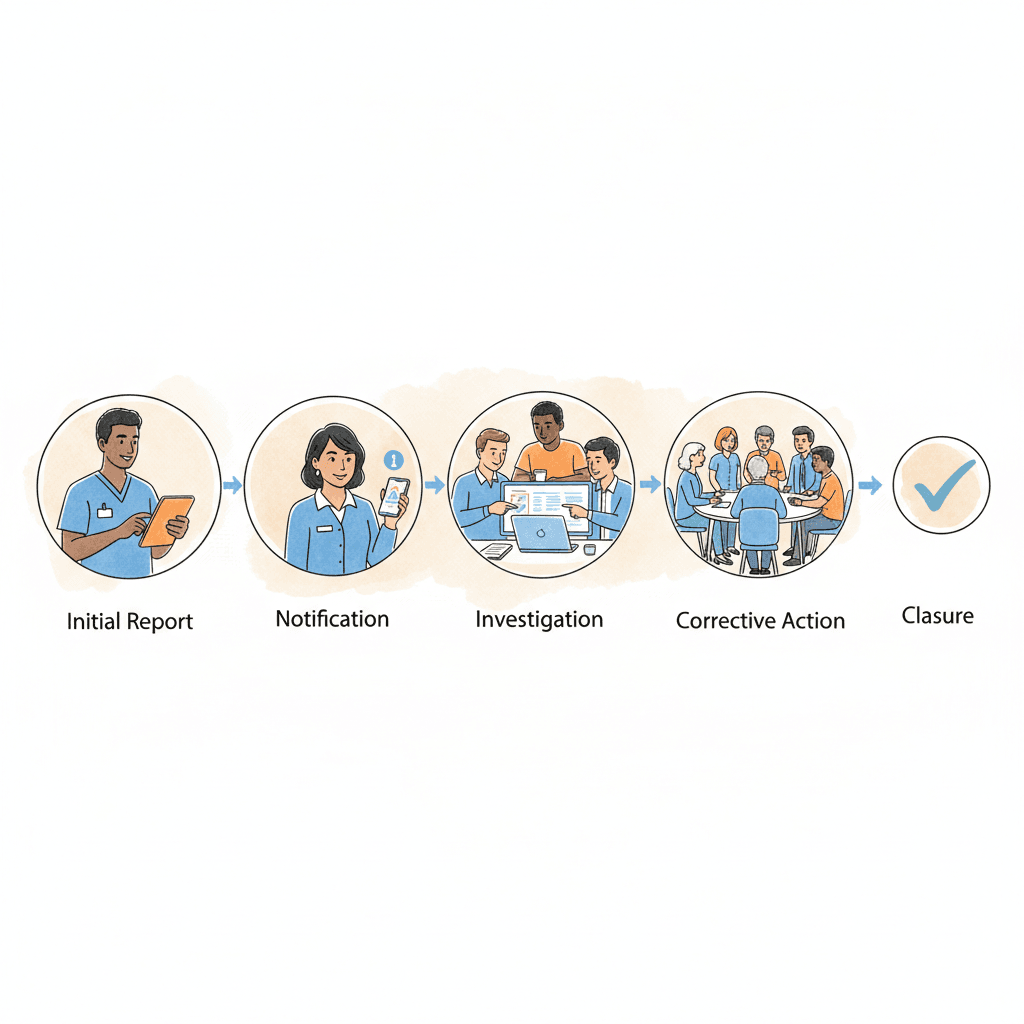
The corrective action plan lifecycle — from finding identification through root cause analysis, corrective action design, implementation tracking, evidence collection, monitoring, and closure — involves dozens of discrete tasks, deadlines, and accountability assignments distributed across multiple people and extended over months. Managing this lifecycle through email chains, shared drives, and spreadsheets is possible for a single facility with a single deficiency. It is not practical for multi-site organizations managing multiple corrective action plans simultaneously, each with its own timelines, evidence requirements, and monitoring schedules.
Corrective Action Tracking
A purpose-built platform provides a centralized registry of all active corrective action plans across the organization, with real-time visibility into the status of each plan, each corrective action within each plan, and each milestone within each corrective action. The platform assigns ownership, tracks completion status, and provides a single source of truth that eliminates the confusion that arises when CAP status is tracked in disconnected documents.
Milestone Alerts
Automated alerts ensure that deadlines are not missed. When a milestone is approaching its due date, the responsible party receives an advance notification. If the milestone passes without a completion update, escalation notifications are sent to the next level of oversight. This simple automation eliminates the most common mode of CAP implementation failure: the deadline that was forgotten because it fell during a period of high operational intensity.
Evidence Attachment
The platform provides a structured evidence repository for each corrective action, where the responsible party can attach policy documents, training records, audit reports, competency assessments, and monitoring data as each milestone is completed. The evidence is linked directly to the corrective action it supports, creating an organized audit trail that can be produced on demand for regulators — rather than assembled retrospectively by a compliance officer searching through shared drives and email attachments.
Harmony's Compliance Module
Harmony's approach to corrective action plan management integrates the full CAP lifecycle into the organization's broader compliance governance framework. When a deficiency is entered into the system, the platform guides the user through a structured workflow: problem statement development, root cause analysis documentation (with templates for 5 Whys, fishbone, and failure mode analysis), SMART corrective action formulation, milestone creation with deadlines and responsible parties, evidence attachment, monitoring schedule configuration, and re-audit tracking. The system generates automated deadline reminders, escalation notifications, progress reports for leadership review, and monitoring summary reports that track compliance trends over the full 90-day monitoring period.
For multi-site organizations, the platform provides cross-facility visibility into CAP status, enabling operations leaders to identify patterns — are the same deficiency categories appearing across multiple sites, suggesting a systemic organizational issue rather than a site-specific problem? Are certain sites consistently completing CAPs on time while others consistently miss deadlines? Are specific root cause categories recurring, suggesting that the organization's standard corrective actions for those categories are not effective?
This cross-facility analysis transforms CAP management from a reactive, site-by-site exercise into a proactive, organizational learning function. Each corrective action plan becomes a data point in a continuous improvement system that identifies patterns, shares successful interventions across sites, and prevents the same root cause from producing deficiencies at multiple locations.
Case Scenario: From Repeat Deficiency to Sustained Resolution
Lakeview Healthcare operates three long-term care facilities in a midwestern state. In 2024, two of the three facilities received deficiency citations for incomplete documentation of resident preferences in care plans — the same deficiency category that had been cited at one of the facilities in 2023. The 2023 corrective action plan had consisted of three elements: a staff in-service on person-centred care planning, a memo from the Director of Nursing reminding staff to document resident preferences, and a single chart audit 30 days after the in-service that showed improved compliance. The CAP was closed after the 30-day audit. Within nine months, the same deficiency appeared again — at the original facility and at a second facility.
The repeat deficiency triggered a different approach. The compliance director convened a cross-facility root cause analysis team that included the Directors of Nursing from all three facilities, the Staff Development Coordinator, two frontline CNAs, and a resident representative. The team used a fishbone analysis and identified contributing factors across five categories:
Process: The care plan template in the electronic health record did not include a structured field for resident preferences — preference documentation required free-text entry in a general notes section, and staff were not consistently navigating to that section during care plan development.
Training: The 2023 in-service on person-centred care planning was a one-hour didactic presentation. It did not include competency assessment, practice exercises, or follow-up supervision. Staff reported understanding the concept of person-centred planning but being unsure where and how to document preferences in the EHR.
Staffing: Care plan development was assigned to the MDS coordinator, who was responsible for care plans for all residents in each facility. The MDS coordinator's workload did not include dedicated time for interviewing residents about their preferences — preference information was expected to come from admission assessments and quarterly reviews, but neither process included a structured preference elicitation protocol.
Measurement: The facility's quality assurance program audited care plan completion (whether required sections were present) but did not audit care plan content (whether the documented information reflected actual resident preferences as reported by the resident).
Culture: Staff at all three facilities described care plan documentation as "paperwork" rather than as a tool for guiding care. Several CNAs reported never reading the care plans for the residents they supported, relying instead on verbal communication from the charge nurse and their own experience with each resident.
Based on this analysis, the corrective action plan included seven interventions:
-
EHR template revision to add a structured "Resident Preferences and Priorities" section with prompted fields (daily routine preferences, communication preferences, dietary preferences, activity preferences, cultural and spiritual considerations) — completed within 21 days by the EHR administrator.
-
Development of a structured Resident Preference Interview protocol — a 15-minute guided conversation tool that could be used by any staff member during admission, quarterly review, or any time a resident expressed a new preference — completed within 14 days by the Staff Development Coordinator.
-
Assignment of the Resident Preference Interview to admission nurses and quarterly review coordinators as a required component of each assessment cycle, documented in the EHR template — implemented within 21 days by Directors of Nursing.
-
Competency-based training for all licensed nursing staff and MDS coordinators on the revised care plan template and the Resident Preference Interview protocol, including practice with a standardized resident scenario and documentation in the EHR test environment — completed within 45 days.
-
Revision of the quality assurance audit to include a care plan content audit: monthly review of five randomly selected care plans per facility, evaluating whether documented preferences match the resident's expressed preferences as verified through direct resident or family interview — implemented at day 30.
-
Monthly care plan content audit results reviewed by the cross-facility quality committee, with any facility scoring below 80% on the content audit triggering a focused improvement intervention — implemented at day 30 and continuing through the monitoring period.
-
Quarterly "Care Plan Rounds" at each facility where the care plan team presents three residents' care plans to the full interdisciplinary team, with the resident (or their representative) invited to participate and verify that the plan reflects their actual preferences — first round scheduled at day 45.
The monitoring results over 90 days showed care plan preference documentation compliance increasing from 34% (baseline measured at the time of the deficiency) to 78% at 30 days, 89% at 60 days, and 93% at 90 days. The content verification audit — which measured whether documented preferences actually matched what residents reported — showed 71% concordance at 30 days, 82% at 60 days, and 88% at 90 days.
The most significant finding was qualitative rather than quantitative. During the quarterly Care Plan Rounds, a resident's daughter said: "This is the first time anyone has asked me whether the care plan reflects what my mother actually wants. It used to just show up with her name on it." The Director of Nursing at that facility later reported that the Care Plan Rounds had become the most valued meeting on the interdisciplinary team's calendar — not because they were required, but because they changed the team's relationship to care planning from a documentation obligation to a clinical conversation.
Common CAP Failures
Even well-intentioned corrective action plans fail. The failures follow predictable patterns that organizations can learn to recognize and avoid.
The Retraining Trap
The most common failure: responding to every deficiency with staff retraining. Retraining is appropriate when the root cause analysis identifies a genuine knowledge or skill deficit — when staff truly do not know how to perform the required task. It is inappropriate when the root cause is a workflow design failure, a staffing inadequacy, a technology gap, or a supervision deficit. The test is simple: did the staff member know the correct procedure and fail to follow it (a system problem), or did the staff member not know the correct procedure (a training problem)? In the majority of deficiencies, staff know the correct procedure. The system does not support consistent execution.
The Scope Mismatch
A corrective action plan that addresses only the specific residents cited in the deficiency finding, rather than the systemic condition that produced the deficiency, is scoped too narrowly. The surveyor found the problem in Residents #12, #18, and #31. The problem exists across the facility — or across the organization. A CAP that retrains the two nurses who were responsible for those three residents' assessments fixes nothing for the 87 other residents whose assessments may have the same gaps.
The Missing Monitoring Plan
A corrective action plan that describes what will be done but does not describe how compliance will be monitored over time is incomplete. Without a monitoring plan, the organization has no mechanism to detect recurrence until the next survey — by which time the deficiency has been recurring undetected for months or years.
The Premature Closure
Closing a corrective action plan after a single satisfactory audit, before the full monitoring period has elapsed, is the organizational equivalent of stopping antibiotics because you feel better. The symptoms have improved, but the underlying condition may not be resolved. Sustained monitoring data — collected over the full 90-day period at minimum — is the only evidence that the corrective action has produced durable change.
The Accountability Vacuum
A corrective action plan that assigns responsibility to a department ("nursing will ensure compliance") rather than to a named individual creates an accountability vacuum. When everyone is responsible, no one is responsible. Each corrective action needs a single named person who will ensure its completion — and that person needs the authority and resources to deliver.
Conclusion
A corrective action plan is not a document you write for the regulator. It is a commitment you make to the people in your care that the system failure that produced the deficiency will be identified, corrected, and prevented from recurring. The regulator is not the audience. The regulator is the accountability mechanism. The audience is every resident, family member, and staff member who will be affected by whether the system failure is fixed or allowed to persist.
The organizations that produce the most effective corrective action plans share a common characteristic: they treat deficiency findings as diagnostic information rather than as criticism. A deficiency finding tells the organization something about its systems that internal quality monitoring should have identified but did not. The corrective action plan, then, is not just a response to the finding — it is a response to the monitoring gap that allowed the finding to reach the surveyor rather than being identified and corrected internally.
This reframe transforms the corrective action plan from a defensive document (proving to the regulator that you have responded) into a quality improvement instrument (demonstrating to yourself that your systems are getting better). The anatomy is the same — problem statement, root cause analysis, SMART corrective actions, responsible parties, evidence, and monitoring. But the intent is different. And the intent determines whether the organization produces a plan that satisfies the surveyor for this cycle or a plan that prevents the deficiency from ever appearing again.
Frequently Asked Questions
How quickly must a corrective action plan be submitted after receiving a deficiency finding?
Submission timelines vary by jurisdiction and by the severity of the finding. In the United States, CMS requires that plans of correction be submitted within 10 calendar days of receiving the Statement of Deficiencies (Form CMS-2567). State licensing agencies may impose different timelines — some require submission within 10 business days, others within 30 calendar days. In the United Kingdom, CQC does not prescribe a universal timeline but sets submission deadlines in the inspection report based on the severity of the findings, with urgent requirements sometimes requiring a response within 48 hours. In Canada, provincial timelines range from 10 to 30 days depending on the province and the severity classification. In Australia, the Aged Care Quality and Safety Commission specifies response timelines in the notice of non-compliance, typically 14 to 28 days. Regardless of the jurisdictional requirement, organizations should begin root cause analysis immediately upon receiving the deficiency notification — the quality of the analysis directly correlates with the time available to conduct it.
What happens if a corrective action plan is rejected by the regulatory body?
Most regulatory bodies will return a corrective action plan with specific feedback identifying the elements that are insufficient — typically vague corrective actions, missing root cause analysis, absent monitoring plans, or unrealistic timelines. The organization is given a defined period (usually 10 to 14 days) to revise and resubmit. A second rejection is unusual if the organization addresses the specific feedback, but it can trigger escalated enforcement action, including increased survey frequency, conditional licensing, or (in extreme cases) civil monetary penalties. The most effective approach to avoiding rejection is to ensure the CAP addresses every element the regulatory body expects: when in doubt, call the survey agency to ask what specific elements they require, because requirements vary not only by jurisdiction but sometimes by individual surveyor or survey team.
Can a corrective action plan reference systemic changes that are already in progress?
Yes, but with important caveats. If the organization was already implementing a relevant system change before the deficiency was cited — for example, an EHR upgrade that will include automated assessment reminders — the CAP can reference this in-progress initiative as a corrective action. However, the plan must also include interim measures that address the deficiency immediately while the systemic change is being completed. A CAP that says "we are upgrading our EHR in six months and this will fix the problem" without identifying what will happen during the intervening six months is non-responsive to the immediate compliance obligation. The interim measures must be independently sufficient to address the deficiency.
How should multi-site organizations coordinate corrective action plans?
Multi-site organizations should treat a deficiency finding at one site as a signal that the same systemic condition may exist at other sites. Best practice is to conduct a proactive assessment of the same compliance area at all sites within 30 days of receiving a deficiency citation at any site. If the assessment identifies similar gaps at other sites, the organization should implement corrective actions proactively — before those sites are surveyed — and document the proactive assessment and remediation. This approach demonstrates organizational learning and may be viewed favorably by regulators during subsequent surveys. From a practical standpoint, multi-site coordination also enables sharing of effective corrective strategies across sites, so that each site does not independently reinvent solutions to the same systemic problem.
What is the difference between a corrective action plan and a quality improvement project?
A corrective action plan is a response to an identified deficiency — it is reactive, targeted, and bounded by the specific finding and the regulatory timeline. A quality improvement project is proactive, broader in scope, and driven by the organization's own quality goals rather than by external findings. However, the two should be connected: a well-executed corrective action plan identifies not just the immediate fix but the quality improvement opportunity. The CAP fixes the specific deficiency. The quality improvement project addresses the category of deficiency — the organizational condition that allowed this type of problem to emerge. Organizations that systematically connect their CAPs to their quality improvement agenda convert regulatory findings into organizational learning, reducing the total number of deficiency findings over time.