Key Takeaways
- Regulators do not simply require that incidents be reported — they require evidence that the organization had a defined, practiced, and consistently followed workflow for identifying, reporting, investigating, correcting, and closing incidents before the incident ever occurred.
- The incident lifecycle contains seven distinct phases — detection, reporting, classification, investigation, corrective action, follow-up, and closure — and each phase carries specific documentation requirements, timeline expectations, and accountability standards that must be satisfied for the workflow to withstand regulatory scrutiny.
- Notification timelines vary materially across jurisdictions — CMS requires reporting within 2, 5, or 24 hours depending on severity, Canadian provinces impose 1-to-24-hour critical incident windows, CQC safeguarding notifications carry same-day expectations, and Australia's SIRS framework mandates priority 1 reporting within 24 hours — and organizations operating across borders must map each requirement precisely.
- The most common workflow failure is not a missing incident report but a broken handoff between phases — the report was filed but never classified, the investigation was started but never completed, the corrective action was documented but never verified, or the case was investigated but never formally closed.
- Escalation protocols must be severity-based, automated where possible, and tested regularly — including after-hours scenarios, multi-site coordination, and family notification pathways — because a protocol that exists on paper but has never been activated under realistic conditions is a protocol that will fail when it matters most.
- Technology that enforces structured intake, auto-classifies by severity, routes investigations to assigned owners, tracks corrective actions to completion, and connects individual incidents to portfolio-wide trend analysis reduces reporting gaps and regulatory exposure by 40 to 60 percent compared to manual or paper-based systems.
Introduction
Regulators do not just want to know that an incident happened. They want to see that you had a system for responding to it before it happened.
This distinction is the difference between an organization that reports incidents and an organization that manages them. Reporting is a single act — a form gets filled out, a notification gets sent, a record gets created. Management is a system — a defined sequence of actions that begins the moment an event is detected and does not end until the root cause has been identified, the corrective actions have been implemented, the effectiveness of those actions has been verified, and the case has been formally closed with documented evidence at every stage. When a surveyor pulls your incident files, she is not checking whether you filed the paperwork. She is evaluating whether your organization operates a functional incident management system — one that was designed before the incident, followed during the incident, and validated after the incident.
The organizations that consistently satisfy regulators are not the ones with the fewest incidents. They are the ones with the most complete workflows. A facility with thirty incident reports — each showing detection, timely reporting, accurate classification, thorough investigation, specific corrective actions, documented follow-up, and formal closure — presents a stronger compliance profile than a facility with five incident reports that trail off after the initial narrative. The first organization is demonstrating a safety culture that identifies events, learns from them, and improves. The second is demonstrating that it fills out paperwork when something goes wrong and then moves on.
The challenge is that designing an incident reporting workflow that truly satisfies regulators requires attention to multiple dimensions simultaneously. You need to understand the lifecycle of an incident — not just what happened, but the seven distinct phases that every reportable event must pass through. You need to know the notification timelines specific to your jurisdictions, because a report that arrives two hours late is a compliance failure regardless of how complete it is. You need to build escalation protocols that activate reliably, including at 2 AM on a Saturday when the administrator is off-site and the on-call staff member has never handled a critical incident. You need to select and configure technology that enforces your workflow rather than merely recording the fact that the workflow was supposed to happen. And you need to do all of this in a way that frontline staff can actually execute — because the most sophisticated workflow in the world is useless if the person who discovers the incident at the bedside does not know what to do next.
This article provides a comprehensive framework for designing incident reporting workflows that meet regulatory requirements across jurisdictions. It maps the seven phases of the incident lifecycle with timeline expectations and documentation requirements for each. It compares notification requirements across CMS, Canadian provincial frameworks, CQC, and Australian SIRS. It addresses escalation protocols, technology selection, common workflow failures, and the practical realities of implementation. It is written for compliance officers, operations leaders, directors of nursing, and quality managers in long-term care, group homes, and assisted living communities who need their incident workflows to satisfy not just the letter of regulatory requirements but the intent behind them — because the intent is what surveyors actually evaluate.
The Incident Lifecycle: Seven Phases From Detection to Closure
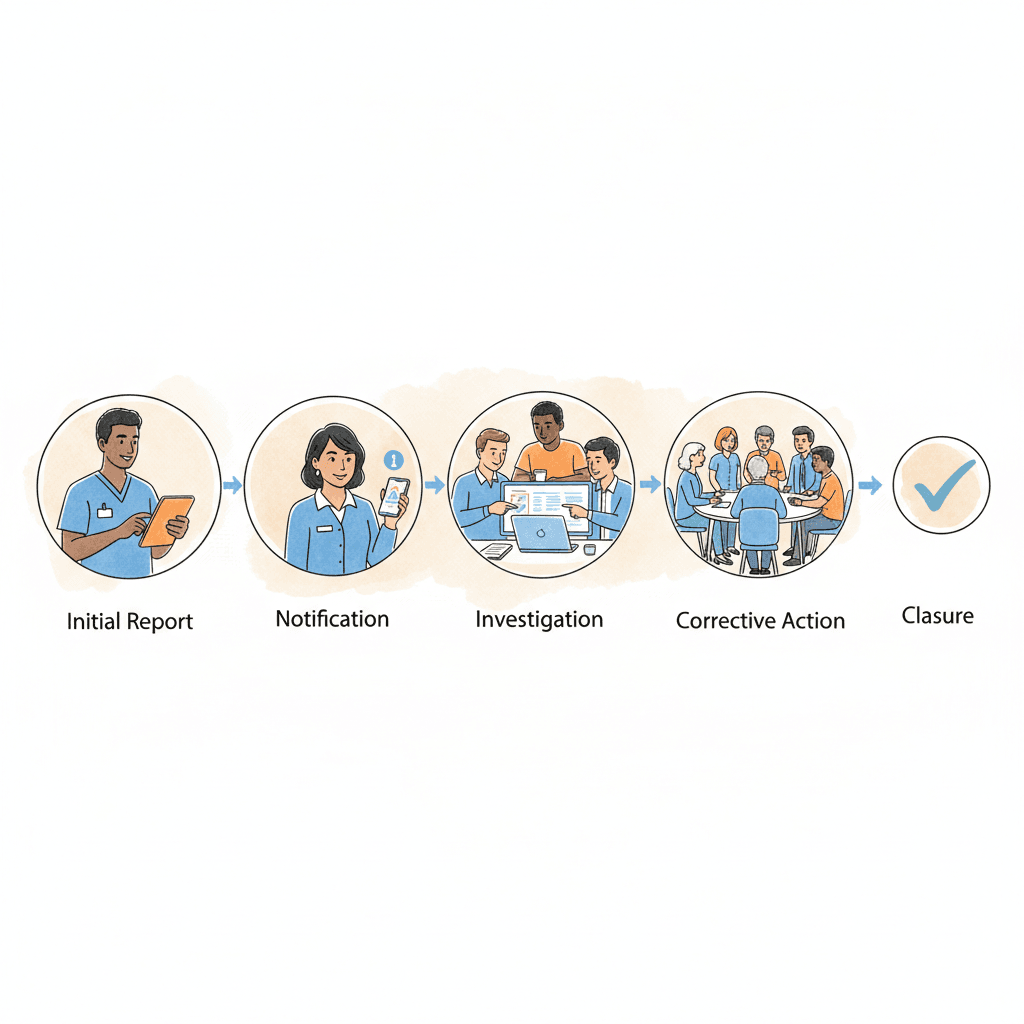
Every reportable incident — regardless of jurisdiction, care setting, or severity level — passes through seven distinct phases. Each phase has specific actions, responsible parties, documentation requirements, and timeline expectations. A workflow that addresses all seven phases completely produces a defensible record. A workflow that skips any phase, or that handles a phase informally without documentation, creates the gaps that surveyors are trained to find.
Phase 1: Detection
Detection is the moment an incident is identified. It may be direct observation (a staff member witnesses a fall), a resident or family report (a resident reports that another resident struck them), a clinical finding (a nurse discovers an unexplained bruise during an assessment), or a system alert (a medication administration system flags a missed dose). Detection is not the same as reporting — detection is the recognition that something has occurred that requires a response.
The critical requirement at the detection phase is immediacy. The clock starts at detection, not at reporting. If a CNA witnesses a fall at 14:00 but does not report it until the end of her shift at 19:00, the regulatory timeline is measured from 14:00. This distinction matters enormously for compliance, and it means that your workflow must make it clear to every staff member at every level that their obligation begins the instant they become aware of an event — not when they find time to document it, not when they finish their current task, not when they can locate a supervisor.
Documentation requirement: The detection time must be captured separately from the reporting time. Many organizations record only when the report was filed, not when the event was discovered. This creates an audit vulnerability, because the surveyor will reconstruct the timeline from other records — shift assignments, medication administration times, camera footage where available — and any gap between what should have been the detection time and the recorded reporting time raises questions about organizational culture and workflow compliance.
Timeline expectation: Immediate. Staff should initiate the reporting process within 15 minutes of detection, after ensuring resident safety and providing immediate care.
Phase 2: Reporting
Reporting is the formal documentation of the incident. This is the phase where most organizations focus their training and their technology — and where many organizations believe their workflow begins. In fact, by the time reporting occurs, the workflow should already be in motion. Reporting converts the detected event into a documented record that activates downstream processes: classification, notification, investigation assignment.
A well-designed reporting workflow captures structured data — not free text alone. The reporter should be prompted for date and time of incident, date and time of detection, location, persons involved, factual description, immediate actions taken, and injuries or outcomes observed. This structured intake ensures completeness and consistency. Free-text narratives are valuable for clinical context but unreliable as the sole documentation mechanism, because they vary dramatically in quality depending on who is writing and how much time they have.
Documentation requirement: The incident report itself, with all required fields completed. Incomplete reports — particularly reports missing time, location, or involved persons — are among the most frequently cited documentation deficiencies in regulatory surveys.
Timeline expectation: The initial report should be filed within one hour of detection for routine incidents. For critical incidents — those involving serious injury, abuse, neglect, death, or elopement — the initial report should be filed within 30 minutes, because it triggers immediate notification requirements in most jurisdictions. Some jurisdictions impose even tighter timelines for specific event types.
Phase 3: Classification
Classification assigns a severity level and category to the reported incident. This phase determines which downstream actions are required — who must be notified, within what timeframe, whether an external report is mandatory, and how quickly an investigation must be initiated. Classification is the routing mechanism of your incident workflow. Get it wrong, and every subsequent phase is misaligned.
Most regulatory frameworks require a tiered classification system. A common structure uses three to five levels:
- Level 1 — Critical: Death, serious bodily injury, abuse, neglect, elopement, sexual assault, or any event requiring emergency medical services. Immediate notification to administrator, regulatory authority, and designated family contacts.
- Level 2 — Major: Injury requiring medical treatment beyond first aid, medication errors with adverse effect, resident-to-resident altercation with injury, environmental hazard with potential for serious harm. Notification to administrator within 2 hours, regulatory authority within 24 hours where required.
- Level 3 — Moderate: Falls without significant injury, medication variances without adverse effect, behavioral incidents without injury, property damage. Notification to supervisor within the shift, investigation within 48 hours.
- Level 4 — Minor: Near-misses, minor equipment failures, procedural deviations with no resident impact. Documentation required, trend analysis, no external notification.
The challenge with classification is that it requires clinical judgment at the point of reporting — and the person reporting may not have the training or experience to classify accurately. This is why the best workflows separate initial classification (by the reporter, based on objective criteria) from confirmed classification (by a supervisor or compliance officer, based on clinical review). Auto-classification tools that use structured intake data to suggest a severity level — and then route the report for confirmation — reduce misclassification rates significantly.
Documentation requirement: Both the initial classification and the confirmed classification must be documented, with the name of the person who confirmed, the date and time of confirmation, and any rationale for reclassification.
Timeline expectation: Initial classification should occur at the time of reporting. Confirmed classification should occur within 2 hours for critical and major incidents, within 24 hours for moderate and minor incidents.
Phase 4: Investigation
Investigation is the phase where the organization moves from documenting what happened to understanding why it happened. This is the phase that separates organizations that report incidents from organizations that learn from them — and it is the phase that surveyors scrutinize most closely, because the presence or absence of thorough investigation is the clearest indicator of whether the organization treats incident management as a compliance exercise or as a safety discipline.
A defensible investigation addresses four questions:
-
What happened? A detailed reconstruction of the event sequence, drawn from witness statements, physical evidence, record review, and environmental assessment. This goes beyond the initial report narrative to include information gathered after the fact — for example, reviewing camera footage, checking equipment maintenance logs, or interviewing staff who were not present at the event but may have relevant context.
-
Why did it happen? Root cause analysis that identifies contributing factors at the individual, process, and system levels. The "5 Whys" methodology or fishbone diagrams are commonly used in residential care, and either is acceptable to regulators as long as the analysis moves beyond surface-level attribution. "The resident fell because she tried to stand up without assistance" is not a root cause — it is a restated description of the event. "The resident attempted to stand without assistance because her toileting schedule did not align with her medication-induced urgency pattern, and call light response times during the medication administration round averaged 4.2 minutes compared to the facility average of 2.1 minutes" is a root cause analysis.
-
Has this happened before? Pattern analysis that places the individual incident in the context of organizational history. Prior incidents involving the same resident, the same location, the same contributing factors, or the same type of event must be reviewed and referenced. This analysis demonstrates that the organization does not treat each incident as an isolated event.
-
What will prevent recurrence? Specific, actionable corrective measures that address the identified root causes. These are documented in the investigation but implemented and tracked in Phase 5.
The investigation must be assigned to a specific person — by name, not by role — with a defined deadline for completion. Unassigned investigations do not get completed. Investigations assigned to a role ("the supervisor on duty will investigate") rather than a person produce inconsistent quality and unclear accountability.
Documentation requirement: The investigation report, including methodology used, persons interviewed, records reviewed, root cause analysis findings, pattern analysis, and recommended corrective actions. The investigator's name, role, and the dates of the investigation must be recorded.
Timeline expectation: Critical incidents — investigation initiated within 24 hours, completed within 72 hours. Major incidents — initiated within 48 hours, completed within 5 business days. Moderate incidents — initiated within 72 hours, completed within 10 business days. Minor incidents — root cause review within 14 days. These timelines should be defined in your policy and enforced through your workflow system.
Phase 5: Corrective Action
Corrective action translates investigation findings into operational changes. This is the phase where organizational learning becomes tangible — where the analysis of why something happened produces a specific change designed to prevent it from happening again. Without documented corrective actions, an investigation is an academic exercise. And without corrective actions that directly address the identified root causes, the organization is demonstrating that it can analyze a problem but cannot solve one.
Each corrective action must specify five elements:
- What will be done — the specific change, intervention, or measure
- Who is responsible for implementing it — a named individual
- When it will be completed — a specific deadline
- How completion will be verified — what evidence will confirm implementation
- Connection to root cause — which identified contributing factor this action addresses
Corrective actions that are vague ("improve communication"), generic ("re-educate staff on fall prevention"), or disconnected from the root cause analysis ("install bed alarms" when the root cause was a medication timing issue) are regulatory red flags. They signal an organization that documents corrective actions as a compliance checkbox rather than as a genuine improvement mechanism.
The most effective corrective action plans include both immediate actions (changes implemented within 24 to 48 hours to address immediate risk) and sustained actions (process or system changes that require longer implementation but address underlying causes). Surveyors expect to see both, because immediate actions alone suggest a reactive posture while sustained actions alone suggest the organization is comfortable with ongoing risk during the implementation period.
Documentation requirement: Each corrective action documented with the five elements above. Implementation evidence (such as updated care plans, revised schedules, training completion records, or equipment installation verification) must be attached or referenced.
Timeline expectation: Immediate corrective actions within 24 to 48 hours. Sustained corrective actions with defined milestones, typically completed within 30 days. All deadlines enforced and tracked.
Phase 6: Follow-Up
Follow-up is the verification that corrective actions were implemented and are effective. This is the most frequently missing phase in incident workflows, and its absence is the single most damaging gap in an auditor's assessment. An incident file that shows detection, reporting, classification, investigation, and corrective action planning — but no evidence that anyone verified whether the corrective actions worked — tells the surveyor that the organization plans responses but does not evaluate them.
Follow-up serves two purposes. First, it confirms implementation: the corrective action was not just planned but actually executed. A corrective action that says "toileting schedule will be revised" must be followed by evidence that the schedule was actually revised — a copy of the updated schedule, documentation of the date it took effect, and acknowledgment from the responsible staff. Second, it evaluates effectiveness: the corrective action actually reduced the risk it was designed to address. If the toileting schedule was revised to reduce fall risk during peak urgency periods, follow-up should document whether falls during those periods decreased in the subsequent 30 to 60 days.
Follow-up should be scheduled at the time corrective actions are documented — not left to the discretion of a future supervisor. The best workflows automatically generate follow-up tasks with defined dates: a 7-day implementation check, a 30-day effectiveness review, and a 90-day sustained impact assessment for critical incidents. These tasks should appear in the responsible person's task queue with the same visibility and tracking as the original investigation assignment.
Documentation requirement: Follow-up notes documenting what was checked, what was found, whether the corrective action was implemented as planned, and whether it appears to be effective. If the corrective action was not implemented or is not effective, the follow-up note must document what additional actions will be taken.
Timeline expectation: Implementation verification within 7 days of the corrective action deadline. Effectiveness review at 30 days. Sustained impact assessment at 90 days for critical and major incidents.
Phase 7: Closure
Closure is the formal determination that the incident has been fully managed — that all phases have been completed, all documentation is in order, all corrective actions have been implemented and verified, and no further action is required. Closure is not automatic. It requires a deliberate review and sign-off by a person with appropriate authority — typically the compliance officer, quality manager, or administrator.
An incident should not be closed until every preceding phase is complete and documented. An incident with an incomplete investigation, unimplemented corrective actions, or missing follow-up verification should remain open, and it should appear on management dashboards as an open item requiring attention. The number of open incidents and their aging — how long they have been open — is a key operational metric that surveyors evaluate.
Closure also triggers the final documentation step: connecting the individual incident to the organization's broader quality and safety data. The closed incident should be categorized and included in trend analysis reports, quality committee reviews, and — for critical incidents — governing body reporting. This integration ensures that the learning from each incident contributes to the organization's aggregate understanding of its safety performance.
Documentation requirement: Closure sign-off by an authorized reviewer, with a statement that all phases are complete, all documentation is verified, and no further action is required. The closure date and the reviewer's name and role must be recorded.
Timeline expectation: Closure within 7 days of the final follow-up for minor and moderate incidents. Within 14 days for major incidents. Within 30 days for critical incidents, following the 90-day sustained impact assessment.
Notification Requirements by Jurisdiction
Incident reporting timelines and notification requirements vary significantly across regulatory jurisdictions. Organizations operating in multiple jurisdictions — or serving populations covered by different regulatory frameworks — must map each requirement precisely and configure their workflows to enforce the most stringent applicable timeline. The following section compares requirements across four major regulatory frameworks.
CMS (United States — Medicare and Medicaid)
The Centers for Medicare and Medicaid Services require long-term care facilities to report incidents through a tiered timeline structure based on severity and event type:
- 2-hour reporting: Allegations of abuse or neglect, injuries of unknown source where abuse or neglect is suspected, and misappropriation of resident property. Reports must be made to the State Survey Agency and local law enforcement (for abuse).
- 5-day reporting: Allegations of abuse or neglect where the facility has concluded that abuse or neglect did not occur, after completing its internal investigation. This 5-day window allows investigation but requires that the initial allegation was reported within 2 hours.
- 24-hour reporting: Incidents resulting in serious injury, unexpected death, or events that constitute an immediate jeopardy to resident health or safety. Written reports to the State Survey Agency.
CMS also requires that the facility administrator or designee be notified immediately of any incident that could reasonably be considered abuse, neglect, exploitation, or mistreatment. The attending physician and responsible family member must be notified promptly.
Canadian Provincial Frameworks
Canadian incident reporting requirements are set at the provincial level, creating significant variation across jurisdictions. Common elements include:
- Ontario: Critical incidents must be reported to the Ministry of Long-Term Care within 1 business day. Critical incidents include unexpected death, abuse, neglect, missing resident, disease outbreak, and injury requiring transfer to hospital. Immediate notification to the Director of Nursing and administrator is required. Investigation and report to the ministry within 10 days.
- British Columbia: Reportable incidents must be reported to the relevant health authority within 24 hours. Categories include unexpected death, serious injury, missing person, and any event that poses a risk to the health and safety of residents. Facilities must also report to the Patient Care Quality Office for certain events.
- Alberta: Serious incidents must be reported to Alberta Health Services within 24 hours. The definition of serious incidents includes death, serious injury, abuse, and events requiring emergency response. The Continuing Care Health Service Standards require that a quality improvement process follow every serious incident.
CQC (England)
The Care Quality Commission requires registered providers to notify CQC of specific events through the CQC notification system:
- Without delay (effectively same day): Death of a service user, abuse or allegation of abuse, serious injury, any event that stops or threatens to stop the regulated activity, police involvement. The safeguarding notification to the local authority must also be made without delay.
- Safeguarding referrals: Where there is reasonable cause to suspect abuse or neglect, a referral to the local authority safeguarding team is required under the Care Act 2014, in addition to the CQC notification.
- Deprivation of Liberty Safeguards (DoLS): Applications and authorizations must be notified to CQC.
CQC inspectors specifically look for evidence that the provider has a system for identifying notifiable events and that notifications are made consistently and on time. Late or missing notifications are recorded as a compliance concern and can affect the provider's rating.
Australian SIRS (Serious Incident Response Scheme)
The Serious Incident Response Scheme, administered by the Aged Care Quality and Safety Commission, applies to all Commonwealth-funded residential aged care services:
- Priority 1 reporting (within 24 hours): Incidents that have caused or are reasonably suspected to have caused a reportable incident that results in, or could reasonably be expected to result in, a consumer's death, serious injury, or serious harm. This includes unreasonable use of force, unlawful sexual contact, psychological or emotional abuse, unexpected death, stealing or financial coercion, neglect, and inappropriate use of restrictive practices.
- Priority 2 reporting (within 30 days): Incidents that are reportable but do not meet priority 1 criteria. These must still be reported but within a longer timeframe.
- Ongoing management: All reported incidents require documented incident management, including investigation, corrective actions, and evidence of continuous improvement.
The SIRS framework places explicit emphasis on the system, not just the report. Providers must demonstrate that they have an effective incident management system, not merely that they filed the required notifications.
Comparison Table
| Requirement | CMS (US) | Ontario (Canada) | CQC (England) | SIRS (Australia) |
|---|---|---|---|---|
| Most urgent timeline | 2 hours (abuse/neglect) | 1 business day | Without delay (same day) | 24 hours (Priority 1) |
| Standard timeline | 24 hours (serious injury/death) | 24 hours | Without delay | 30 days (Priority 2) |
| External report to | State Survey Agency | Ministry of Long-Term Care | CQC + Local Authority | Aged Care Quality Commission |
| Investigation required | Yes (5-day conclusion window for abuse) | Yes (10-day report to ministry) | Yes (per safeguarding framework) | Yes (documented incident management) |
| System evidence required | Yes (F-tag 609/610) | Yes (LTCHA compliance) | Yes (fundamental standard) | Yes (SIRS framework) |
| Family notification | Promptly | As per facility policy | Without delay where appropriate | As per consumer rights |
The practical implication of this variation is that organizations must build their workflows to the most stringent applicable standard. If you operate across multiple jurisdictions — even within a single country — you must either maintain jurisdiction-specific workflow configurations or default to the most aggressive timeline across all sites. The latter is simpler to implement and train but may create unnecessary urgency for lower-severity events. The former is more precise but requires more complex workflow configuration and staff training.
Designing Your Workflow
A workflow that satisfies regulators is not simply a list of steps. It is a defined system with clear answers to six questions: who reports, to whom, within what timeframe, who investigates, using what methodology, and how is closure verified? Each question must be answered with specificity, documented in policy, trained across all staff levels, and enforced through operational systems.
Who Reports
Every staff member who witnesses, discovers, or is informed of an incident has a reporting obligation. This is not optional, and it cannot be delegated upward — "I told my supervisor" does not satisfy the regulatory requirement unless the supervisor then completes the formal report. Your workflow must make it clear that the person who detects the incident is responsible for initiating the reporting process, even if a supervisor or charge nurse ultimately completes the formal documentation.
The practical challenge is that frontline staff — CNAs, DSPs, home health aides — often do not perceive themselves as having reporting authority or responsibility. They have been trained to "tell someone" when something happens, but not trained in what "reporting" means in a regulatory context. Your workflow training must address this gap explicitly: detecting an incident and telling a supervisor is not reporting. Detecting an incident, ensuring resident safety, and completing a structured intake form — or initiating a digital report — is reporting. The supervisor reviews, classifies, and routes the report, but the reporter is the person who detected the event.
To Whom
The reporting chain must be documented with names, roles, and contact methods for each escalation level. A generic instruction to "notify your supervisor" is insufficient when the supervisor is on break, when the shift charge nurse is covering two units, or when the incident occurs at 3 AM and the on-call structure is unclear. Your workflow should specify:
- Immediate report to: Shift charge nurse or house manager on duty (by name or by role with a current on-duty roster)
- Escalation if unavailable: On-call supervisor with documented contact information accessible to all staff
- Administrative notification: Administrator or designee, with timeline based on classification level
- Regulatory notification: Compliance officer or designee, responsible for external reporting
- Family notification: Designated staff member with training in family communication, following documented protocol
Each notification must be documented — who was notified, when, by what method, and what instructions or orders were received. Undocumented notifications are, from a regulatory perspective, notifications that did not happen.
Within What Timeframe
Timelines must be specific and tied to classification levels. Generic instructions to report "promptly" or "as soon as possible" are regulatory vulnerabilities because they invite inconsistent interpretation. Your policy should specify exact timelines for each action at each severity level:
- Detection to initial report: 15 minutes (all levels)
- Initial report to supervisor notification: Immediate for critical, 30 minutes for major, end of shift for moderate and minor
- Supervisor notification to classification confirmation: 2 hours for critical and major, 24 hours for moderate and minor
- Classification to external regulatory notification: Per jurisdiction-specific requirements (see comparison table above)
- Classification to investigation assignment: 24 hours for critical, 48 hours for major, 72 hours for moderate
- Investigation assignment to investigation completion: 72 hours for critical, 5 business days for major, 10 business days for moderate
- Investigation to corrective action plan: Within the investigation report
- Corrective action deadline to follow-up verification: 7 days
- Final follow-up to closure: 7 days for minor and moderate, 14 days for major, 30 days for critical
These timelines should be configured in your workflow system so that approaching and missed deadlines trigger automated alerts. A timeline that exists in policy but is not enforced by the system will be inconsistently followed — and the inconsistency will be visible to surveyors when they review your incident files.
Investigation Assignment
Investigations must be assigned to specific individuals — not to roles, not to departments, not to committees. The assignment must specify the investigator's name, the expected methodology, and the deadline. Your workflow should include criteria for who is qualified to investigate at each severity level:
- Critical incidents: Investigated by the administrator, compliance officer, or a designated senior leader with investigation training. May require external investigation for allegations of abuse or neglect.
- Major incidents: Investigated by the house manager, charge nurse, or quality coordinator with root cause analysis training.
- Moderate incidents: Investigated by the shift supervisor or charge nurse using a structured investigation template.
- Minor incidents: Root cause review by the house manager or charge nurse, documented using a simplified investigation form.
Root Cause Methodology
Your workflow should specify the root cause analysis methodology to be used, and your investigators should be trained in that methodology. The two most common approaches in residential care settings are the "5 Whys" method and the fishbone (Ishikawa) diagram. Both are acceptable to regulators as long as they are applied consistently and documented thoroughly.
The "5 Whys" method is simpler to train and faster to execute, making it appropriate for moderate incidents and for investigators with limited root cause analysis experience. The fishbone diagram is more structured and comprehensive, making it more appropriate for major and critical incidents where multiple contributing factors are likely. Whichever methodology you select, it must be documented in your policy, reflected in your investigation templates, and demonstrated consistently in your completed investigation reports.
The critical requirement — regardless of methodology — is that the analysis moves beyond the proximate cause to the systemic factors. "The resident fell" is not a root cause. "The resident fell because she attempted to ambulate independently during a period of medication-induced urgency, at a time when her toileting schedule was not aligned with her diuretic regimen, and call light response times were elevated due to a concurrent staffing gap" is a root cause analysis. The difference is not one of length — it is one of depth.
Corrective Action Planning
Corrective actions must be specific, measurable, time-bound, and directly connected to the identified root causes. Your workflow template should enforce this structure by requiring each corrective action to link to a specific root cause finding, identify a responsible individual by name, specify a completion deadline, and define the evidence that will confirm implementation.
The corrective action plan should also distinguish between immediate risk mitigation (actions taken within 24 to 48 hours to address the immediate hazard) and systemic corrections (process or policy changes that address underlying causes and require longer implementation). Both types must be documented, and both must be tracked to completion.
Evidence of Closure
Closure is not the absence of further action — it is the documented determination that all required actions have been completed. Your workflow must define who has the authority to close an incident (typically the compliance officer, quality manager, or administrator) and what they must verify before closure:
- All seven lifecycle phases have been completed and documented
- All corrective actions have been implemented with documented evidence
- Follow-up verification has confirmed effectiveness
- The incident has been included in trend analysis and quality committee reporting
- All required external notifications have been made and documented
- All required family notifications have been made and documented
An incident that is left open indefinitely is a workflow failure. An incident that is closed prematurely — before all phases are complete — is a compliance failure. Your workflow system should track both, surfacing aging open incidents for management attention and preventing closure until prerequisite conditions are met.
Escalation Protocols
Escalation protocols determine how incidents move from detection to organizational response based on severity. A well-designed escalation protocol ensures that critical events receive immediate leadership attention while routine events are managed through standard supervisory channels. A poorly designed protocol — or one that exists on paper but has never been tested — allows critical events to languish in supervisory queues while leadership remains unaware.
Severity-Based Escalation
Your escalation matrix should map every classification level to a specific escalation pathway. The matrix should be available to every staff member — posted in every nursing station, accessible on every mobile device, included in every new hire orientation — and it should answer three questions instantly: who do I call, how do I reach them, and how quickly?
Critical incidents — Immediate escalation to the administrator or administrator on call, plus compliance officer, plus director of nursing. No intermediary steps. The person who discovers the incident should be able to reach the administrator directly, without going through a chain of supervisors. In critical situations, the chain of command is a source of delay, not a source of value.
Major incidents — Escalation to the house manager or charge nurse, who notifies the administrator within 2 hours. The house manager owns the incident management process; the administrator provides oversight and makes decisions about external notifications.
Moderate incidents — Managed by the shift supervisor with notification to the house manager before end of shift. The house manager reviews classification and determines whether escalation to administration is warranted.
Minor incidents — Documented by the reporter and reviewed by the house manager during routine daily review. No active escalation unless pattern analysis reveals a concern.
Auto-Notification Triggers
Manual escalation depends on human judgment and human action — both of which are unreliable under stress, during understaffed shifts, and at 3 AM. Technology-driven auto-notification reduces the risk of failed escalation by automatically alerting designated recipients when specific conditions are met:
- Any incident classified as critical triggers immediate SMS and email notification to the administrator, compliance officer, and director of nursing
- Any incident involving a fall with injury triggers notification to the attending physician and physical therapy
- Any incident involving a medication error with adverse effect triggers notification to the pharmacy and medical director
- Any incident involving an allegation of abuse or neglect triggers notification to the administrator, compliance officer, and — where required by law — law enforcement and the state ombudsman
- Any incident report that remains unclassified after 2 hours triggers notification to the compliance officer
- Any investigation that passes its deadline triggers notification to the investigator's supervisor and the quality manager
These triggers should be configured in your incident management system and tested regularly. A trigger that has never fired in production may have a configuration error that will not be discovered until a critical event occurs and the notification fails.
After-Hours Protocols
The majority of critical incidents in residential care settings occur outside business hours — during evening, night, and weekend shifts when administrative and clinical leadership coverage is reduced. Your escalation protocol must address after-hours scenarios explicitly:
- On-call roster: A current, accessible roster identifying the administrator on call, the nurse supervisor on call, and the compliance officer on call for each day of the week. The roster must include direct contact information — cell phone numbers, not office lines. It must be updated whenever the schedule changes.
- Response expectations: The on-call administrator must respond to critical incident notifications within 15 minutes. If no response within 15 minutes, the protocol should specify a secondary contact. If no response within 30 minutes, a tertiary contact.
- Decision authority: The on-call administrator must have the authority to make decisions about external notifications, family communication, and immediate interventions without waiting for the next business day. After-hours incidents do not pause regulatory timelines.
- Documentation during after-hours: The reporting and documentation process must be identical regardless of when the incident occurs. If the on-call staff member cannot access the digital reporting system, there must be an alternative process (such as a mobile-accessible reporting form) that captures the same structured data.
Family Notification
Family notification is not a regulatory afterthought — it is a specific requirement in most jurisdictions and a risk management imperative in all of them. Your escalation protocol should include family notification as a defined step, with clear answers to these questions:
- Who notifies: A designated staff member who has received training in family communication. For critical incidents, this should be a supervisor or administrator, not the frontline staff member who filed the report.
- When: Within the timeframe specified by your policy — typically within 1 hour for critical incidents, within 4 hours for major incidents, and within 24 hours for moderate incidents. Some jurisdictions specify that family notification must occur "promptly" or "without delay."
- What is communicated: A factual summary of the event, the resident's current condition, the actions taken, and the next steps. Opinions about causation, blame, or liability should never be communicated during the initial notification.
- Documentation: The notification must be documented — who was notified, when, by whom, by what method, and what was communicated. If the family member could not be reached, the attempts must be documented with times and methods.
Testing Your Protocols
An escalation protocol that has never been tested under realistic conditions is a hypothesis, not a protocol. At least quarterly, your organization should conduct a tabletop exercise or simulation that tests the escalation pathway for critical incidents — including after-hours scenarios, multi-site coordination, and situations where the primary on-call contact is unavailable. These exercises should be documented, and any gaps discovered should be addressed through protocol revisions and retraining.
Technology for Incident Workflows
Technology does not create a good incident workflow — but it enforces one. A well-configured incident management system ensures that every report follows the defined pathway, every deadline is tracked, every notification is sent, and every gap is visible. A paper-based system depends on individual diligence and supervisory oversight for each of these functions. At scale — across multiple homes, multiple shifts, and multiple staff members — individual diligence is an unreliable foundation for regulatory compliance.
Structured Intake Forms
Digital incident reporting should begin with a structured intake form that prompts the reporter through every required field. Unlike a blank text box, a structured form ensures that every report captures the minimum required data: date and time of incident, date and time of detection, location, persons involved, event description, immediate actions taken, and observed injuries or outcomes. Fields that are critical for classification — such as whether the event involved abuse, neglect, fall with injury, or medication error — should be presented as structured selections rather than free-text entries, enabling auto-classification.
Mobile accessibility is essential. Incidents do not occur at desks. They occur in hallways, resident rooms, dining areas, and community outings. If the reporting system requires a desktop computer, a login to a complex application, and 15 minutes of navigation, frontline staff will delay reporting — or report verbally to a supervisor who may or may not complete the formal documentation. The reporting interface should be accessible from a smartphone or tablet, completable in under five minutes, and designed for the literacy and technology comfort level of frontline care workers.
Auto-Classification and Routing
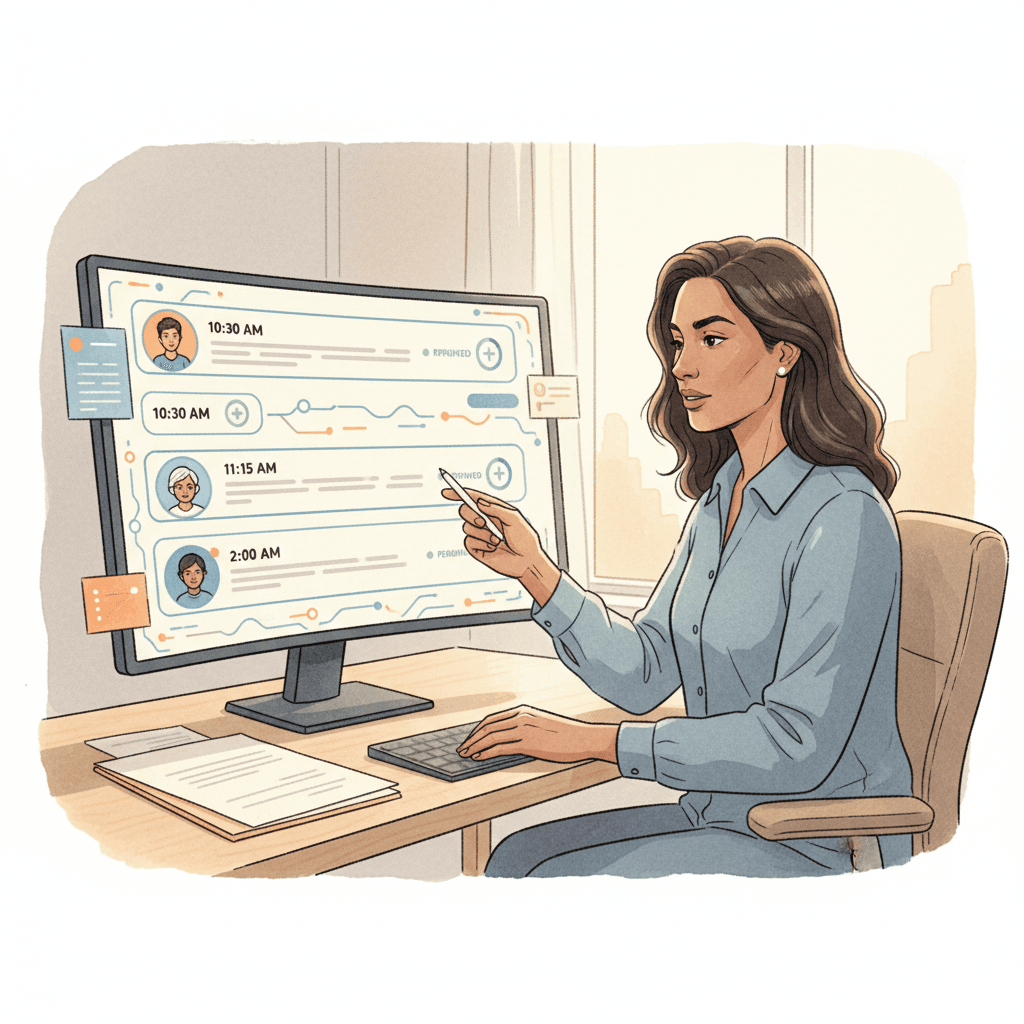
When the structured intake form captures key data points — event type, injury severity, resident demographics, prior incident history — the system can automatically suggest a classification level and route the report to the appropriate workflow pathway. Auto-classification does not replace clinical judgment, but it provides a consistent starting point that reduces the risk of under-classification (failing to escalate an event that meets critical criteria) and ensures that even a novice reporter's submission enters the correct workflow track.
The classification should be auto-suggested, not auto-finalized. A supervisor or compliance officer must confirm the classification, and the system should provide a clear interface for reclassification with documented rationale. Auto-classification that is never reviewed becomes a liability; auto-classification that is consistently reviewed and occasionally adjusted demonstrates the system is functioning as intended.
Investigation Templates
Pre-built investigation templates ensure consistency across investigators and across sites. The template should reflect your selected root cause methodology — whether "5 Whys," fishbone diagram, or another approach — and should prompt the investigator through each required element: event reconstruction, contributing factors analysis, pattern review, and corrective action recommendations. Templates reduce the variation that comes from individual investigator experience and writing style, producing investigation reports that are structurally comparable across the portfolio.
Corrective Action Tracking
Each corrective action documented in an investigation should generate a trackable task with an assigned owner, a deadline, and a status indicator. These tasks should appear in the responsible individual's task queue alongside their other operational responsibilities — not in a separate system that requires a separate login and a separate checking habit. When a corrective action deadline approaches, the system should send a reminder. When a deadline passes, it should escalate to the owner's supervisor. The compliance officer should have a dashboard showing all open corrective actions across the portfolio, sorted by aging and severity.
Trend Analytics
Individual incidents are data points. Patterns across incidents are intelligence. A technology platform that connects individual incident reports to portfolio-wide trend analysis transforms incident management from a reactive compliance function into a proactive safety discipline. Trend analytics should surface patterns that manual review cannot: increasing fall rates at a specific home, medication errors clustering on particular shifts, behavioral incidents correlating with staffing levels, or elopement attempts concentrating at specific times of day.
Harmony's incident management module integrates structured intake, auto-classification, investigation templates, corrective action tracking, and trend analytics into a single platform designed for residential care operations. Reports filed on a mobile device at the bedside flow through classification, investigation assignment, corrective action tracking, and follow-up verification — with automated notifications at each transition point and real-time dashboards that give compliance officers portfolio-wide visibility into open incidents, aging investigations, and trending event categories. The system enforces the workflow by preventing incidents from advancing to the next phase until prerequisite documentation is complete, and by surfacing incidents that are stalled, aging, or approaching regulatory notification deadlines.
Case Scenario: Sunrise Group Homes Network
Sunrise Group Homes operates twelve group homes for adults with intellectual and developmental disabilities across two counties. In 2024, a state survey identified three deficiencies related to incident reporting: late regulatory notifications, incomplete investigations, and a pattern of incidents closed without documented follow-up. The surveyor noted that the organization had an incident reporting policy, but the policy was not reflected in actual practice. Reports were filed on paper forms that varied by home, investigations were informal and inconsistently documented, and there was no mechanism for tracking corrective actions to completion.
The compliance director mapped the organization's existing workflow against the seven-phase incident lifecycle and identified three critical breakdowns. First, detection and reporting were conflated — there was no separate capture of detection time versus reporting time, and reports were frequently completed hours after the event, making it impossible to demonstrate timeline compliance. Second, investigation was treated as optional for non-critical incidents — moderate incidents like falls without injury were documented and closed without any root cause analysis, which meant the same residents were falling repeatedly in the same circumstances without any corrective intervention. Third, follow-up did not exist as a formal phase — corrective actions were occasionally documented, but no one was assigned to verify that they were implemented.
Sunrise implemented a redesigned workflow with three structural changes. They deployed a mobile reporting application with structured intake fields that captured detection time and reporting time separately, auto-classified events based on event type and injury severity, and routed each report to the appropriate supervisor for classification confirmation within 2 hours. They required investigation for all severity levels — not just critical incidents — and assigned investigations by name with defined deadlines enforced by the system. They added automated follow-up tasks that generated 7-day, 30-day, and 90-day verification prompts for each corrective action, with escalation to the compliance director for any verification that was not completed on time.
The results over 12 months were measurable. Regulatory notification compliance improved from 71 percent to 98 percent. Investigation completion rates increased from 45 percent to 94 percent. The percentage of incidents closed with documented follow-up increased from 18 percent to 89 percent. Fall recurrence rates among residents with three or more falls decreased by 34 percent, driven by the consistent application of root cause analysis and corrective action planning to every fall event, not just the ones classified as critical.
The compliance director noted that the most significant change was not any single process improvement but the visibility the system provided. Before the redesign, she did not know how many incidents were open, how many investigations were overdue, or how many corrective actions had been planned but never implemented. After the redesign, she could see all of it on a single dashboard — and so could every house manager. The workflow did not eliminate incidents. It eliminated the gaps between incidents and organizational response.
Common Workflow Failures
Even well-designed incident workflows fail in predictable ways. Understanding these failure patterns allows organizations to build safeguards against them.
The Classification Bottleneck
Reports are filed promptly but sit in a queue waiting for classification confirmation. Without confirmed classification, the downstream workflow does not activate — notifications are not sent, investigations are not assigned, timelines are not enforced. This bottleneck typically occurs when classification authority is centralized in a single person (the compliance officer or director of nursing) who is unavailable during evenings, nights, and weekends. The fix is to delegate classification authority to shift supervisors for initial confirmation, with compliance officer review within 24 hours.
The Investigation Dead End
Investigations are assigned but never completed. The investigator is a house manager with competing operational demands, and the investigation — which has no immediate consequence for non-completion — loses priority to shift coverage, family complaints, and daily operations. The fix is automated deadline tracking with escalation. When an investigation passes its deadline, the system notifies the investigator's supervisor. When it passes 48 hours beyond the deadline, it notifies the compliance officer. When it passes 72 hours, it appears on the administrator's exception report.
The Corrective Action Graveyard
Corrective actions are documented in investigation reports but never tracked to implementation. The investigation file records that the toileting schedule will be revised, the staffing overlap will be adjusted, and the pharmacy will be consulted — but no one verifies that any of these actions actually occurred. This is the most common workflow failure, and it is the one that surveyors find most quickly, because they pull the corrective action plan, then check for evidence of implementation, and the evidence does not exist. The fix is task generation: every corrective action produces a trackable task with an owner, a deadline, and required evidence of completion.
The Premature Closure
Incidents are closed before all phases are complete — typically because someone confuses completing the report with completing the workflow. The report is filed, the investigation is done, the corrective actions are listed, and the case is marked closed. But follow-up was never conducted, implementation was never verified, and the incident was never included in trend analysis. The fix is system-enforced closure criteria: the system should prevent closure until prerequisite fields are complete and prerequisite tasks are verified.
The Isolated Incident
Every incident is treated as a unique, standalone event — disconnected from the incidents that preceded it, from the residents who experienced it, and from the locations where it occurred. Pattern analysis does not happen because the system does not support it, the staff are not trained to perform it, or the organizational culture treats each incident as a problem to be solved rather than a data point to be analyzed. The fix is portfolio-wide trend analytics that automatically surface recurring patterns and present them to quality committees for systemic intervention.
Conclusion
An incident reporting workflow that satisfies regulators is not one that produces the most reports. It is one that produces the most complete lifecycle for every report. From the moment an event is detected to the moment the case is formally closed, every phase — reporting, classification, investigation, corrective action, follow-up, and closure — must be defined, documented, staffed, timed, and verified.
The organizations that consistently perform well in regulatory surveys are not the ones with the most sophisticated policies. They are the ones whose actual practice matches their written policy — where the workflow that is defined on paper is the workflow that is followed at 3 AM on a Sunday, during an understaffed shift, by a staff member who has been on the job for three weeks. That level of consistency does not come from training alone. It comes from systems — technology systems that enforce the workflow, escalation systems that activate reliably, and management systems that track every open incident to completion.
The seven-phase lifecycle described in this article is not a theoretical framework. It is a practical operational standard that maps directly to what surveyors evaluate, what regulators require, and what a genuine safety culture demands. Organizations that implement it fully will not eliminate incidents — incidents are inherent to the care of vulnerable populations. But they will eliminate the gaps between incidents and organizational learning, and those gaps are what regulators are actually looking for when they open your incident files.
FAQ
How do we get frontline staff to report incidents promptly when they are overwhelmed with direct care responsibilities?
The single most effective intervention is reducing the time required to file the initial report. If a frontline staff member must complete a ten-page paper form or navigate a complex desktop application, reporting will be delayed because it competes with direct care responsibilities for the same limited time. A mobile-accessible structured intake form that captures the essential initial data — time, location, event type, persons involved, immediate actions — in under three minutes removes the practical barrier without reducing the quality of the initial report. The detailed narrative, supervisor review, and classification can follow within the defined timeline. The initial report must be fast, because the people filing it are providing care simultaneously. Additionally, organizational culture matters: if staff perceive that reporting creates more work for them without producing visible improvement in resident safety, they will underreport. Closing the feedback loop — sharing how a reported incident led to a corrective action that improved care — reinforces the value of reporting and sustains staff engagement with the process.
What is the most common reason incident workflows fail regulatory scrutiny?
The most common reason is not a missing incident report but a broken handoff between workflow phases. Surveyors consistently identify the gap between investigation and follow-up as the most prevalent failure — the organization investigated the incident, identified root causes, documented corrective actions, and then did not verify that any of those actions were actually implemented. This pattern tells the surveyor that the organization's workflow is performative rather than functional: it produces documentation but does not produce improvement. The fix is structural, not cultural. Follow-up verification must be a system-generated task with an assigned owner, a deadline, and an escalation pathway — not a discretionary action that depends on someone remembering to check.
How do we handle incidents that span multiple jurisdictions — for example, a multi-state operator?
The most practical approach is to configure your incident management system with jurisdiction-specific notification rules while maintaining a single universal workflow for the seven lifecycle phases. The lifecycle phases — detection through closure — are consistent across jurisdictions. The notification requirements — who to notify, within what timeframe, through what mechanism — vary by jurisdiction and must be mapped precisely. Your system should associate each facility with its applicable regulatory framework and auto-generate the correct notification checklist based on the incident's location and classification. Staff training should focus on the universal workflow, with jurisdiction-specific notification requirements handled by the system and verified by the compliance officer. This approach avoids training frontline staff in the regulatory nuances of multiple jurisdictions while ensuring that notification compliance is accurate and timely.
Should we report incidents that we are not certain are reportable?
Yes. The regulatory and legal risk of under-reporting is dramatically greater than the risk of over-reporting. Filing a report that ultimately proves non-reportable creates a documented record of organizational diligence — a record that demonstrates the organization errs on the side of disclosure rather than concealment. Failing to report an event that later proves to be reportable creates a documentation gap that no amount of after-the-fact explanation can close. Surveyors understand that organizations face ambiguous situations. They do not penalize organizations for reporting events that are ultimately classified as non-reportable. They do penalize organizations for failing to report events that meet reporting criteria. When in doubt, file the report, classify it as "pending review," and let your compliance officer make the final determination within the classification confirmation timeline.
How often should we review and update our incident reporting workflow?
At minimum, the workflow should be formally reviewed annually as part of your quality improvement program. However, three events should trigger an immediate review: a regulatory survey that identifies incident-related deficiencies, a significant change in applicable regulatory requirements (such as a new reporting mandate or revised notification timeline), or a pattern of workflow failures identified through internal trend analysis. Each review should compare the documented workflow against actual practice — not just whether the policy is current, but whether staff are following it. The most reliable way to assess actual practice is to pull a random sample of 20 to 30 closed incidents and audit each one against the seven lifecycle phases, checking for completeness, timeliness, and documentation quality at each phase. Gaps between the documented workflow and the audited practice are the most actionable findings the review can produce.