Key Takeaways
- The worst time to prepare for a regulatory survey is when you know one is coming — organizations that shift into "survey mode" reveal a systemic gap between their daily operations and their compliance standards, and experienced surveyors recognize the difference between a facility that is always ready and one that recently scrambled.
- Year-round survey readiness is not an additional workload layered on top of operations — it is an operating model that integrates compliance activities into the daily, weekly, monthly, and quarterly rhythms of care delivery so that readiness is a byproduct of doing the work, not a separate project.
- A structured 12-month compliance cycle with monthly self-audits, quarterly mock surveys, semi-annual policy reviews, and an annual comprehensive assessment creates predictable accountability and eliminates the feast-or-famine pattern where compliance receives intense attention before a known survey and minimal attention afterward.
- Self-audits are only valuable when they use the same standards and scoring criteria that surveyors use — internal audits conducted with lower thresholds or softer expectations produce a false sense of readiness that collapses under actual regulatory scrutiny.
- Surveyors assess organizational culture within the first 30 minutes of a survey through staff interactions, environmental observations, and initial document requests — a facility's readiness or lack thereof is evident long before the surveyor opens a chart.
- Technology that provides continuous compliance monitoring, automated gap detection, and real-time corrective action tracking transforms survey readiness from a periodic project into a persistent state, but only when the technology is configured to reflect current regulatory requirements and is actively used by staff at every level.
- Building a dedicated survey readiness team with clear roles, cross-functional representation, and standing meeting cadence ensures that compliance is owned organizationally rather than by a single compliance officer who becomes the single point of failure for the entire regulatory posture.
Introduction
The worst time to prepare for a regulatory survey is when you know one is coming. And yet, that is precisely when most residential care organizations mobilize their compliance efforts. An unannounced survey is scheduled — or rumored, or overdue — and the facility enters what staff have come to call "survey mode." Binders are organized. Logs are reviewed. Policy manuals are dusted off and redistributed. Staff receive refresher training on documentation standards they should have been following all along. Managers walk the building with fresh eyes, noticing things they stopped seeing months ago: the expired fire extinguisher tag in the laundry room, the medication storage temperature log with three missing entries, the care plan that has not been updated since the resident's condition changed in October.
Survey mode is a familiar ritual in residential care, and nearly everyone involved understands its limitations. The compliance officer knows that the binder she is assembling contains documentation that reflects the organization's standards, not necessarily its practices. The administrator knows that the building looks different this week than it did last week, and that the difference is not sustainable. The direct care staff know that the heightened attention to documentation and procedure will subside once the surveyor leaves, returning to whatever baseline the facility actually operates at. Everyone knows this. And yet, the cycle repeats — survey after survey, year after year — because the organization has never established a different model.
The facilities that consistently perform well in regulatory surveys are not the ones that prepare the best. They are the ones that do not need to prepare at all, because readiness is embedded in how they operate every day. Their documentation is current because documentation is part of every workflow, not an afterthought. Their environment is compliant because environmental standards are monitored continuously, not inspected periodically. Their staff can answer surveyors' questions about care plans and protocols because those care plans and protocols are tools they use daily, not documents they review annually.
This distinction — between readiness as a project and readiness as an operating model — is the central argument of this article. Survey preparation is not something that happens before a survey. It is something that happens every day, in every shift, across every domain of operations. The 12-month framework presented here is not a checklist to complete before an expected inspection. It is a system for integrating compliance monitoring, self-assessment, corrective action, and continuous improvement into the operational rhythm of a residential care organization so that any day could be survey day, and the organization would be ready.
This article is written for compliance officers, administrators, directors of nursing, operations leaders, and house managers in long-term care facilities, group homes, and assisted living communities who are tired of the survey preparation cycle and ready to build something more durable. It assumes familiarity with regulatory survey processes and compliance fundamentals, and it prioritizes practical, implementable frameworks over theoretical compliance models.
The Survey Readiness Mindset: Reactive vs. Proactive Compliance
Before addressing the mechanics of year-round survey readiness, it is worth examining why so many residential care organizations default to reactive compliance — and what it costs them.
Reactive compliance is the dominant operating model in residential care for understandable reasons. Regulatory surveys are periodic events, often separated by 12 to 18 months. Between surveys, the daily demands of care delivery — staffing, medications, incidents, family communications, admissions, discharges — consume every available hour and every available person. Compliance monitoring, by contrast, produces no immediate clinical benefit. No resident's condition improves because the policy manual was updated. No family calls to thank you because the fire drill logs are current. The urgency of care delivery consistently outcompetes the importance of compliance maintenance, and so compliance maintenance gets deferred until the next survey forces it back to the top of the priority list.
The cost of this deferral compounds over time. When compliance activities are concentrated in the weeks or days before a survey, they produce a specific pattern that experienced surveyors recognize immediately. The documentation is technically complete but lacks the organic variation that characterizes genuine ongoing use. All the staff training signatures are dated within the same two-week period. The corrective action plans from the last survey show implementation dates clustered in the month after the survey and no subsequent follow-up. The environmental inspection logs show monthly entries that become sporadic, then stop, then resume abruptly three weeks ago. To a surveyor who has conducted hundreds of inspections, this pattern tells a clear story: the organization treats compliance as a project with a start date and an end date, not as a continuous operational discipline.
The consequences extend beyond survey outcomes. Organizations that operate in reactive compliance mode experience what might be called the "compliance debt" phenomenon — the accumulation of small gaps, deferred corrections, and unmonitored standards that individually seem minor but collectively represent significant regulatory exposure. A single medication storage temperature log with missing entries is a minor finding. A pattern of incomplete documentation across medication management, incident reporting, care planning, and environmental safety suggests organizational systems that are not functioning. Surveyors do not cite individual gaps in isolation; they read them as evidence of systemic conditions.
Proactive compliance, by contrast, treats regulatory standards as operational baselines — the minimum acceptable condition for how the organization operates, regardless of whether a survey is imminent. In a proactive compliance model, self-audits occur on a fixed schedule and use the same criteria that surveyors use. Corrective actions from previous surveys are tracked to completion and verified for sustained implementation, not just initial compliance. Policy reviews happen on a defined cycle rather than in response to a deficiency citation. Staff training is ongoing and documented throughout the year rather than concentrated in pre-survey preparation periods. Environmental rounds are conducted routinely, with findings addressed as they are discovered rather than accumulated on a list for later attention.
The shift from reactive to proactive compliance is not primarily a resource question, though it does require reallocation of existing effort. The total hours spent on compliance in a reactive model — the pre-survey scramble, the survey itself, the post-survey correction plan, the initial burst of implementation — often exceeds the total hours required for continuous compliance monitoring spread across the year. The difference is distribution: reactive compliance concentrates effort in acute bursts that disrupt operations, while proactive compliance distributes effort across the calendar in manageable increments that integrate with existing workflows.
The more fundamental shift is cultural. Proactive compliance requires that every staff member, from the administrator to the newest direct support professional, understands that regulatory standards are not external impositions to be satisfied during inspections but internal standards that define how the organization operates. This understanding does not develop through a single training session or a memo from the administrator. It develops through consistent reinforcement: managers who conduct environmental rounds every week rather than before surveys, supervisors who review documentation quality monthly rather than annually, compliance officers who share self-audit results transparently rather than burying them until they are corrected.
The facilities that achieve this cultural shift do not experience surveys as stressful events. They experience them as opportunities to demonstrate what they already do. The surveyor's arrival does not trigger a change in behavior because the organization's daily behavior already meets the standard. This is not idealism. It is operational design, and it begins with a structured compliance cycle.
The 12-Month Compliance Cycle
Year-round survey readiness requires a structured calendar that distributes compliance activities across the entire year. The following 12-month framework establishes a rhythm of monthly self-audits, quarterly mock surveys, semi-annual policy reviews, and an annual comprehensive assessment. Each activity builds on the one before it, creating a cumulative body of evidence that demonstrates sustained compliance rather than periodic preparation.
Monthly Activities
Every month, the organization conducts focused self-audits in two to three operational domains, rotated so that all domains are covered within a quarter. These audits are not comprehensive; they are targeted reviews of specific areas using standardized checklists derived from regulatory standards. The audit results are documented, corrective actions are assigned with deadlines and owners, and follow-up is tracked to completion.
Monthly activities also include a review of incident trends, medication error patterns, and staffing metrics. These reviews serve a dual purpose: they identify operational issues that require intervention, and they generate the trend analysis data that surveyors expect to see during an inspection. A facility that can present 12 months of documented trend analysis — with evidence that trends were identified, analyzed, and acted upon — presents a fundamentally different picture to a surveyor than a facility that can produce raw data but no evidence of analysis.
Quarterly Activities
Every quarter, the organization conducts a mock survey of one to two domains using the same survey protocols and criteria that the regulatory body uses. Mock surveys should be conducted by staff who are not directly responsible for the domain being surveyed — ideally by a compliance officer, an external consultant, or trained staff from a different department or location. The purpose of the mock survey is to simulate the survey experience, identify gaps that self-audits may have missed, and test staff readiness to answer surveyor questions.
Quarterly activities also include a review of all open corrective actions from previous self-audits and mock surveys, verification that completed corrective actions have been sustained (not just initially implemented), and an update to the compliance dashboard or tracking system.
Semi-Annual Activities
Twice per year, the organization conducts a comprehensive policy review of all operational policies and procedures. This review confirms that policies reflect current regulatory requirements, current organizational practices, and any changes that have occurred since the last review. Policies that have been updated are redistributed to relevant staff with documented acknowledgment. Policies that require staff training to implement are linked to the training calendar.
Semi-annual activities also include a review of all staff training records to verify that required certifications, competency assessments, and continuing education are current. Training gaps identified during this review are addressed before they become regulatory findings.
Annual Activities
Once per year, the organization conducts a comprehensive compliance assessment that covers every domain subject to regulatory review. This assessment functions as a full internal survey, conducted with the rigor and objectivity of an external inspection. The results are documented in a formal report that includes findings, corrective action plans, implementation timelines, and responsible parties. The annual assessment report becomes the baseline for the next year's compliance cycle.
The 12-Month Compliance Calendar
The following table maps specific activities to each month of the year, creating a predictable rhythm that staff and managers can plan around.
| Month | Self-Audit Focus | Additional Activities |
|---|---|---|
| January | Documentation and record keeping | Annual compliance assessment (comprehensive); establish annual compliance goals |
| February | Medication management | Review and update corrective action plans from annual assessment |
| March | Incident management and reporting | Quarterly mock survey (Domain 1); review incident trends Q4 prior year |
| April | Care planning and assessments | Semi-annual policy review (all operational policies); staff training records review |
| May | Staffing and scheduling compliance | Review staffing ratios, credential verification, and overtime patterns |
| June | Environmental safety and maintenance | Quarterly mock survey (Domain 2); review environmental inspection data Q1-Q2 |
| July | Resident rights and grievances | Mid-year corrective action review; verify sustained implementation of all year-to-date corrections |
| August | Infection control and hygiene | Review infection control protocols, training, and outbreak response plans |
| September | Dietary and nutrition services | Quarterly mock survey (Domain 3); review dietary compliance and resident satisfaction |
| October | Activities and community integration | Semi-annual policy review (updated policies); staff training records review |
| November | Emergency preparedness | Review emergency plans, conduct tabletop exercise, verify equipment readiness |
| December | Quality improvement and trend analysis | Quarterly mock survey (Domain 4); annual trend analysis report; prepare for January comprehensive assessment |
This calendar is a framework, not a mandate. Organizations should adjust the sequence based on their specific regulatory environment, known areas of vulnerability, and operational realities. The critical principle is consistency: every month has assigned compliance activities, every quarter has a mock survey, every six months has a policy review, and every year has a comprehensive assessment. This rhythm, maintained over time, eliminates the need for pre-survey preparation because the preparation never stops.
Adapting the Calendar to Multi-Site Operations
Organizations operating across multiple locations face the additional challenge of standardizing the compliance cycle while accommodating site-specific differences. The most effective approach is a centralized calendar with localized execution: the corporate compliance office establishes the monthly audit focus, provides standardized tools and checklists, and sets deadlines for reporting, while site-level managers conduct the actual audits, implement corrective actions, and document results. Quarterly mock surveys can be conducted by rotating teams across sites, which provides cross-pollination of best practices and prevents the audit fatigue that occurs when the same people evaluate the same areas repeatedly.
Self-Audit Checklists by Domain
Self-audits are the foundation of year-round survey readiness. They transform abstract regulatory requirements into concrete, observable, assessable items that can be verified on a scheduled basis. The following checklists provide a starting framework for six core operational domains. Each checklist should be customized to reflect the specific regulatory requirements of your jurisdiction, the standards of your accrediting body, and the operational characteristics of your care setting.
Documentation and Record Keeping
Documentation is the domain most frequently cited in regulatory surveys, not because organizations lack documents but because the documents they maintain do not consistently meet the standards surveyors apply. A documentation self-audit examines the completeness, accuracy, timeliness, and accessibility of the organization's records.
- All resident records contain current demographic information, emergency contacts, and legal representative documentation
- Admission assessments are completed within the timeframe required by regulation (typically 24 to 72 hours for initial assessments, 14 to 30 days for comprehensive assessments)
- Progress notes are entered within the required timeframe and contain objective, specific, clinically relevant information
- All entries in the resident record include date, time, author identification, and credentials
- Late entries are clearly marked as late entries with the actual date and time of the event documented
- Electronic records have appropriate access controls, audit trails, and backup procedures in place
- Paper records are stored securely, organized consistently, and accessible to authorized personnel within 15 minutes of a request
- Consent forms are current, signed by the appropriate party, and reflect the specific services being provided
- Record retention policies are documented and implemented in compliance with jurisdictional requirements
Medication Management
Medication management surveys examine the entire medication lifecycle, from ordering through administration through monitoring and disposal. Deficiencies in medication management can result in immediate jeopardy determinations in many jurisdictions, making this domain particularly high-stakes.
- Medication administration records (MARs) are complete with no unexplained gaps or missed signatures
- All medications are stored at proper temperatures, with temperature logs complete and signed for the current and prior three months
- Controlled substance counts are conducted at each shift change and documented with dual signatures
- Medications are stored in locked, organized containers with no expired medications present
- PRN (as needed) medications have documented parameters for administration, assessment of effectiveness, and follow-up notation within the required timeframe
- Medication errors are reported, documented, investigated, and trended, with corrective actions implemented for recurring patterns
- Physician orders are current, legible, and accurately transcribed to the MAR
- Staff administering medications have current, documented competency assessments on file
- Self-administration assessments are current for any residents who self-administer medications
Incident Management
Incident management audits examine not just the documentation of individual incidents but the organization's system for identifying, reporting, investigating, trending, and learning from safety events.
- All incidents are documented within the timeframe required by organizational policy and regulation
- Incident reports contain the 12 elements of a defensible incident record: date and time, location, persons involved, factual description, immediate actions, notifications, injuries and outcomes, root cause analysis, corrective actions, follow-up plan, supervisory review, and resolution documentation
- Reportable incidents are reported to the appropriate regulatory body within the mandated timeframe
- Root cause analyses are completed for all incidents meeting the organization's threshold criteria
- Corrective actions from incident investigations are specific, assigned, time-bound, and tracked to completion
- Incident trend reports are generated monthly and reviewed by management with documented evidence of action taken on identified trends
- Staff demonstrate knowledge of what constitutes a reportable incident and how to initiate the reporting process
Care Planning
Care planning audits assess whether care plans are current, individualized, person-centred, and actively used to guide care delivery. The most revealing test of a care plan's quality is not whether it exists but whether the staff member providing care can describe the plan's key elements without looking at the document.
- All residents have a current care plan that has been reviewed and updated within the required timeframe
- Care plans are based on a documented comprehensive assessment and reflect identified needs, strengths, and preferences
- Goals are measurable, time-bound, and connected to assessment findings
- Interventions are specific enough that any trained staff member can implement them consistently
- Care plans document resident and family participation in development and review
- Care plans are revised in response to significant changes in the resident's condition, after incidents, and at scheduled review intervals
- Staff providing direct care can describe key elements of the care plan for residents they serve
Staffing and Scheduling
Staffing audits examine whether the organization maintains the staffing levels, qualifications, and training required by regulation and whether documentation supports compliance claims.
- Current staffing levels meet or exceed regulatory minimums for the census and acuity of residents served
- All staff have current, verified credentials, certifications, and licensure on file
- Required training is completed within mandated timeframes for new hires and on an ongoing basis for existing staff
- Training records are organized, accessible, and include documented competency assessments where required
- Staff-to-resident ratios are documented and reconcilable with time-and-attendance records
- Background checks are completed, documented, and repeated at the frequency required by regulation
- Orientation records for new staff demonstrate completion of all required content areas
Environment and Safety
Environmental audits cover the physical plant, life safety systems, infection control infrastructure, and general habitability of the care setting. These items are often the first things a surveyor observes upon entering the building, making them disproportionately influential in shaping the surveyor's initial impression.
- Fire safety systems (alarms, sprinklers, extinguishers, emergency lighting) are inspected, tested, and documented on the required schedule
- Exit pathways are clear, unobstructed, and properly marked
- Emergency evacuation plans are posted, current, and reflect the actual building layout
- Fire drills are conducted at the required frequency across all shifts, with documented participation and debrief notes
- Water temperature at points of use is within safe ranges, with testing documented at the required frequency
- Hazardous materials are stored, labeled, and disposed of in compliance with OSHA and environmental regulations
- Common areas, resident rooms, and bathrooms are clean, well-maintained, free of odors, and in good repair
- Equipment maintenance logs are current, with evidence of preventive maintenance on the required schedule
- Infection control supplies (hand sanitizer, PPE, cleaning materials) are stocked and accessible in all required locations
What Surveyors Actually Look For
Understanding survey mechanics — what surveyors prioritize, how they allocate their time, and what signals they use to calibrate the depth of their review — fundamentally changes how an organization approaches readiness. Surveyors are not auditors in the traditional accounting sense, checking every line item against every standard. They are pattern readers. They enter a facility, observe, interact, and begin forming a picture of how the organization actually operates, then test that picture against the documentary record.
The First 30 Minutes
The first 30 minutes of a survey are the most consequential period of the entire inspection, though no individual finding during that window is likely to appear in the final report. What happens in those initial minutes establishes the surveyor's cognitive frame — the lens through which every subsequent observation will be filtered.
When a surveyor walks through the front door, she is already assessing. Is the reception area clean and welcoming? Is there a staff member available, or does the surveyor stand unacknowledged? When staff are informed that a survey is beginning, how do they react? Visible anxiety, urgent phone calls to off-site administrators, and staff suddenly appearing in hallways with clipboards all signal an organization that is not in its normal operating state. Calm acknowledgment, clear communication about who will serve as the survey coordinator, and staff who continue providing care without disruption signal an organization whose daily operations align with its compliance posture.
The surveyor's initial walkthrough covers the environment before she opens a single chart. She notes the condition of hallways, common areas, and resident rooms. She observes staff-to-resident interactions. She notes whether call lights are being answered, whether residents appear groomed and engaged, and whether the building smells clean without smelling chemically masked. These observations do not appear as individual line items in a survey report, but they calibrate the surveyor's expectations for what she will find in the records.
Patterns Over Isolated Findings
Surveyors are trained to look for patterns, not isolated incidents. A single expired medication in a storage area is a minor finding. Three expired medications across two storage areas suggest a breakdown in the medication management system. A medication error that was documented, investigated, and resolved with specific corrective actions is evidence of a functional quality system. A medication error that was documented but shows no investigation, no root cause analysis, and no corrective action is evidence of a system that records events without learning from them. When the surveyor finds this same pattern — documentation without follow-through — in incident reports, care plans, and staffing records, the finding is no longer about any single domain. It is a finding about the organization's quality management infrastructure.
This is why year-round readiness matters more than pre-survey preparation. You cannot manufacture patterns in the weeks before a survey. Twelve months of documented self-audits, corrective actions, trend analyses, and quality improvement activities create a pattern that is visible and verifiable. Twelve months of minimal compliance activity followed by three weeks of intensive preparation create a different pattern — one that is equally visible and equally verifiable.
Staff Knowledge as a Compliance Indicator
Surveyors interview staff at every level, and the consistency of their responses provides one of the most reliable indicators of organizational compliance. When a surveyor asks a direct support professional about a resident's care plan and the DSP can describe the resident's goals, current interventions, and recent progress without consulting the chart, that response tells the surveyor that the care plan is a living document that guides daily care. When the DSP cannot answer or provides information that conflicts with the written plan, the surveyor knows that the care plan is a paper exercise disconnected from actual care delivery.
Staff interviews are not limited to clinical topics. Surveyors ask about emergency procedures, infection control protocols, incident reporting processes, and resident rights. They ask new hires about their orientation experience. They ask supervisors about how they monitor care quality. They ask nurses about how they communicate with physicians. In each case, the surveyor is testing whether the organization's policies and procedures exist only in binders or whether they have been internalized by the people who must implement them.
The implication for survey readiness is clear: staff training and competency assessment are not administrative tasks to be completed for the file. They are operational necessities that directly determine how staff interact with surveyors and, more importantly, how staff deliver care. Organizations that train continuously — through monthly in-services, shift huddles, real-time coaching, and competency assessments — produce staff who can answer surveyor questions confidently and accurately. Organizations that train annually — or worse, only before surveys — produce staff whose knowledge is superficial and inconsistent.
Resident Outcomes as the Ultimate Standard
Regulatory frameworks have shifted increasingly toward outcome-based evaluation. Surveyors still review processes and documentation, but the ultimate question is whether the organization's systems produce good outcomes for residents. Are residents achieving the goals documented in their care plans? Are incident rates declining over time, suggesting that quality improvement activities are working? Are medication error rates within acceptable parameters? Are residents reporting satisfaction with their care and living environment?
Outcome data is difficult to fabricate and impossible to create retroactively. An organization that tracks resident outcomes throughout the year — goal achievement rates, incident trends, satisfaction scores, clinical indicators — has a body of evidence that speaks directly to the quality of care being delivered. An organization that does not track outcomes has no way to demonstrate that its systems are effective, regardless of how well-organized its policy manuals appear.
Technology for Continuous Compliance
The volume and complexity of compliance requirements in residential care have exceeded what manual processes can reliably manage. A single facility may be subject to hundreds of individual regulatory standards across medication management, care planning, documentation, staffing, environmental safety, incident management, and resident rights. Tracking compliance across all these standards, across all residents, across all shifts, across all staff, using paper-based systems or spreadsheets, introduces gaps that are not the result of negligence but of system design. Manual systems depend on human vigilance, and human vigilance is not sustainable at the scale and duration that continuous compliance requires.
Automated Compliance Monitoring
Technology platforms designed for residential care compliance provide automated monitoring that replaces periodic manual checks with continuous system-level surveillance. Rather than discovering during a monthly self-audit that medication storage temperatures were not logged for five consecutive days, an automated system flags the gap on day one — or, better, prevents it by requiring temperature entry as part of the daily workflow. Rather than discovering during a quarterly mock survey that three care plans have not been reviewed within the required timeframe, an automated system generates alerts as review deadlines approach and escalates to supervisors when deadlines are missed.
This shift from discovery to prevention is the fundamental value of compliance technology. Every compliance gap that is prevented costs less to address than a gap that is discovered, and far less than a gap that is cited by a surveyor.
Gap Detection and Corrective Action Tracking
Effective compliance platforms do more than flag individual deficiencies. They identify patterns across deficiencies that suggest systemic issues — the same gap appearing across multiple residents, multiple shifts, or multiple months. This pattern detection capability mirrors what surveyors do during an inspection, but it occurs continuously rather than annually. When the system identifies that medication documentation gaps correlate with specific shifts, specific staff, or specific medication types, it provides the actionable intelligence needed to address root causes rather than symptoms.
Corrective action tracking closes the loop that most manual systems leave open. When a self-audit identifies a deficiency and a corrective action is assigned, the system tracks implementation, verifies completion, and monitors for recurrence. If the corrective action was to revise the medication storage temperature monitoring process, the system can verify that temperature logs are being completed consistently after the revision — not just that the revised process was documented. This sustained verification is what distinguishes corrective action from corrective intention.
Survey Readiness Dashboards
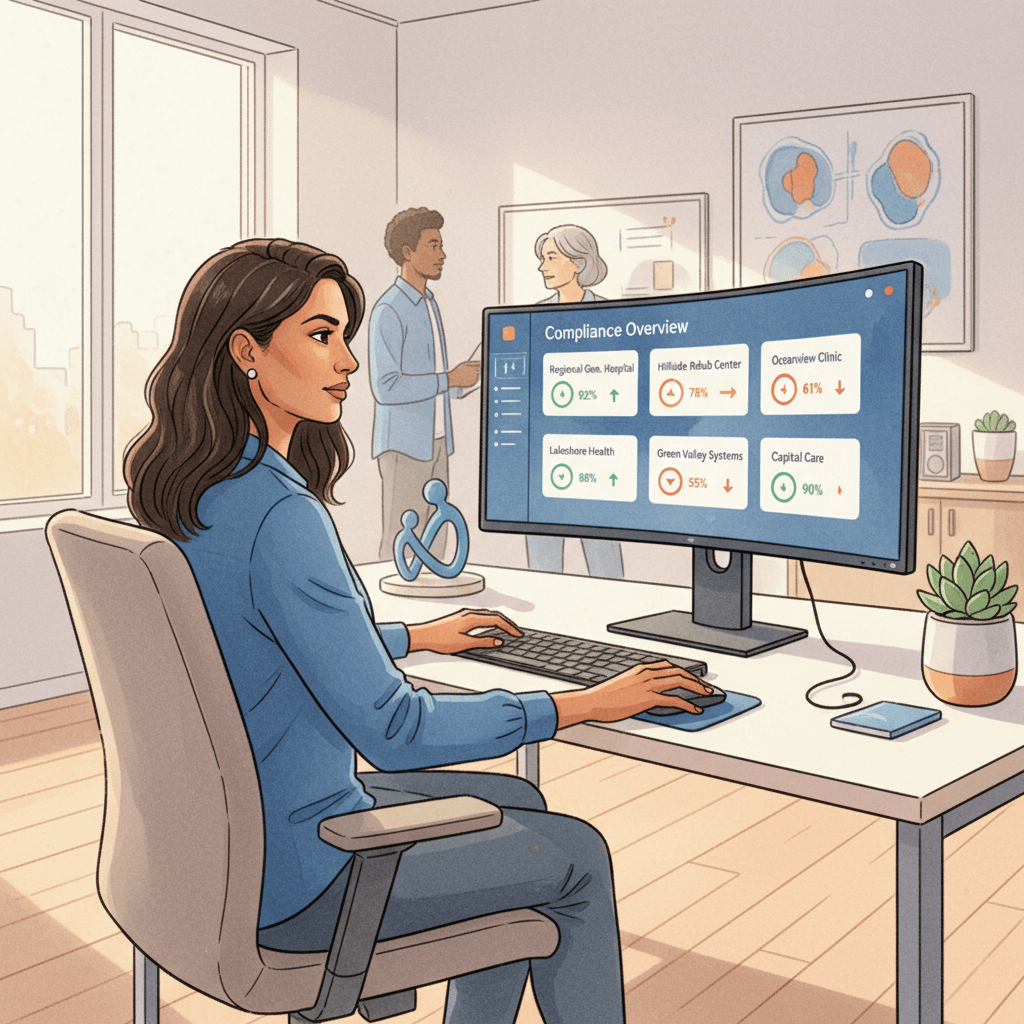
A compliance dashboard provides real-time visibility into the organization's regulatory posture across all domains, all locations, and all time periods. Rather than assembling a readiness assessment from disparate sources — paper checklists, spreadsheets, email threads, meeting minutes — the dashboard presents an integrated view of compliance status: which domains are fully compliant, which have open deficiencies, which corrective actions are overdue, and which areas have not been audited within the required cycle.
This visibility transforms survey readiness from a question that can only be answered after extensive investigation into a question that can be answered by opening a screen. When the compliance officer can see, at any time, that 94% of care plans are current, three medication management corrective actions are pending, and the environmental safety self-audit is two days overdue, she has the information needed to allocate resources effectively rather than guessing at where the gaps might be.
Harmony's compliance module is designed specifically for this purpose — providing residential care organizations with continuous monitoring, automated gap detection, corrective action tracking, and survey readiness dashboards that maintain visibility across all compliance domains. The platform integrates compliance monitoring with the operational workflows that staff use daily, so that compliance data is generated as a natural byproduct of care delivery rather than requiring separate documentation effort.
Case Scenario: Evergreen Care's Transformation
Evergreen Care operates four assisted living communities across a mid-Atlantic state, serving a combined census of 168 residents. When the organization's compliance director, Janet Okoro, took her position in early 2024, she inherited a compliance program that operated almost entirely in reactive mode. The most recent state surveys across the four communities had produced a combined total of 12 deficiencies, including two in medication management, three in care planning, two in incident management, three in environmental safety, and two in staffing documentation. None of the deficiencies were immediate jeopardy, but several were repeat citations — the same findings had appeared in prior survey cycles, suggesting that corrective actions from previous surveys had not been sustained.
Janet's assessment of the root cause was straightforward: the organization did not have a compliance system. It had compliance activities — training events, binder reviews, pre-survey preparations — but no system that connected those activities to each other or sustained them across survey cycles. Corrective action plans from previous surveys were written, filed, and largely forgotten until the next survey cycle revealed the same deficiencies.
Over the following 18 months, Janet implemented the 12-month compliance cycle described in this article, adapted to Evergreen Care's specific circumstances. The implementation followed a deliberate sequence.
In the first quarter, Janet established the monthly self-audit cadence, beginning with the two highest-risk domains: medication management and care planning. She developed standardized checklists based on state survey protocols and trained site-level nurse managers to conduct the audits. The initial self-audits were revealing — they identified 23 findings across the four communities that mirrored the types of deficiencies surveyors had cited. This was, paradoxically, a positive outcome: the self-audit process was working because it was finding the same things surveyors would find.
In the second quarter, Janet introduced quarterly mock surveys, conducted by rotating teams across sites. A nurse manager from Community A would conduct the mock survey at Community C, and vice versa. This cross-site approach provided two benefits: it brought fresh eyes to each facility, and it created an informal knowledge-sharing network as managers observed how different sites handled similar challenges. The mock surveys identified additional gaps that monthly self-audits had missed, particularly in staff knowledge — several direct care staff could not describe the care plan goals for residents they served daily.
By the third quarter, the organization had implemented a compliance technology platform that automated gap detection, corrective action tracking, and trend analysis. The platform replaced the spreadsheets and paper checklists that had made it difficult to maintain visibility across four sites. Corrective action completion rates, which had been unmeasured before Janet's arrival, became a tracked metric — starting at 62% and rising to 89% within six months.
By the end of the 18-month period, Evergreen Care's next survey cycle produced a combined total of two deficiencies across all four communities — both minor environmental findings that were corrected on the day of the survey. The medication management, care planning, and incident management domains that had previously generated repeat citations were all surveyed without findings.
The transformation was not the result of any single initiative. It was the result of a system — self-audits feeding mock surveys feeding corrective actions feeding trend analysis feeding policy updates feeding staff training — that operated continuously rather than episodically. Janet describes the shift in practical terms: "We used to get ready for surveys. Now we are ready for surveys. Those are two completely different things."
Building Your Survey Readiness Team
Year-round survey readiness cannot be the responsibility of a single person. A compliance officer working alone — regardless of her competence and dedication — represents a single point of failure for the organization's entire regulatory posture. When that person is on vacation, on medical leave, or overwhelmed by the operational demands of a particular month, the compliance system degrades. When that person leaves the organization, the compliance system may collapse entirely, because the knowledge and routines that sustained it existed primarily in one person's head.
A survey readiness team distributes compliance responsibility across multiple roles and functional areas, creating a system that survives personnel changes and absorbs workload fluctuations. The team does not need to be large — even in a small organization, three to five people with defined roles can maintain a functional compliance cycle.
Core Team Composition
The compliance officer or designee serves as the team lead, responsible for maintaining the compliance calendar, coordinating self-audit schedules, tracking corrective actions, preparing reports, and serving as the primary liaison with regulatory bodies. This role requires dedicated time — compliance cannot be an afterthought attached to another full-time operational role, though in smaller organizations the compliance lead may hold dual responsibilities with clearly defined time allocations.
The director of nursing or clinical lead provides clinical oversight for care planning, medication management, clinical documentation, and incident management domains. This person ensures that self-audit criteria reflect current clinical standards and that corrective actions are clinically sound, not just administratively compliant. In organizations without a director of nursing, a senior nurse or clinical coordinator fills this role.
A site-level operations manager — the administrator, house manager, or facility director — provides operational context and ensures that compliance activities integrate with daily operations rather than competing with them. This person is closest to the frontline staff who must implement compliance standards and is best positioned to identify when a compliance requirement is creating an unsustainable workflow burden that will eventually result in non-compliance.
A frontline staff representative — a senior DSP, charge nurse, or shift supervisor — provides the perspective of the people who actually execute compliance requirements on every shift. Including a frontline voice on the survey readiness team accomplishes two things: it ensures that compliance processes are designed with implementation reality in mind, and it creates a channel for frontline staff to raise compliance concerns before they become regulatory findings.
A quality improvement or data analyst, if available, supports the team by managing trend analysis, generating compliance reports, and maintaining the compliance dashboard. In organizations without a dedicated analyst, this function can be distributed among other team members or supported by technology platforms that automate data aggregation and reporting.
Meeting Cadence and Structure
The survey readiness team meets monthly for 60 to 90 minutes, with a standing agenda that includes review of completed self-audit results, review of open corrective actions and their status, discussion of emerging regulatory changes or guidance, preview of next month's scheduled compliance activities, and identification of resource needs or barriers. Quarterly meetings are extended to include mock survey debriefs, trend analysis review, and strategic planning for upcoming compliance priorities.
The meeting structure should be documented with minutes, action items, and follow-up tracking. This documentation serves a dual purpose: it provides operational accountability for the team's work, and it creates a record that demonstrates to surveyors the organization's ongoing commitment to compliance management. A surveyor who reviews 12 months of monthly compliance team meeting minutes — with consistent attendance, documented discussion, and tracked action items — sees an organization with a functioning quality management system.
Cross-Functional Accountability
The most effective survey readiness teams operate with clear domain ownership. Each team member is responsible for one or more compliance domains and is accountable for the self-audit results, corrective action completion, and sustained compliance in those domains. This ownership model ensures that every domain has a named person who is paying attention to it year-round, not just when the compliance calendar calls for a review.
Domain ownership does not mean isolation. The team functions as a peer review group, with each member's domain subject to quarterly review by another member. This cross-review prevents the blind spots that develop when the same person audits the same area repeatedly, and it creates the shared knowledge base that allows the team to function even when a member is unavailable.
Conclusion
Survey readiness is not a destination. It is not a state you achieve in the weeks before an inspection and maintain until the surveyor leaves. It is an operating discipline — a set of practices, rhythms, and systems that produce continuous compliance as a natural output of how your organization delivers care.
The framework presented in this article — the 12-month compliance cycle, domain-specific self-audits, mock surveys, policy reviews, technology integration, and a dedicated readiness team — is not a theoretical model. It is a practical system that residential care organizations of every size and type can implement, adapt, and sustain. The individual components are not new; most compliance officers are familiar with self-audits, mock surveys, and corrective action tracking. What is often missing is the system that connects these components into a continuous cycle with defined cadence, clear accountability, and sustained execution.
The organizations that perform best in regulatory surveys share a common characteristic: they do not think about surveys very much. They think about operations, about care quality, about documentation integrity, about staff competency, about resident outcomes. They have built systems that monitor compliance as a dimension of operational performance rather than as a separate discipline that activates periodically. When a surveyor arrives, these organizations do not change what they are doing. They simply continue doing what they have always done — and the surveyor finds an organization that operates the way it should.
The choice between reactive and proactive compliance is not a choice between more work and less work. It is a choice between concentrated, disruptive, stressful work that produces inconsistent results and distributed, integrated, manageable work that produces durable results. The 12-month cycle does not add compliance burden; it reorganizes existing burden into a sustainable pattern. The self-audit checklists do not create new requirements; they translate existing requirements into observable, assessable items. The readiness team does not add headcount; it distributes existing responsibility across a resilient structure.
Begin where your organization is. If you are currently in reactive mode, start with a single monthly self-audit in your highest-risk domain. Build from there. The goal is not perfection in month one. The goal is a system that improves every month, so that by the time the next survey arrives, readiness is not something you did. It is something you are.
Frequently Asked Questions
How often should we conduct internal self-audits?
Monthly self-audits focused on two to three operational domains per month represent the most effective cadence for residential care organizations. This schedule ensures that every major compliance domain — documentation, medication management, care planning, incident management, staffing, and environmental safety — is audited at least once per quarter. The key to effective self-auditing is using the same criteria and rigor that external surveyors apply. Internal audits conducted with softer standards produce a false sense of readiness. Each audit should produce documented findings, assigned corrective actions with deadlines and owners, and follow-up verification that corrective actions have been implemented and sustained. Some organizations add targeted mini-audits between full monthly audits — for example, weekly medication storage spot checks or daily environmental walkthrough checklists completed by shift supervisors — which provide additional monitoring without the resource investment of a full domain audit.
What is the difference between a self-audit and a mock survey?
A self-audit is a focused, systematic review of compliance within a specific operational domain, typically conducted by internal staff using a standardized checklist. A mock survey simulates the experience of an actual regulatory survey — it covers multiple domains, follows the survey protocol used by the regulatory body, and ideally is conducted by someone who is not directly responsible for the areas being surveyed. The distinction matters because mock surveys test two things that self-audits do not: the organization's ability to respond to the survey process itself (locating records, making staff available for interviews, providing access to residents and families) and the consistency of staff knowledge and behavior under observation. Both activities are essential components of a year-round readiness program, and they serve complementary purposes. Self-audits identify technical compliance gaps. Mock surveys test whether the organization, as a functioning system, can withstand external scrutiny.
How do we sustain compliance improvements after corrective actions are implemented?
Sustained compliance is the most common point of failure in post-survey correction plans. The initial corrective action is implemented — a process is revised, staff are retrained, a new form is introduced — but over time, the organization drifts back to previous practices and the deficiency recurs. Sustainability requires three elements that most corrective action plans omit: verification that the correction is still in place at 30, 60, and 90 days after implementation; integration of the correction into the organization's standard operating procedures so that it becomes part of the routine rather than an exception to it; and monitoring through ongoing self-audits that include the previously cited area as a standing review item. Technology plays a significant role in sustaining corrections by automating monitoring and alerting when compliance metrics begin to degrade, providing early warning before a gap becomes a deficiency.
What should we prioritize if we are just starting a year-round compliance program?
Start with the domains that represent the highest regulatory risk in your specific care setting and jurisdiction. For most residential care organizations, medication management and care planning documentation represent the highest-risk domains because deficiencies in these areas can escalate to immediate jeopardy determinations or substantial compliance findings. Begin monthly self-audits in these two domains while establishing the infrastructure — checklists, tracking tools, meeting cadence — that will support expansion to additional domains. Simultaneously, address any open corrective actions from your most recent survey, as these represent known vulnerabilities that will be re-evaluated during your next inspection. Within three to six months, you should have the capacity to expand to the full 12-month cycle. The most important thing is to start and to maintain consistency. A single self-audit conducted every month for six months builds more organizational capability than six self-audits conducted in the month before a survey.
How can technology help with year-round survey readiness?
Technology serves three functions in a year-round compliance program that manual processes cannot reliably deliver: continuous monitoring, pattern detection, and accountability tracking. Continuous monitoring means that compliance metrics — documentation completeness rates, training currency, care plan review timeliness, corrective action status — are tracked in real time rather than assessed periodically. When a care plan review deadline passes without a documented review, the system flags it immediately rather than waiting for the next self-audit to discover it. Pattern detection means that the system identifies connections across individual data points that humans would need hours of analysis to see — for example, that medication documentation gaps correlate with a specific shift or that incident report completion rates drop when census exceeds a certain threshold. Accountability tracking means that corrective actions have documented owners, deadlines, and completion evidence, with automated escalation when deadlines are missed. These capabilities do not replace human judgment or clinical expertise; they provide the infrastructure that allows human judgment to be applied to the right problems at the right time rather than being consumed by the administrative burden of data gathering and status tracking.