Key Takeaways
- Most residential care operators experience a 24- to 72-hour delay between an incident occurring at the facility level and leadership becoming aware of it — a gap that creates regulatory, clinical, and reputational risk.
- Operational visibility is not the same as data collection. Many organizations already capture the information they need; the problem is that it sits in disconnected systems, paper forms, and individual inboxes.
- A layered visibility framework — facility, shift, portfolio, and compliance — ensures that each role in the organization sees exactly what it needs to act, without drowning in irrelevant detail.
- The path to visibility begins with process standardization, not technology. Dashboards built on inconsistent data only automate confusion.
- Staff adoption improves when visibility is framed as accountability support rather than surveillance — the goal is to surface problems early so frontline teams get help, not scrutiny.
- Real-time care operations data transforms leadership from reactive firefighting to proactive pattern recognition, enabling organizations to catch staffing shortfalls, documentation gaps, and compliance drift before they become crises.
Introduction
A COO at a twelve-site residential care organization recently described a moment that changed how she thought about her operation. A family member called to ask about the status of their loved one after a fall. The COO had no knowledge of the fall. She checked her email — nothing. She called the regional director, who had received a summary from the house manager two days earlier but had not yet escalated it because it was "resolved on site." The house manager, in turn, had learned about it from a shift supervisor who documented it on a paper incident form the morning after it happened. The original fall occurred on a Tuesday evening. The COO learned about it on Friday afternoon, from a family member.
The incident itself was handled appropriately at the care level. The resident was assessed, a nurse was consulted, the physician was notified, and follow-up monitoring was put in place. Clinically, the response was sound. Operationally, the information traveled through four people, three systems, and seventy-two hours before reaching the person accountable for the organization's performance. By the time the COO was aware, the family was already frustrated, and the opportunity to demonstrate proactive communication had passed.
This is not an unusual story. In residential care — whether group homes serving individuals with intellectual and developmental disabilities, assisted living communities, or long-term care facilities — the gap between what happens at the point of care and what leadership can see is one of the most consequential operational challenges. It is not a technology problem in the narrow sense. It is a visibility problem: a structural failure in how information flows from the people who generate it to the people who need to act on it.
Operational visibility in residential care means that the right people have access to the right information at the right time to make decisions that protect residents, support staff, and sustain the organization. It sounds straightforward. In practice, it requires rethinking how data is captured, how it moves between roles, how it is aggregated, and how it is presented.
This article lays out a practical framework for building operational visibility across residential care facilities. It is written for CEOs, COOs, and regional directors who know their organizations have data — and suspect that data is not working hard enough for them. The goal is not to prescribe a specific technology stack, but to describe the layers of visibility that matter, the process changes that make them possible, and the cultural shifts that make them sustainable.
The Visibility Gap
What Most Operators Actually See
Ask most multi-site care operators what they know about what happened across their facilities yesterday, and the honest answer is: not much. They know what was escalated to them. They know what showed up in their inbox. They may have a weekly staffing report and a monthly quality summary. But the real-time texture of operations — who was on shift, whether documentation was completed, how many incidents occurred and of what type, whether medication administration was on schedule — is largely invisible until someone aggregates it, usually days or weeks after the fact.
This is not because operators are inattentive. It is because the information infrastructure of most residential care organizations was not designed for visibility. It was designed for documentation. The systems, processes, and habits that govern how information moves were built to satisfy a different requirement: proving, after the fact, that something was done. A shift note exists to show a surveyor that a wellness check was completed. An incident report exists to demonstrate that a protocol was followed. A staffing schedule exists to confirm that ratios were met. These are records of compliance, not instruments of awareness.
The difference matters. Compliance documentation answers the question, "Can we prove this happened?" Operational visibility answers a different question: "Do we know what is happening right now, and can we act on it?"
The Information Pipeline Problem
To understand the visibility gap, trace the path that a single piece of operational information takes from origin to action. Consider a behavioral incident at a group home serving individuals with IDD.
Step 1: The incident occurs. A direct support professional (DSP) intervenes during a behavioral episode. The immediate focus is on de-escalation and safety. Documentation is not the priority in the moment, and it should not be.
Step 2: The DSP documents the incident. This happens after the situation is stable — sometimes thirty minutes later, sometimes at the end of a shift. In many organizations, this documentation is on a paper form or in a system that does not connect to anything else. The DSP records what happened, what interventions were used, and the outcome.
Step 3: The shift supervisor reviews the documentation. Depending on the organization, this may happen during the same shift, the next shift, or the next business day. The supervisor may add context, flag follow-up needs, or simply file the form.
Step 4: The house manager learns about it. This might happen through a verbal handoff, a shift summary email, or a review of documentation during the manager's next on-site day. In many group home settings, house managers oversee multiple homes and are not physically present every day.
Step 5: The regional director receives a summary. House managers typically roll up incident information into weekly or bi-weekly reports — often spreadsheets or email narratives. The regional director now sees a summary that is at least several days old, stripped of the clinical detail that characterized the original documentation.
Step 6: The executive team reviews aggregate data. Monthly or quarterly, incident data is compiled into board reports or quality committee presentations. By this point, the information is statistical rather than operational. Trends may be visible, but the connection to specific events, staff, or residents is attenuated.
Each step in this pipeline serves a purpose. The problem is not that any single step is wrong — it is that every step adds latency, strips context, and reduces the organization's ability to intervene in time. A pattern of escalating behavioral incidents at a particular home might be visible in the quarterly report, but by then it has been a pattern for months. A staffing shortfall that correlates with increased incidents might be obvious in a connected dataset, but it is invisible when staffing data lives in one system and incident data lives in another.
What Gets Lost
The information pipeline is not just slow. It is lossy. At each handoff, detail is reduced. The DSP's narrative about what preceded the incident — a change in routine, a new medication, a conflict with a housemate — may not survive the translation to the supervisor's summary. The supervisor's assessment of whether the incident reflects a systemic issue may not make it into the house manager's weekly report. The house manager's concern that staffing levels are inadequate may be expressed verbally but not captured in the data that reaches leadership.
What reaches the top of the organization is a number: twelve incidents this month, up from nine last month. Without the context that traveled the pipeline and was lost along the way, that number is difficult to interpret and nearly impossible to act on with precision.
This is the visibility gap. It is not a gap in data — most organizations generate plenty of data. It is a gap in actionable awareness. The information exists, but it does not arrive at the right desk, in the right form, at the right time, to enable a decision that changes an outcome.
The Cost of the Gap
The consequences of this gap are not abstract. They manifest as regulatory citations discovered during surveys rather than caught during internal audits. They appear as family complaints that escalate because leadership was unaware of an issue until the family raised it. They show up as staff burnout in homes where workload has been climbing for weeks without anyone at the regional level noticing. They emerge as quality variation across sites — where one home performs well because of a strong house manager, and another drifts because problems are not surfaced until they become crises.
For operators managing five, ten, or fifty sites, the visibility gap is not a minor inconvenience. It is a structural risk that grows with every facility added to the portfolio.
The Four Layers of Operational Visibility
Operational visibility is not a single dashboard or a single metric. It is a layered framework, where each layer serves a different time horizon, a different audience, and a different decision type. Getting this architecture right matters more than the technology used to implement it.
Layer 1: Facility-Level Visibility (What Is Happening Now)
This is the foundation. Facility-level visibility answers the question: "What is the current state of this home or unit?" It operates in real time or near real time, and its primary audience is the house manager and shift supervisor.
At this layer, the metrics that matter are immediate and concrete:
- Census status. How many residents are in the facility right now? Are there any temporary absences (hospital, home visit)?
- Staffing status. Who is on shift? Are all positions filled, or are there open slots? Is the staff-to-resident ratio within policy?
- Incident activity. Have any incidents occurred in the last 24 hours? What type? What is the follow-up status?
- Documentation completeness. Are shift notes current? Have all scheduled assessments been completed? Are medication administration records up to date?
- Task completion. Which scheduled care activities have been completed this shift, and which are overdue?
Facility-level visibility is about situational awareness. It enables a house manager to walk into a home (physically or virtually) and understand its current state in minutes rather than hours. It enables a shift supervisor to hand off to the next shift with a clear, documented picture rather than a hurried verbal summary.
For most organizations, this layer is the one most in need of improvement, because it is the layer where paper forms and disconnected systems create the most friction. When a DSP documents a wellness check in one system, records a medication administration in another, and writes a shift note on paper, the house manager cannot see a unified picture of the home's current state without manually checking each source.
Layer 2: Shift-Level Visibility (Handoff Quality)
The second layer focuses on transitions — the points where information is most likely to be lost. In residential care, the shift change is the single highest-risk moment for information continuity. What the day shift knew must transfer cleanly to the evening shift, and what the evening shift observed must reach the overnight staff.
Shift-level visibility tracks:
- Handoff completeness. Were all critical items communicated at the shift change? Is there a documented handoff record?
- Carry-over items. What tasks or observations from the previous shift require follow-up? Are they tracked in a system, or do they exist only in someone's memory?
- Behavioral and clinical flags. Were any residents exhibiting behaviors, symptoms, or mood changes that the incoming shift needs to monitor?
- Open incidents. Are there any incidents from the previous shift that require continued documentation or follow-up action?
This layer matters because many of the failures that surface as quality or safety issues originate at shift transitions. A resident's new medication was started on the day shift, but the evening DSP was not informed about potential side effects to monitor. A behavioral episode occurred in the afternoon, but the overnight staff did not know to adjust the resident's evening routine. These are not failures of care — they are failures of information transfer.
Visibility at this layer means that handoff quality is measurable, not assumed. Organizations that track handoff completeness and carry-over resolution can identify which homes, which shifts, and which transition points are most vulnerable — and intervene before the information gap causes a clinical consequence.
Layer 3: Portfolio-Level Visibility (Cross-Site Trends)
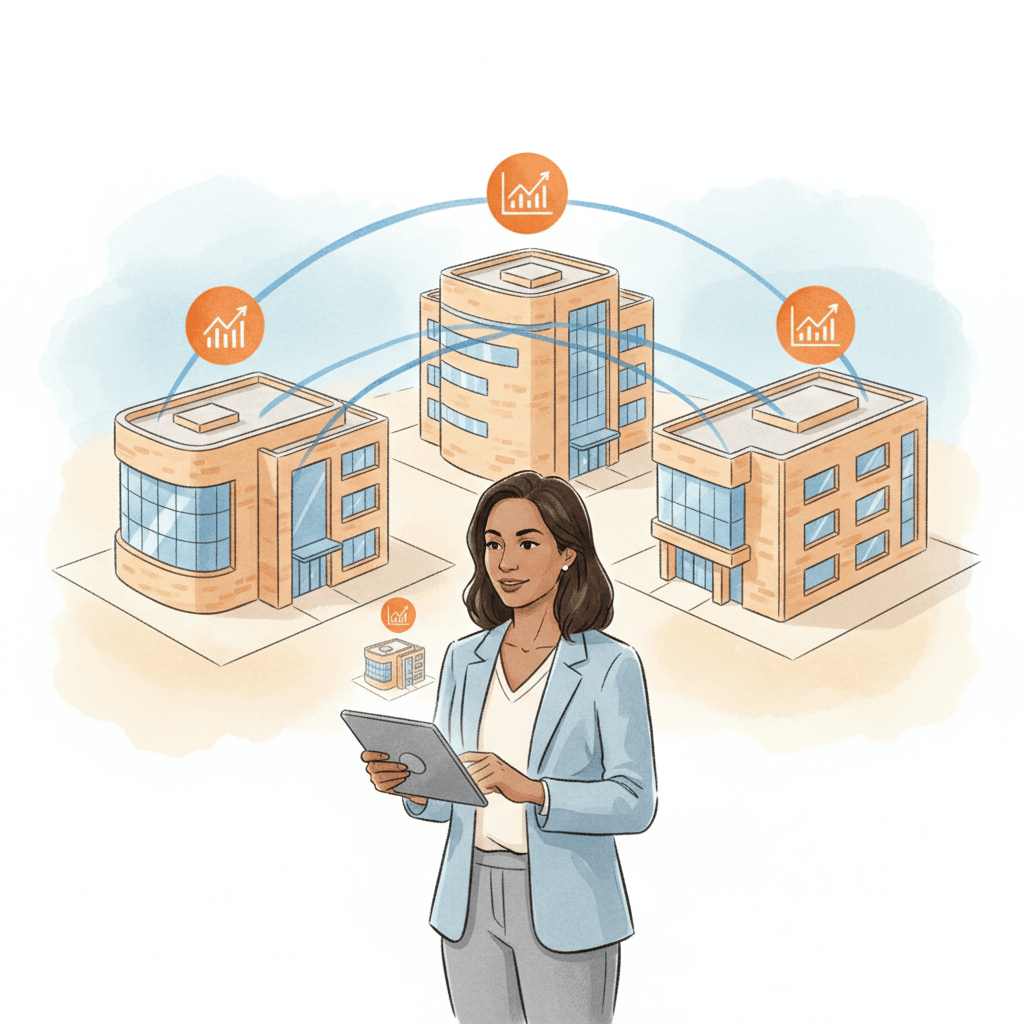
The third layer is where leadership begins to see the forest, not just the trees. Portfolio-level visibility aggregates data across facilities to reveal patterns that are invisible at the individual site level. Its primary audience is the regional director and executive team, and it operates on a weekly or monthly cadence.
Key metrics at this layer include:
- Incident rates by facility, type, and trend. Which homes have rising incident rates? Which incident types are most common across the portfolio? Are there seasonal or staffing-related patterns?
- Staffing stability. What is the turnover rate by facility? How many shifts are unfilled across the portfolio? Which homes rely most heavily on agency staff?
- Documentation compliance. What percentage of required documentation is completed on time, by facility? Which facilities are consistently late, and on what document types?
- Resident acuity trends. Is the overall acuity of the population changing? Are certain homes experiencing disproportionate increases in care complexity?
- Family and stakeholder satisfaction. What is the complaint rate by facility? Are there emerging themes in family feedback?
Portfolio-level visibility is what enables an operations leader to allocate resources intelligently. If one home has a rising incident rate and another has stable metrics but chronic staffing shortfalls, those are different problems requiring different interventions. Without aggregated, comparable data, resource allocation decisions are based on whoever makes the loudest request — not on evidence.
This layer also enables benchmarking. When a regional director can compare documentation completion rates across ten homes, the conversation shifts from "is this good enough?" to "why is Home 7 consistently better than the others, and what can we learn from them?" Visibility creates the conditions for performance improvement by making variation visible.
Layer 4: Compliance-Level Visibility (Regulatory Readiness)
The fourth layer addresses a reality that every residential care operator lives with: the next survey could happen any time. Compliance-level visibility tracks the organization's readiness for regulatory review — not as a periodic exercise, but as a continuous state.
This layer monitors:
- Regulatory training status. Are all staff current on required training? Which certifications are expiring in the next 30, 60, 90 days?
- Policy acknowledgment. Have all staff reviewed and signed off on current policies?
- Care plan currency. Are all resident care plans up to date? Have they been reviewed within required intervals?
- Audit trail integrity. Are documentation records complete, consistent, and retrievable? Could the organization produce the records a surveyor would request within hours, not days?
- Corrective action tracking. Are previously identified deficiencies being addressed? Is there documentation of progress?
Compliance-level visibility is not the same as the other three layers, because it is forward-looking. It does not just tell you what happened — it tells you where you are exposed. An organization with real-time compliance visibility can identify that three staff members at a particular home have expired CPR certifications before a surveyor walks through the door, rather than discovering it during the survey.
For multi-site operators, this layer is also where the cost of inconsistency is highest. If each facility tracks training compliance in its own spreadsheet, aggregating a portfolio-wide compliance picture requires someone to manually collect and reconcile those spreadsheets — a process that is slow, error-prone, and typically only happens before a known survey date. Continuous compliance visibility replaces that fire drill with a standing awareness that enables proactive management.
Building Your Visibility Stack
Understanding the four layers is the conceptual foundation. Building them into a functioning system is the operational challenge. The most common mistake organizations make is treating this as a technology project first. It is not. It is a process standardization project that technology can accelerate, but only after the groundwork is in place.
Step 1: Audit What You Already Measure
Before adding new metrics or new systems, take inventory of what data your organization already captures. In most residential care organizations, the volume of data collected is substantial — the problem is that it lives in silos.
Map every data source across your operation:
- Electronic health records or clinical documentation systems
- Staffing and scheduling tools
- Incident and event reporting systems
- Training and credentialing records
- Financial and billing systems
- Communication channels (email threads, messaging apps, verbal reports)
For each source, note what data it captures, who enters it, how current it is, and who can access it. This audit almost always reveals two things: first, that the organization already has most of the raw data it needs for each visibility layer; and second, that no single person or role can see all of it in one place.
This mapping exercise also surfaces a less obvious problem: inconsistent definitions. One facility might categorize a resident-to-resident altercation as a "behavioral incident," while another classifies it as a "safety event." One house manager might count a shift as "unfilled" only if no one shows up, while another counts it if the position is filled by someone who is not trained for that specific home. These definitional inconsistencies mean that even when data is aggregated, the aggregation is misleading.
Step 2: Standardize Data Capture
Visibility is only as reliable as the data that feeds it. Before connecting systems or building dashboards, establish standardized definitions, categories, and workflows for the information that matters most.
Start with the metrics that are most critical to your operation — typically incidents, staffing, and documentation completion. For each metric, define:
- What counts. Create a clear taxonomy. What constitutes an incident? What subcategories exist? What is the threshold for escalation?
- When it is recorded. Set expectations for documentation timeliness. An incident that is documented 48 hours later is not useful for real-time visibility.
- Who records it. Clarify roles. If the DSP documents the incident and the supervisor reviews it, make both steps explicit and trackable.
- Where it is recorded. Eliminate parallel systems where possible. If incidents can be documented on paper or in a digital system, you have two data streams and no single source of truth.
This step is the hardest and most important. It requires organizational alignment, training, and in many cases, a willingness to simplify. Organizations that try to capture everything at maximum granularity often find that the burden on frontline staff is unsustainable, leading to poor data quality that undermines the entire visibility effort.
The guiding principle is: capture what you will act on. If a data point will not inform a decision at any of the four visibility layers, question whether it needs to be captured in its current form.
Step 3: Connect Your Systems
With standardized data capture in place, the next step is connecting data sources so that information can flow between layers without manual re-entry. This is where technology becomes relevant — but the technology choice should follow the process design, not precede it.
The connection strategy depends on the organization's current systems:
- If your systems have APIs or integration capabilities, explore connecting them through middleware, integration platforms, or direct API connections. The goal is automated data flow — an incident entered in the documentation system should appear in the regional dashboard without someone re-entering it.
- If your systems are siloed legacy tools, the integration path may be longer. Consider whether consolidating onto a single platform is more cost-effective than building bridges between disconnected systems. For many organizations, the total cost of maintaining and integrating five separate tools exceeds the cost of one purpose-built platform.
- If your "system" is largely spreadsheets and email, the connection step and the standardization step may need to happen simultaneously. Moving from unstructured to structured data capture is itself a form of system integration.
The critical requirement at this step is a single source of truth for each data domain. Staffing data should live in one place. Incident data should live in one place. If the same information exists in two systems and they disagree, no one trusts either.
Step 4: Build Role-Appropriate Views
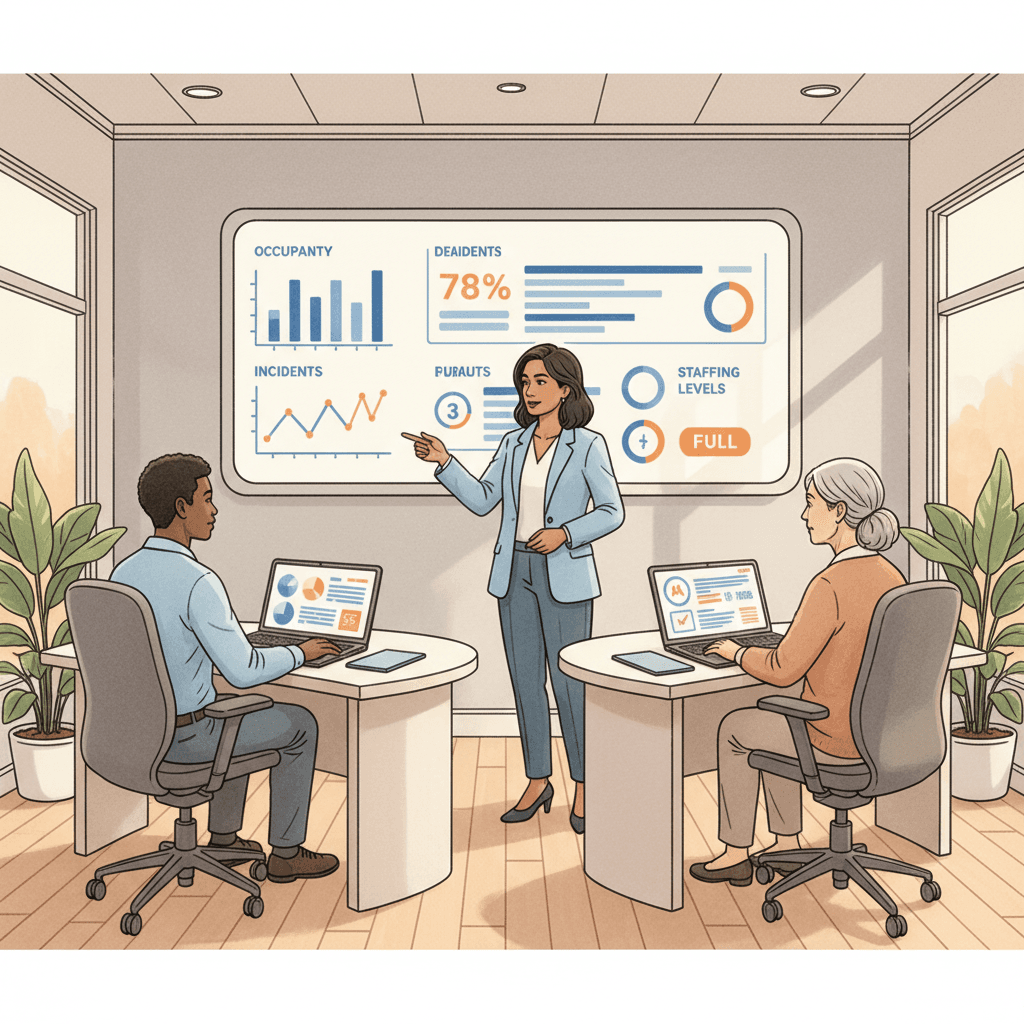
The final step is presenting the connected, standardized data in ways that are useful to each role. This is where dashboards, reports, and alerts come into play — but with an important design principle: every role should see what it needs to act, and nothing more.
The house manager does not need the portfolio-level trend analysis. The COO does not need the task-by-task shift completion log. Information overload is as much an enemy of visibility as information scarcity. The goal is not to give everyone access to everything — it is to give each role a curated view that enables their specific decisions.
Role-based views also reduce the most common objection to visibility initiatives: the feeling of surveillance. When a DSP's view of the system is focused on their residents, their tasks, and their shift — rather than on metrics that will be used to evaluate them — the system feels like a tool rather than a monitor. This distinction is more than cosmetic. It determines whether staff engage with the system or resist it.
What Every Role Needs to See
The following framework defines what operational visibility looks like at each level of a residential care organization. The principle behind it is simple: each role should see the information required to fulfill their responsibilities, at the cadence that matches their decision cycle.
Direct Support Professional / Nurse
Decision cycle: Within the current shift.
| Category | What They Need to See | Why It Matters |
|---|---|---|
| My residents | Current care plans, behavioral support plans, dietary requirements, mobility status, and any changes since their last shift | DSPs cannot provide individualized care without current, accessible information about each resident |
| My tasks | Scheduled care activities, medication administration times, wellness check intervals, and documentation deadlines for this shift | Task visibility prevents missed care activities and creates a clear record of completion |
| Shift context | Handoff notes from the previous shift, including behavioral observations, family communications, and any emerging clinical concerns | Context prevents information loss at shift transitions — the most vulnerable point in residential care |
| Alerts | Overdue tasks, pending follow-ups from previous shifts, and any resident-specific flags (fall risk, behavioral protocol changes, new medication) | Alerts surface priority items that might otherwise be buried in a general handoff |
The DSP view should feel like a personal workstation: here are my residents, here are my tasks, here is what I need to know. It should not feel like a reporting tool.
House Manager
Decision cycle: Daily, with real-time awareness of exceptions.
| Category | What They Need to See | Why It Matters |
|---|---|---|
| Facility status | Current census, staffing levels, any open incidents, documentation completion rate for the current period | The house manager needs a daily "state of the home" view that surfaces issues without requiring manual data gathering |
| Staffing | Shift coverage for the next 72 hours, any open shifts, overtime trends, and agency usage | Staffing problems are the leading upstream cause of quality and compliance issues; early visibility prevents cascading failures |
| Incidents | All incidents in the last 7 days with type, severity, status, and follow-up actions | The manager must track whether incidents are properly documented, escalated, and resolved — not just that they occurred |
| Documentation | Completion rates for shift notes, care plan reviews, medication records, and other required documentation | Incomplete documentation is both a regulatory risk and a clinical risk; visibility enables coaching before it becomes a citation |
| Resident highlights | Any residents with recent changes in condition, behavior, medication, or family concerns | Proactive awareness of changing resident needs enables care adjustments before situations escalate |
Regional Director
Decision cycle: Weekly, with real-time alerts for critical events.
| Category | What They Need to See | Why It Matters |
|---|---|---|
| Portfolio overview | Side-by-side comparison of all facilities on key metrics: incident rate, staffing stability, documentation compliance, family complaints | Cross-site comparison reveals which facilities need attention and which are performing well — enabling targeted resource allocation |
| Trending metrics | Week-over-week and month-over-month trends for incidents, staffing, and documentation across all facilities | Trends are more actionable than snapshots; a rising incident rate over three weeks is a signal that demands investigation |
| Staffing health | Turnover rate, vacancy rate, overtime percentage, and agency utilization by facility | Staffing instability is the single best predictor of operational problems; regional directors must see it early |
| Escalations | All incidents or events that meet escalation thresholds, with current status and assigned follow-up | The regional director is the first line of executive-level accountability; they need to see what has been escalated and what is pending |
| Compliance readiness | Training currency, care plan review status, and corrective action progress across the region | Regional directors are typically accountable for survey readiness; they need standing visibility into compliance posture, not last-minute scrambles |
COO / Executive Leadership
Decision cycle: Monthly, with immediate awareness of critical events.
| Category | What They Need to See | Why It Matters |
|---|---|---|
| Organization-wide performance | Aggregate KPIs across all regions: incident trends, staffing metrics, documentation compliance, survey outcomes, family satisfaction | The executive view enables strategic decision-making about resource investment, growth, and organizational priorities |
| Risk exposure | Facilities or regions with deteriorating metrics, upcoming survey dates, pending corrective actions, and open complaints | Risk visibility enables proactive intervention before problems escalate to regulatory action or public attention |
| Financial-operational correlation | How operational metrics connect to financial performance — overtime costs, agency spend, census stability, revenue per resident | Operational and financial data are typically siloed; connecting them reveals the true cost of staffing instability, documentation deficiency, and quality variation |
| Strategic benchmarks | How the organization compares to industry benchmarks and its own historical performance on key metrics | Benchmarking contextualizes performance and supports the business case for operational investment |
| Board-ready summaries | Clean, structured data that can support board reporting without manual compilation | If producing a board report requires weeks of manual data gathering, the organization is spending leadership time on data assembly rather than data analysis |
Start with one layer
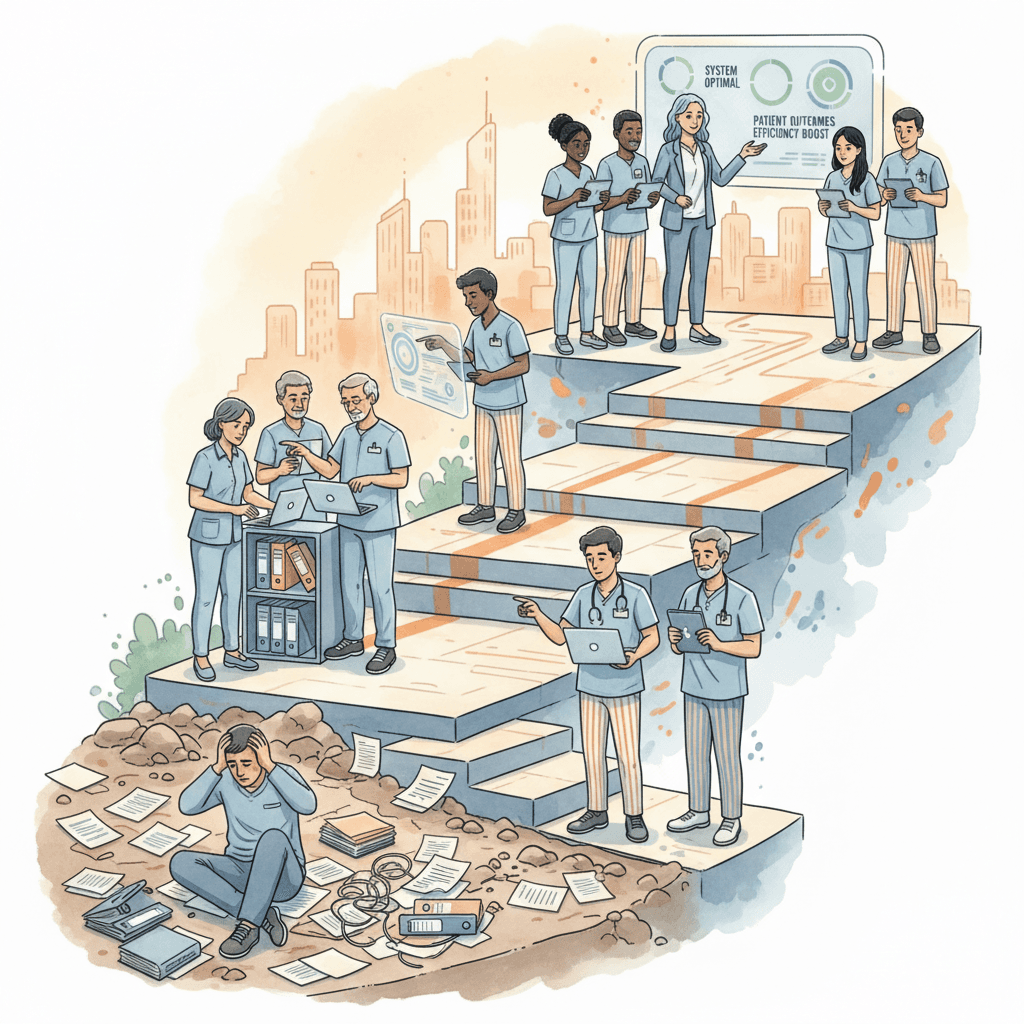
If your organization currently has limited visibility, resist the urge to build all four layers simultaneously. Start with facility-level visibility — the foundation layer. Standardize how incidents, staffing, and documentation are captured at each home. Once that data is reliable, rolling it up to portfolio and compliance views becomes a tractable problem. Starting at the top and pushing reporting requirements down to facilities that lack standardized data capture is a recipe for unreliable dashboards and frustrated staff.
The Technology Question
When Spreadsheets Stop Working
Every residential care organization starts with spreadsheets. For a single facility or a small cluster of homes, a well-maintained spreadsheet can serve as a reasonable visibility tool. The house manager tracks incidents in one tab, staffing in another, and documentation compliance in a third. The regional director asks each house manager to submit their spreadsheet weekly, consolidates the data, and produces a report.
This works until it does not. The breakpoints are predictable:
Volume. As the number of facilities grows, the time required to consolidate spreadsheets grows linearly. At ten sites, a regional director may spend an entire day each week assembling a consolidated view. At twenty sites, it becomes a full-time job for an administrative role.
Timeliness. Spreadsheet-based reporting is inherently batch-oriented. Data is entered, submitted, consolidated, and reviewed in cycles — typically weekly at best. For the facility-level and shift-level visibility layers, weekly is too slow. An incident that happened Monday is not actionable information on Friday.
Consistency. Despite best efforts, spreadsheets drift. One house manager adds a column. Another changes a category name. A third stops using the template entirely and sends a narrative email instead. The consolidation process becomes an exercise in data cleaning rather than data analysis.
Auditability. Spreadsheets do not inherently track who changed what, when. In a regulated environment where documentation integrity matters, this is a significant limitation. When a surveyor asks when an incident was documented, "it's in the spreadsheet" is not a satisfying answer if the spreadsheet has no audit trail.
Single point of failure. If the person who maintains the master spreadsheet leaves, goes on vacation, or is overwhelmed with other responsibilities, the visibility system collapses. Knowledge is concentrated in a person rather than embedded in a system.
These breakpoints do not occur at a precise facility count. Some organizations manage twenty sites on spreadsheets through sheer administrative discipline; others begin struggling at five. The signal is not the number of sites — it is the answer to the question: "How confident are you that the data in your reports is complete, current, and accurate?"
What to Look for in a Platform
When the decision is made to move beyond spreadsheets, the market offers a range of options, from general-purpose business intelligence tools to purpose-built care management platforms. The right choice depends on the organization's specific needs, but several criteria apply broadly:
Designed for care settings. Generic project management or business intelligence tools can be configured for residential care, but the configuration burden is substantial. Look for platforms that understand the language and workflows of residential care — incidents, shift handoffs, care plans, medication administration, regulatory surveys — without requiring your team to build those concepts from scratch.
Role-based access and views. The platform should support the principle that each role sees what it needs. A DSP should see a shift-focused task view. A COO should see a portfolio dashboard. This is not just a permissions feature — it is a design philosophy that determines whether the system is usable at every level of the organization.
Real-time data flow. The platform should eliminate the batch reporting cycle. When a DSP documents an incident, it should be visible to the house manager immediately and reflected in the regional dashboard within the same time frame. The value of visibility degrades rapidly with latency.
Configurable alerts and escalation rules. Not every piece of information requires attention from every role. The platform should support configurable thresholds — an incident of a certain severity automatically notifies the regional director; a staffing shortfall triggers an alert to the scheduling coordinator; a documentation gap flags the house manager.
Compliance support. The platform should track regulatory requirements — training currency, care plan review schedules, documentation deadlines — and make compliance status visible without manual tracking. Ideally, it should support the specific regulatory frameworks relevant to your care settings and jurisdictions.
Interoperability. Few organizations will consolidate all of their systems onto a single platform. The ability to integrate with existing EHR systems, payroll tools, and scheduling software — through APIs, data feeds, or middleware — determines whether the platform becomes a true hub of visibility or just another silo.
How Harmony Approaches This
HarmonyCare was built around the premise that operational visibility should be a natural byproduct of daily care work, not a separate reporting exercise. When direct support professionals document care activities, incidents, and observations through Harmony, that information flows directly into the dashboards and reports that house managers, regional directors, and executives rely on. There is no re-entry step, no weekly consolidation, and no spreadsheet.
The platform supports the four-layer visibility framework described in this article: facility-level views for house managers, shift-level handoff tracking, portfolio dashboards for regional and executive leadership, and continuous compliance monitoring. Role-based views are built in — each user sees the information relevant to their responsibilities, presented at the cadence that matches their decision cycle.
This is not the only way to build operational visibility. Some organizations assemble their visibility stack from multiple best-of-breed tools. Others build custom solutions on top of business intelligence platforms. The right approach depends on the organization's size, complexity, existing systems, and internal technical capacity. What matters is that the outcome — reliable, timely, role-appropriate information at every level of the organization — is achieved.
Case Scenario: Lakewood Care Partners
Lakewood Care Partners is a fictional organization based on patterns observed across dozens of residential care operators. It operates eight group homes for adults with intellectual and developmental disabilities across two counties, with a total census of 52 residents, approximately 120 staff members, and a leadership team of one CEO, one operations director, and two regional coordinators.
Before: Quarterly Visibility
Eighteen months ago, Lakewood's operational information flowed like this:
DSPs documented care activities and incidents on paper forms. House managers collected those forms weekly and entered summary data into a facility-specific spreadsheet. Regional coordinators requested those spreadsheets every two weeks and manually consolidated them into a regional summary. The operations director reviewed the regional summary monthly and produced a quarterly board report.
The board report was Lakewood's primary tool for operational decision-making. It showed quarterly incident counts by facility, aggregate staffing metrics, and a narrative summary of significant events. The board report was typically finalized three to four weeks after the quarter ended, meaning that leadership's view of operations was, at best, four months old by the time decisions were made.
During this period, Lakewood experienced several situations where delayed visibility had concrete consequences. A home with gradually increasing behavioral incidents did not receive additional behavioral support resources until the quarterly data revealed the trend — by which point two DSPs had resigned, citing safety concerns. A documentation compliance issue at another home was not identified until a state surveyor found it, because the internal audit process relied on the same delayed reporting pipeline.
The Transition
Lakewood's operations director initiated a visibility improvement project that took approximately nine months to fully implement. The project followed the framework described in this article, though not all steps were executed in clean sequence.
Months 1-3: Standardization. Lakewood defined a standardized incident taxonomy, unified their staffing metrics definitions across all homes, and established timeliness expectations for documentation (incidents documented within the same shift; shift notes completed before the shift ends). This required training for all house managers and DSPs, and several rounds of revision as edge cases surfaced.
Months 3-6: Digital capture. Lakewood transitioned from paper-based documentation to a digital care management platform, with DSPs documenting directly on tablets at each home. The initial rollout was challenging — several experienced DSPs were resistant to the change, and documentation times increased temporarily as staff learned the new workflow. Lakewood addressed this by designating "super users" at each home who provided peer support.
Months 6-9: Dashboard deployment and refinement. With standardized data flowing into a single system, Lakewood built role-based dashboards for house managers (daily facility view), regional coordinators (weekly portfolio view), and the operations director (monthly organizational view). The first versions of these dashboards revealed data quality issues — inconsistent categorization, duplicate entries, and gaps in documentation — that required additional training and process refinement.
After: Real-Time Awareness
Today, Lakewood's information flow looks different:
A DSP documents an incident on a tablet in the home. The house manager sees it in their facility dashboard within minutes. If the incident meets escalation criteria (severity, type, or repeat occurrence for a specific resident), the regional coordinator receives an automatic notification. The operations director's dashboard updates continuously, showing current incident rates, staffing coverage, and documentation completion across all eight homes.
The quarterly board report still exists, but it is now generated from the same data that leadership sees daily. Producing it takes hours rather than weeks. More importantly, the board report is no longer the first time leadership sees the data — it is a structured summary of information they have been monitoring all quarter.
Lakewood's operations director reports three concrete changes in how the organization operates since implementing real-time visibility:
-
Faster intervention. A pattern of increased fall incidents at one home was identified within two weeks rather than waiting for the quarterly review. Investigation revealed that a new resident with mobility challenges had been admitted without a corresponding update to the home's environmental safety assessment. The issue was addressed within days of identification.
-
Better resource allocation. Staffing data showed that one home consistently had higher overtime costs, not because of vacancies, but because the resident acuity had increased beyond the standard staffing model. The operations director adjusted the staffing template for that home based on data rather than anecdote.
-
Proactive compliance. The compliance dashboard flagged that six staff members across three homes had first aid certifications expiring within 30 days. The training coordinator scheduled recertification sessions before any certifications lapsed — avoiding what would have been a survey finding had the timing aligned with a state visit.
Overcoming Resistance
Building operational visibility is as much a cultural project as a technical one. The most sophisticated dashboard in the world is useless if frontline staff do not trust the system, do not enter data accurately, or view the entire effort as management surveillance.
The Surveillance Concern
The most common objection from frontline staff — and it is a legitimate one — is that increased visibility feels like increased monitoring. DSPs in residential care already operate in a high-accountability environment. Adding digital documentation, real-time dashboards, and automated alerts can feel like management does not trust them to do their jobs.
This concern cannot be dismissed or designed around with clever user interface choices. It must be addressed directly, honestly, and repeatedly.
The framing that works best in practice is accountability support, not accountability enforcement. The distinction is meaningful: accountability enforcement means "we are watching to make sure you do your job." Accountability support means "we want to see what is happening so that we can get you help when you need it."
Concrete examples make this real. When visibility reveals that a home is consistently behind on documentation, the supportive response is to investigate why — not to issue a corrective action. Is the documentation burden unreasonable for the shift? Are there competing demands on DSP time? Is there a training gap? When the system surfaces a problem and the organizational response is support rather than punishment, staff begin to see visibility as something that works in their favor.
Leadership Behavior Matters
Staff will take their cues from how leadership uses the data. If the first time a house manager hears about a dashboard is when their regional director calls to ask why their documentation completion rate is below 80%, the dashboard is a surveillance tool regardless of what leadership says in all-hands meetings.
Conversely, if leadership uses visibility data to say, "I noticed your facility has had a tough week with staffing — what support do you need?" the system becomes a communication channel rather than a scorecard.
This is not a naive prescription. Accountability matters, and visibility should enable it. But in the early stages of implementation, the balance should tilt heavily toward supportive use. Once staff experience that visibility leads to better resources, faster problem resolution, and fairer workload distribution, resistance diminishes. The system earns trust through its consequences.
Practical Adoption Strategies
Beyond framing, several practical strategies improve adoption:
- Involve frontline staff in design. When DSPs and nurses have input into what they see on their dashboard and how documentation workflows are structured, the result is more usable and the process builds ownership.
- Show the value back. When a visibility-enabled insight leads to a concrete improvement — more staffing, a resolved maintenance issue, a better schedule — communicate that connection explicitly. "We noticed through the system that evening shifts were consistently short-staffed at Home 3, so we adjusted the schedule" makes the system's value tangible.
- Reduce documentation burden where possible. If you are asking staff to enter data into a new system, look for ways to reduce the overall documentation load. Eliminate redundant forms, streamline workflows, and automate where possible. The net documentation burden should stay flat or decrease.
- Celebrate data quality, not just data volume. Recognize teams that maintain accurate, timely documentation — not just teams that have the most entries. Quality of data matters more than quantity for every layer of the visibility framework.
Conclusion
Operational visibility in residential care is not a luxury for large organizations with technology budgets. It is a foundational capability that determines whether leaders can make timely, informed decisions about the care their organizations deliver. The gap between what happens at the point of care and what leadership can see is not a technology problem in isolation — it is a structural challenge that requires process standardization, clear role-based information architecture, and a culture that treats visibility as support rather than surveillance.
The four-layer framework — facility, shift, portfolio, and compliance — provides a structure for thinking about what visibility means at each level of the organization. Building from the bottom up, starting with reliable facility-level data capture and expanding to portfolio and compliance views, creates a foundation that sustains itself rather than requiring constant manual effort.
For many organizations, the journey begins not with a new platform but with a clear-eyed assessment of what information already exists, where it gets stuck, and what gets lost along the way. The COO who learned about a fall 72 hours later did not lack information — she lacked a system that moved information to her at the speed her responsibility demanded.
Whether you build your visibility stack with a purpose-built platform, a set of integrated tools, or a phased modernization of your current systems, the outcome should be the same: every person in your organization, from the DSP starting a shift to the CEO preparing for a board meeting, can see what they need to see, when they need to see it, to make the decisions their role requires.
That is operational visibility. And for residential care organizations serving vulnerable populations across multiple sites, it is not optional — it is the infrastructure that makes quality, safety, and sustainability possible.
Frequently Asked Questions
What is operational visibility in residential care?
Operational visibility is the ability of leaders and staff at every level of a residential care organization to access timely, accurate, and relevant information about what is happening across their facilities. It encompasses real-time awareness of incidents, staffing levels, documentation completion, and compliance status. Unlike traditional reporting, which looks backward at historical data on a monthly or quarterly cycle, operational visibility provides a continuous picture that enables proactive decision-making. The goal is not to collect more data, but to ensure that existing data reaches the people who can act on it in a time frame that allows them to make a difference. For multi-site operators, this means breaking down the information silos that form naturally between individual facilities and centralized leadership.
How is operational visibility different from a care facility dashboard?
A care facility dashboard is one component of operational visibility, but they are not the same thing. A dashboard is a presentation layer — it displays data in a visual format. Operational visibility is the end-to-end system that generates, moves, aggregates, and presents data across an organization. You can have a beautifully designed dashboard that displays inaccurate or outdated information because the underlying data capture is inconsistent or the data pipeline introduces delays. True operational visibility requires standardized data capture at the point of care, automated data flow between systems, role-appropriate views for different audiences, and configurable alerts that surface exceptions without requiring someone to monitor a screen. The dashboard is the visible part, but the pipeline behind it is what determines whether the dashboard can be trusted.
What are the most important residential care KPIs to track?
The specific KPIs depend on your care setting, regulatory environment, and organizational priorities, but a core set applies across most residential care operations. Incident rate per facility, broken down by type and severity, reveals safety trends. Staffing metrics — fill rate, overtime percentage, agency utilization, and turnover — predict operational stability. Documentation completion rate, measured by timeliness as well as volume, indicates both regulatory readiness and care quality. Family complaint rate and resolution time reflect stakeholder satisfaction. Compliance currency — the percentage of staff with up-to-date training, certifications, and policy acknowledgments — measures regulatory exposure. Start with five to seven KPIs that your organization can measure reliably, and expand from there. A small number of trusted metrics is more valuable than a large number of unreliable ones.
How long does it take to build operational visibility across multiple sites?
For most organizations, the journey from limited visibility to reliable real-time awareness takes nine to eighteen months. The timeline depends on your starting point — an organization that already uses digital documentation and has standardized processes will move faster than one transitioning from paper forms and inconsistent definitions. The work typically unfolds in three phases: standardization of data capture and definitions (two to four months), system implementation or integration (three to six months), and refinement based on real-world use, including staff training, data quality improvement, and dashboard iteration (three to six months). The most common mistake is underestimating the standardization phase. Organizations that rush to deploy dashboards before ensuring consistent, reliable data capture end up with impressive-looking displays of unreliable information — which erodes trust faster than no dashboard at all.
Will staff feel like they are being watched?
This is the most frequently raised concern, and it deserves an honest answer: some staff will initially feel that way, regardless of how the initiative is framed. The difference between visibility-as-surveillance and visibility-as-support is not determined by the technology — it is determined by how leadership uses the information the system provides. If the first use of a new dashboard is to identify and reprimand underperforming staff, the message is clear: this is a monitoring tool. If the first use is to identify and address a systemic issue — understaffing, an unreasonable documentation burden, a training gap — the message is equally clear: this is a tool that makes problems visible so they can be solved. Organizations that succeed with visibility initiatives invest as much in communicating purpose and demonstrating supportive use as they do in the technical implementation. Frontline staff will judge the system by its consequences, not its stated intentions.