Key Takeaways
- The operations team evaluates platforms for features. IT evaluates for security. The compliance officer evaluates for defensibility — the ability to demonstrate, under regulatory scrutiny, that the organization maintained required standards, detected deviations, and responded appropriately.
- Most technology evaluation checklists are written from an IT or operations perspective and miss the compliance-specific criteria that determine whether a platform will support or undermine the organization's regulatory posture.
- A compliance-focused evaluation framework examines eight dimensions: audit trail integrity, access control granularity, regulatory report generation, incident lifecycle management, PHI protection, data retention and destruction, AI governance, and change management.
- The 50-point checklist in this article provides specific questions to ask and benchmarks for what a good answer looks like across all eight evaluation dimensions, giving compliance officers a structured tool for vendor assessment.
- Red flags during vendor evaluation are more diagnostic than feature lists — a vendor that cannot demonstrate an immutable audit trail, offers no role-based access controls, or has no data retention policy is revealing fundamental architectural limitations that cannot be fixed with a feature request.
- AI governance is the newest and most rapidly evolving evaluation dimension. Compliance officers must assess how AI-generated content is identified, how decisions are audited, whether human oversight is enforced, and how training data is handled before any AI capability is acceptable in a compliance-regulated environment.
- The evaluation does not end at vendor selection. Post-selection compliance validation — verifying that the platform actually delivers the compliance capabilities demonstrated during the sales process — is a critical step that most organizations skip and later regret.
Introduction
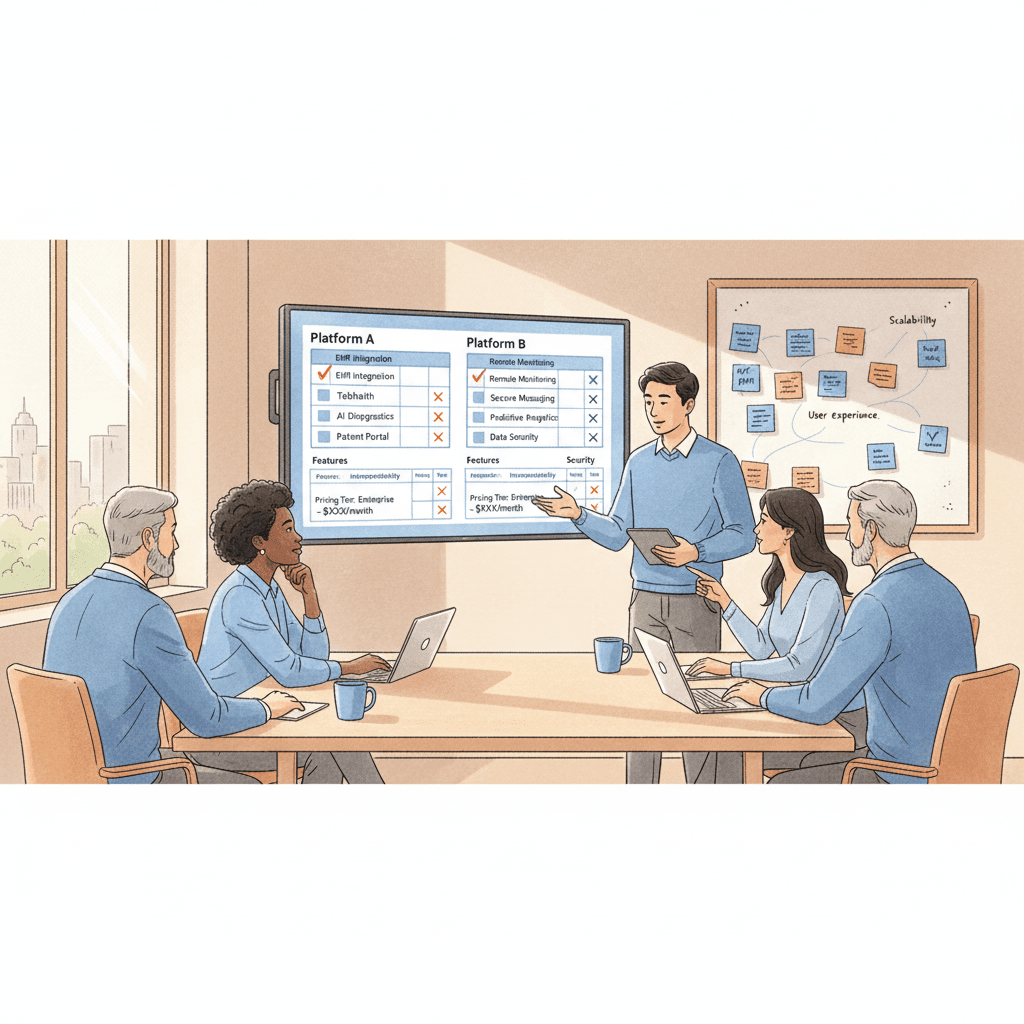
When a residential care organization evaluates a new technology platform, three perspectives converge on the same product with fundamentally different questions.
The operations team asks: "Will this make our workflows more efficient? Will staff adopt it? Will it reduce the documentation burden that consumes hours of every shift?" These are important questions. A platform that nobody uses is a platform that solves nothing.
The IT team asks: "Is this architecturally sound? Does it integrate with our existing systems? Is the infrastructure reliable, the data encrypted, the vendor financially stable?" These are critical questions. A platform that is insecure or unreliable creates new problems worse than the ones it was purchased to solve.
But the compliance officer asks a different question — the question that most vendors are least prepared to answer: "Is this platform defensible?"
Defensibility, in the compliance context, means something specific. It means that when a regulatory surveyor arrives — announced or unannounced — the platform enables the organization to demonstrate, with evidence, that required standards were maintained, that deviations were detected and documented, that corrective actions were taken and verified, and that the entire chain of accountability from the point of care to the executive suite is transparent and traceable. Defensibility is not a feature. It is a property of the system's architecture — its audit trails, its access controls, its data governance, its incident management workflows, and its relationship with the regulatory reporting obligations the organization is bound by.
Most technology evaluation processes underweight this perspective. The typical RFP process is designed around operational features and IT requirements. Compliance gets a few questions — "Are you HIPAA compliant?" "Do you have an audit trail?" — that are easy for any vendor to answer affirmatively without revealing whether the platform's compliance architecture is genuinely robust or merely superficial.
This article provides a different kind of evaluation framework. It is written specifically for compliance officers, quality assurance directors, and risk management leaders at residential care organizations who are evaluating — or preparing to evaluate — care operations platforms. It provides eight evaluation dimensions, a 50-point checklist with specific questions and benchmarks, red flags that should disqualify vendors, guidance on evaluating AI governance, and demo questions that separate vendors with genuine compliance architecture from those with compliance marketing.
Whether you are evaluating your first purpose-built care platform, replacing a system that has proven compliance-inadequate, or conducting a compliance review of a platform your organization has already selected, this framework will give you the structure and specificity to assess what matters most: will this platform help you defend your compliance posture, or will it create new gaps that you will discover at the worst possible moment?
The Compliance Evaluation Framework
A comprehensive compliance evaluation examines eight dimensions. Each dimension represents a distinct area of compliance concern, and a platform must perform adequately across all eight — strength in audit trails does not compensate for weakness in access controls, and robust reporting does not offset inadequate data governance.
Dimension 1: Audit Trail Integrity
The audit trail is the foundation of defensibility. Without a complete, accurate, tamper-evident record of who did what and when, the organization cannot demonstrate compliance with any standard that requires documentation, accountability, or chain-of-custody evidence.
A compliant audit trail records every significant action in the system: creation, modification, and deletion of records; user logins and logoffs; permission changes; configuration modifications; and data exports. Each audit record includes the identity of the user who performed the action, the timestamp with timezone, the specific action taken, the data before and after modification (for changes), and the system context (device, location, session). Critically, the audit trail itself must be immutable — no user, including system administrators, should be able to modify, delete, or suppress audit records. If the people whose actions are being audited can edit the audit trail, the trail has no evidentiary value.
The compliance officer should also verify that audit trails are retained for the full duration required by applicable regulations. In the United States, HIPAA requires retention of compliance-related documentation for a minimum of six years. State-specific requirements may be longer. Medicaid waiver programs often have their own retention mandates. The platform's audit trail retention must meet or exceed the longest applicable requirement — and the retention should be automatic, not dependent on administrator action or additional storage purchases.
Dimension 2: Access Control Granularity
Access controls determine who can see, create, modify, and delete data within the platform. In a compliance context, access controls serve two functions: they prevent unauthorized access to protected information (a security requirement), and they enforce the principle that staff should have access only to the data necessary for their role (a governance requirement).
Compliance officers should evaluate access control at three levels. First, role-based access control (RBAC): does the platform support granular roles that match the organization's operational structure? A direct support professional should not have the same system permissions as a clinical director, and a clinical director should not have the same permissions as a compliance officer. Second, facility-level segmentation: in a multi-site organization, can access be restricted so that a house manager at Facility A cannot view resident records at Facility B? Third, function-level permissions: can the platform distinguish between read access, write access, approval authority, and administrative functions within the same role?
Beyond configuration, the compliance officer should verify that access control changes are themselves audited. When a user's permissions are elevated, reduced, or revoked, the audit trail should capture who made the change, when, and why. This is essential for investigating incidents where unauthorized access is suspected.
Dimension 3: Regulatory Report Generation
Residential care organizations are required to submit reports to regulatory agencies on schedules and in formats that vary by jurisdiction, care setting, and funding source. The platform's ability to generate these reports — accurately, completely, and in the required format — directly affects the organization's regulatory compliance.
The compliance officer should evaluate whether the platform natively supports the specific reporting formats required in the organization's operating jurisdictions. This means more than "we can export data to CSV." It means the platform produces reports in the exact format, with the exact data elements, that the regulatory agency requires. For organizations operating in multiple states, the platform should support multiple state-specific reporting formats without requiring manual adaptation.
Equally important is the platform's ability to keep pace with regulatory reporting changes. When a state changes its incident reporting form, its quality metrics definitions, or its submission timeline, the vendor must update the platform's reporting capabilities in advance of the effective date. The compliance officer should ask about the vendor's track record: how quickly do they implement regulatory reporting changes, and do they charge additional fees for regulatory updates?
Dimension 4: Incident Lifecycle Management
Incidents — falls, medication errors, behavioral events, injuries, allegations of abuse or neglect — are among the highest-compliance-risk events in residential care. The platform's incident management capability must support the complete incident lifecycle: initial reporting, classification, investigation, corrective action, regulatory notification (where required), follow-up, and resolution verification.
The compliance officer should evaluate whether the platform enforces required steps in the incident lifecycle. Can staff skip the investigation step and mark an incident as resolved? Can an incident be closed without documenting corrective actions? Can a regulatory notification deadline pass without the system alerting someone? The platform should make it difficult — ideally impossible — to skip compliance-required steps in the incident workflow.
Beyond workflow enforcement, the platform should support incident pattern analysis. A single fall is an incident. Five falls in the same facility in the same month is a pattern that requires root cause analysis and systemic corrective action. The platform should provide analytical tools that surface these patterns automatically rather than requiring the compliance officer to manually review individual incident records to identify trends.
Dimension 5: Protected Health Information (PHI) Protection
Residential care platforms contain extensive PHI: medical records, behavioral health information, medication histories, assessment results, and demographic data. The platform's PHI protection architecture is not just a security concern — it is a compliance obligation under HIPAA, state privacy laws, and international privacy regulations where applicable.
The compliance officer should evaluate PHI protection at multiple layers. Data encryption at rest and in transit is the baseline — verify the specific encryption standards (AES-256 for data at rest, TLS 1.2 or higher for data in transit). Data minimization should be practiced in the platform's design: does the system collect and display only the PHI necessary for each function, or does it expose more information than needed? PHI in system-generated communications (notifications, alerts, reports) should be handled carefully — is PHI included in email subject lines, push notification previews, or SMS messages where it could be visible on a locked screen?
The compliance officer should also evaluate the vendor's Business Associate Agreement (BAA). The BAA is not a formality — it is the legal instrument that establishes the vendor's obligations regarding PHI protection. Review the BAA carefully: does it address breach notification timelines, data disposition upon contract termination, subcontractor obligations, and the vendor's liability for unauthorized disclosures? A vendor that does not offer a BAA, or offers one with inadequate terms, should not be considered for any platform that will process PHI.
Dimension 6: Data Retention and Destruction
Compliance officers must verify that the platform supports both data retention (keeping data for the legally required minimum period) and data destruction (disposing of data securely when the retention period expires or when the organization's relationship with the vendor ends).
On the retention side, the platform should support configurable retention periods that can be set to meet the longest applicable regulatory requirement. Retention should be automatic — data should not be deleted or archived before the retention period expires, even if the user requests it, unless an explicit legal override is documented.
On the destruction side, the platform should provide a documented process for secure data destruction when the organization terminates the vendor relationship. This includes specifying how data will be provided to the organization in a portable format, the timeline for data transfer, and the method by which the vendor will verify that all copies of the organization's data — including backups, replicas, and disaster recovery copies — have been permanently destroyed. A certificate of destruction should be provided.
The compliance officer should also ask about data portability: if the organization decides to leave the platform, in what format will data be exported? If the format is proprietary or difficult to import into another system, the organization's ability to transition is compromised, which creates vendor lock-in that has compliance implications when the current platform no longer meets regulatory requirements.
Dimension 7: AI Governance
As care platforms increasingly incorporate artificial intelligence — for documentation assistance, risk prediction, clinical decision support, and operational analytics — the compliance officer must evaluate the governance framework surrounding AI capabilities. AI in a compliance-regulated environment introduces unique risks that traditional evaluation criteria do not address.
The core compliance concern with AI is accountability. When an AI system assists with documentation, generates clinical alerts, or recommends actions, the compliance officer must be able to determine what the AI contributed, what a human verified, and who is accountable for the outcome. An audit trail that records "note documented by User X" without distinguishing between content the user wrote and content an AI generated creates an accountability gap that a surveyor or litigator will eventually discover.
AI governance evaluation is addressed in depth in a dedicated section later in this article.
Dimension 8: Change Management
Care platforms are not static. They are updated, reconfigured, and expanded over the life of the vendor relationship. The compliance officer should evaluate how changes to the platform — whether vendor-initiated updates, organization-requested configurations, or regulatory-driven modifications — are managed, communicated, and documented.
The platform should maintain a change log that records every system update: what changed, when it changed, who approved the change, and what testing was performed before deployment. Changes that affect compliance-relevant functionality — audit trail behavior, access control rules, regulatory reporting formats, incident workflow configurations — should require explicit approval from the organization's compliance function before deployment. The vendor should provide advance notice of changes that could affect the organization's compliance posture, with sufficient lead time for the compliance officer to assess the impact and prepare any necessary process adjustments.
The 50-Point Checklist
The following checklist is organized by the eight evaluation dimensions described above. For each item, a specific question to ask the vendor is followed by a description of what a good answer looks like. Use this checklist during vendor demos, RFP responses, and reference check conversations.
Audit Trail Integrity (Items 1-8)
1. Is the audit trail immutable? Ask the vendor to demonstrate that no user — including system administrators — can modify, delete, or suppress audit trail entries. A good answer includes a technical explanation of how immutability is enforced (write-once storage, cryptographic chaining, or append-only architecture) and a live demonstration showing that deletion attempts are blocked.
2. What actions are captured in the audit trail? Ask for a complete list of audited actions. A good answer covers all CRUD operations on clinical data, all user authentication events, all permission changes, all configuration modifications, all data exports, and all administrative actions — not just logins and document edits.
3. What data elements does each audit record include? Ask to see a sample audit record. A good answer includes user identity, timestamp with timezone, action type, the specific data element affected, the value before and after change (for modifications), session identifier, device information, and IP address.
4. How long are audit records retained? Ask about the default retention period and whether it is configurable. A good answer is that audit records are retained for a minimum of seven years by default (exceeding the six-year HIPAA minimum) and that the retention period is configurable upward without additional cost.
5. Can audit records be exported for independent analysis? Ask whether the organization can export audit data in a standard format (CSV, JSON, or SIEM-compatible format) for analysis in the organization's own tools. A good answer is yes, with scheduled or on-demand exports available without vendor intervention.
6. Does the audit trail capture failed actions? Ask whether unsuccessful attempts — failed login attempts, unauthorized access attempts, rejected data submissions — are captured. A good answer is yes, with the same data elements as successful actions, plus the reason for failure.
7. Are audit trail queries available to compliance staff without IT involvement? Ask whether the compliance officer can search, filter, and report on audit data directly. A good answer is a compliance-accessible audit query interface with role-appropriate access controls — the compliance officer should not need to submit a ticket to IT every time they need to review audit records.
8. Is the audit trail architecture independently certified? Ask whether the audit trail implementation has been reviewed as part of a SOC 2 Type II audit or equivalent independent assessment. A good answer includes a current SOC 2 Type II report that specifically addresses the audit trail controls.
Access Control Granularity (Items 9-15)
9. How many predefined roles does the platform support, and can custom roles be created? A good answer includes at least eight to ten predefined roles that match residential care organizational structures (DSP, nurse, house manager, regional director, compliance officer, administrator, read-only auditor) and allows the organization to create custom roles with granular permission sets.
10. Can access be restricted at the facility level in multi-site deployments? Ask for a demonstration showing that a user at Facility A cannot access resident data at Facility B unless explicitly granted cross-facility permissions. A good answer is a live demonstration of facility-level data segmentation.
11. Does the platform support the principle of least privilege? Ask how the platform ensures that users have only the minimum permissions necessary for their role. A good answer describes default-deny access (no permissions unless explicitly granted), regular access review capabilities, and the ability to identify users with excessive permissions.
12. Are access control changes audited? Ask to see the audit record for a permission change. A good answer shows that every change to any user's access rights — including who made the change, when, and the permissions before and after — is captured in the immutable audit trail.
13. Does the platform support multi-factor authentication (MFA)? A good answer is that MFA is supported and can be required by organizational policy for all users or for specific roles (e.g., required for administrative and compliance roles, optional for direct-care staff on shared devices).
14. How does the platform handle shared device access? In residential care, staff often share devices at nursing stations or in group homes. Ask how the platform handles session management on shared devices. A good answer includes automatic session timeout, re-authentication requirements between users, and prevention of one user accessing another user's session.
15. Can the platform generate an access review report? Ask whether the platform can produce a report showing all users, their assigned roles, their permission sets, and their last activity date. A good answer includes a scheduled access review report that helps the compliance officer identify inactive accounts, over-provisioned users, and accounts that should be deactivated.
Regulatory Report Generation (Items 16-21)
16. Which state or provincial reporting formats does the platform support natively? Ask for a list of supported regulatory reporting formats. A good answer names the specific states or provinces supported and identifies the exact reporting forms or portals the platform generates output for — not "we support most states" but "we support California LIC 624, Texas HHSC incident reporting, Florida AHCA adverse event reporting, and New York DOH HERDS submissions."
17. How quickly does the vendor implement regulatory reporting changes? Ask for examples of how the vendor has responded to regulatory reporting changes in the past. A good answer includes specific timelines ("when California changed the LIC 624 form in 2025, our updated template was available to customers 30 days before the effective date") and a commitment to implementing changes before the regulatory effective date at no additional cost.
18. Can the platform auto-populate regulatory reports from existing data? Ask for a demonstration of the report generation workflow. A good answer shows that the platform pre-fills regulatory reports with data already in the system (resident demographics, incident details, staff information) rather than requiring manual re-entry of information that already exists in the platform.
19. Does the platform track regulatory submission deadlines? Ask whether the platform monitors and alerts on regulatory reporting deadlines. A good answer includes automated deadline tracking based on the incident date and the applicable regulatory timeframe, with escalating alerts as the deadline approaches.
20. Can the platform generate compliance status reports for internal use? Ask for a demonstration of internal compliance reporting. A good answer includes dashboards showing documentation completion rates, overdue assessments, expired certifications, pending incident reports, and training compliance percentages — aggregated across facilities for multi-site operators.
21. Does the platform support electronic submission to regulatory portals? Ask whether the platform can submit reports directly to state or federal regulatory systems or generates output in the format required for electronic submission. A good answer identifies which regulatory portals support direct integration and which require formatted export for manual submission.
Incident Lifecycle Management (Items 22-28)
22. Does the platform enforce a structured incident workflow? Ask for a demonstration of the complete incident lifecycle from initial report through resolution. A good answer shows that the platform enforces required steps — classification, investigation documentation, corrective action planning, regulatory notification (when applicable), follow-up, and resolution verification — and prevents users from skipping steps.
23. Can incident severity classifications be customized to match organizational definitions? A good answer is yes, with the ability to define severity levels, associate each level with specific workflow requirements (such as mandatory escalation for high-severity incidents), and align classifications with regulatory reporting thresholds.
24. Does the platform support incident pattern analysis? Ask for a demonstration of trend reporting. A good answer shows analytical dashboards that surface incident patterns across time, facility, resident, incident type, contributing factors, and shift — enabling the compliance officer to identify systemic issues rather than reviewing incidents individually.
25. Can the platform track corrective actions with accountability and deadlines? Ask how the platform manages corrective action plans. A good answer shows that each corrective action is assigned to a responsible person, has a deadline, tracks status, sends reminders as deadlines approach, and requires verification of completion before the action can be closed.
26. Does the platform distinguish between timely and late incident reports in the audit record? A good answer is yes — the platform captures when the incident occurred and when it was reported, and late reports are flagged in the audit trail and in compliance reports. This is critical because late documentation is a common survey finding, and the platform should make timeliness visible rather than hiding it.
27. Can the platform generate regulatory incident notifications automatically? Ask whether the platform can identify incidents that meet regulatory reporting thresholds and initiate the notification process. A good answer includes automated identification of reportable incidents based on classification, pre-populated regulatory notification forms, and submission tracking.
28. Does the platform support root cause analysis workflows? A good answer includes a structured RCA template or workflow that can be linked to specific incidents, documents contributing factors, identifies systemic issues, and connects to corrective action plans.
PHI Protection (Items 29-35)
29. What encryption standards does the platform use for data at rest and in transit? A good answer specifies AES-256 for data at rest and TLS 1.2 or higher for data in transit, with details on key management practices.
30. Is PHI excluded from system-generated notifications? Ask what information appears in email notifications, push notifications, and SMS alerts. A good answer is that notifications reference events without including PHI ("Incident report submitted at Facility A — review required") rather than including resident names, diagnoses, or other protected information in notification content visible outside the secure platform.
31. Does the platform support data minimization in user interfaces? Ask whether the platform displays PHI based on role-based need. A good answer shows that users see only the PHI relevant to their role and current task — a scheduling coordinator does not need to see clinical notes, and a billing specialist does not need to see behavioral health records.
32. How does the platform handle PHI in logs and error reports? Ask whether system logs, error messages, or crash reports could contain PHI. A good answer is that PHI is scrubbed from all system logs, error reports, and diagnostic data before it leaves the production environment.
33. Does the vendor offer a Business Associate Agreement? A good answer is an immediate yes, with a BAA that has been reviewed by healthcare-experienced legal counsel and is available for the organization's review during the evaluation process — not "we can discuss that after contract signing."
34. What are the vendor's breach notification obligations under the BAA? A good answer specifies a notification timeline (ideally within 24 to 48 hours of discovery), the information that will be included in the notification, and the vendor's obligations to assist with breach investigation and regulatory notification.
35. How does the platform handle PHI when accessed on mobile devices? A good answer includes mobile-specific security controls: remote wipe capability, local data encryption, session timeout enforcement, prevention of local data caching, and restriction of copy/paste or screenshot functions for PHI-containing screens.
Data Retention and Destruction (Items 36-40)
36. What is the platform's default data retention period, and is it configurable? A good answer is a default retention period that meets or exceeds the longest applicable regulatory requirement (typically seven years minimum), with the ability to configure longer retention without additional fees.
37. What happens to the organization's data if the vendor relationship ends? Ask for the vendor's data disposition process upon contract termination. A good answer includes data export in a standard, portable format (not proprietary), a defined timeline for data transfer (within 30 to 60 days), continued data access during the transition period, and secure destruction of all vendor-held copies after transfer with a certificate of destruction.
38. Does the platform support automated data destruction after retention periods expire? A good answer includes configurable retention rules that automatically identify data eligible for destruction, a review and approval workflow before destruction occurs, and a documented destruction record in the audit trail.
39. How does the vendor handle backups and disaster recovery copies for data destruction? Ask specifically about backup tapes, disaster recovery replicas, and archived copies. A good answer confirms that data destruction extends to all copies — including backups and DR replicas — not just the production database.
40. In what format can data be exported? Ask for specifics on export formats. A good answer includes industry-standard formats (CSV, JSON, HL7 FHIR, CCD/CDA) that can be imported into other systems without proprietary conversion tools. Proprietary export formats that effectively prevent data migration should be treated as a red flag.
AI Governance (Items 41-46)
41. Does the platform clearly identify AI-generated content in the user interface and audit trail? A good answer includes visible labeling in the UI (AI-assisted content is marked distinctly from human-authored content) and structured metadata in the audit trail that identifies the AI model, the input data, and the confidence level for each AI-generated element.
42. Does AI-generated content require human review before it becomes part of the official record? A good answer is yes — AI-generated documentation, assessments, or recommendations are presented as drafts or suggestions that require explicit human approval before being saved as official records. The platform should not allow AI content to be auto-committed without human review.
43. Can AI features be disabled at the organizational or facility level? A good answer is yes, with granular controls that allow the organization to enable specific AI features (documentation assistance, risk scoring, scheduling optimization) while disabling others, and to configure different AI settings for different facilities or roles.
44. How does the vendor handle data used to train AI models? A good answer includes a clear statement that customer data is not used to train the vendor's AI models without explicit consent, that any data used for model improvement is de-identified in compliance with HIPAA Safe Harbor or Expert Determination standards, and that the organization can opt out of data sharing entirely.
45. Does the platform provide an AI audit trail distinct from the standard audit trail? A good answer includes a dedicated AI audit log that records every AI inference or generation event: the input data, the model used, the output produced, whether the output was accepted or rejected by the human reviewer, and any modifications made before final approval.
46. How does the vendor address AI bias in clinical or operational recommendations? A good answer includes a description of bias testing methodology, the frequency of bias audits, and a process for identifying and correcting biased outputs. The vendor should be able to provide documentation of bias testing results, not just a general statement about fairness principles.
Change Management (Items 47-50)
47. How does the vendor communicate platform updates that affect compliance functionality? A good answer includes advance notification (minimum 30 days for significant changes), detailed release notes that specifically call out compliance-relevant changes, and a process for the organization to test changes in a staging environment before they are deployed to production.
48. Can the organization control when updates are deployed? A good answer includes the ability to schedule updates during maintenance windows that the organization selects, the ability to delay non-critical updates, and mandatory advance deployment to a staging environment for compliance-relevant changes.
49. Does the platform maintain a change log accessible to compliance staff? A good answer includes a user-accessible change log that records every platform update, configuration change, and administrative action — distinct from the clinical audit trail — that the compliance officer can review without vendor assistance.
50. How does the vendor handle emergency patches or security updates? A good answer includes a defined process for emergency changes: notification to the organization (even if deployment cannot be delayed), post-deployment documentation, and a commitment to providing the organization with a detailed description of the change and its compliance implications within 24 hours of deployment.
Red Flags for Compliance Officers
While the checklist above evaluates what a platform offers, red flags evaluate what a platform reveals about its underlying architecture and the vendor's compliance maturity. A vendor can add features, but architectural limitations and cultural blind spots are far more difficult to fix. The following red flags should be treated as serious concerns — and in several cases, disqualifiers.
No Immutable Audit Trail
If the vendor cannot demonstrate an immutable audit trail — one where administrative users cannot modify or delete audit records — the platform's entire compliance architecture is compromised. An audit trail that can be altered is not an audit trail; it is a log file. Surveyors and investigators will not trust records that could have been modified after the fact. This is not a feature gap that the vendor can resolve with a future release — it reflects a fundamental architectural choice that typically requires a platform rebuild to change. If the audit trail is mutable, stop the evaluation.
Manual Regulatory Reporting
If the platform requires compliance staff to manually compose regulatory reports by pulling data from multiple screens, copying it into external forms, and submitting through channels outside the platform, the system is adding compliance work rather than reducing it. Manual report generation is error-prone, time-consuming, and creates a gap between the data in the platform and the data submitted to the regulatory agency. A platform designed with compliance in mind generates regulatory reports from existing data with minimal manual intervention.
No Role-Based Access Controls
If the platform offers only a binary access model — administrator and user, or full access and read-only — it cannot support the granular access control that compliance requires. Every user seeing every resident's complete record is both a HIPAA concern and a governance failure. If the platform was built without role-based access as a foundational concept, retrofitting it is architecturally complex and often results in superficial access restrictions that do not hold up under examination.
PHI in URLs, Logs, or Notifications
If resident names, diagnoses, medications, or other PHI appear in system URLs, browser history, notification previews, email subject lines, or system error logs, the platform has a fundamental data handling problem. PHI in URLs means that browser history, proxy logs, and analytics tools are all capturing protected health information. PHI in notifications means that locked phone screens and email previews are displaying protected information to anyone within visual range. These are not configuration issues — they are design decisions that reveal how deeply (or superficially) the vendor understands PHI protection.
No Data Retention Policy
If the vendor cannot articulate a data retention policy — how long data is kept, what happens when the retention period expires, how data is destroyed when the relationship ends — the organization is committing its most sensitive information to a vendor that has not thought through the full data lifecycle. This is particularly concerning because data retention obligations in healthcare are long (six to seven years minimum, often longer for minors), and a vendor that has not addressed retention may not be architecturally prepared to manage data over those timeframes.
No Business Associate Agreement Offered
Under HIPAA, any vendor that creates, receives, maintains, or transmits PHI on behalf of a covered entity must enter into a Business Associate Agreement. A vendor that does not offer a BAA — or offers one only reluctantly, after extensive negotiation — is either not experienced with healthcare compliance or has identified terms in the standard BAA that they are unwilling to accept. Either situation should disqualify the vendor from consideration for any platform that will handle PHI.
AI Without Human Oversight
If the platform includes AI capabilities — documentation assistance, risk scoring, clinical alerts, scheduling optimization — and those capabilities produce outputs that are automatically committed to the record without human review, the platform has introduced an accountability gap. In a regulatory survey, the question "who is responsible for this documentation?" must have a clear answer. If the answer is "the AI generated it and no one reviewed it," the organization has a defensibility problem. AI assistance is valuable; AI autonomy in a compliance-regulated environment is a risk.
No Incident Investigation Workflow
If the platform captures incident reports but does not provide a structured workflow for investigation, corrective action, and resolution verification, it is a reporting tool, not a compliance tool. Incident reporting without investigation is documentation without accountability. The platform should enforce the complete incident lifecycle — and if it does not, the organization will need to manage investigation workflows outside the platform, which creates gaps, duplication, and the risk that investigations fall through the cracks.
Evaluating AI Governance
AI governance deserves extended attention because it is the newest, least standardized, and most rapidly evolving dimension of compliance technology evaluation. Regulatory frameworks for AI in healthcare are still emerging, which means that compliance officers must evaluate AI governance based on principles and risk analysis rather than established checklists.
Transparency and Explainability
The compliance officer should be able to understand what AI capabilities the platform includes, how they work at a functional level, and what data they use. This does not require a deep technical understanding of machine learning algorithms. It requires that the vendor can explain, in plain language, what the AI does, what inputs it uses, what outputs it produces, and how confident those outputs should be considered. A vendor that cannot or will not explain how their AI works is asking you to trust a black box — and black boxes are the opposite of defensibility.
Audit Trails for AI Actions
Every AI action should be auditable. When AI generates a documentation suggestion, the audit trail should record the input data the AI used, the suggestion it produced, whether the human user accepted, modified, or rejected the suggestion, and the final content that was saved to the record. This audit trail should be separate from — but linked to — the standard clinical documentation audit trail, so that AI-specific queries can be run without parsing every clinical record.
Human-in-the-Loop Enforcement
For any AI capability that affects clinical documentation, care decisions, or compliance-relevant records, the platform should enforce human-in-the-loop review. This means that AI outputs are presented as suggestions or drafts, human review is required before the output becomes part of the official record, the human reviewer's identity and approval are recorded in the audit trail, and the platform cannot be configured to bypass human review for compliance-relevant AI outputs.
Data Handling and Privacy
AI systems require data to function, and the compliance officer must understand how that data is handled. Key questions include: does the AI process PHI, and if so, under what safeguards? Is customer data used to train or improve the vendor's AI models? If data is used for model training, is it de-identified to HIPAA standards? Can the organization opt out of data sharing for AI training? Is AI processing performed within the same security and data residency boundaries as the rest of the platform, or is data sent to third-party AI services with their own data handling practices?
Bias Detection and Mitigation
AI systems can perpetuate or amplify biases present in training data. In a residential care context, this could manifest as documentation suggestions that differ based on resident demographics, risk scores that correlate with race or ethnicity rather than clinical factors, or clinical alerts that are more or less sensitive for different populations. The compliance officer should ask the vendor what steps they take to detect and mitigate bias in their AI models, how frequently bias audits are conducted, and what process exists for reporting and investigating suspected bias.
Vendor Demo Questions
The vendor demo is the compliance officer's opportunity to move beyond marketing materials and see the platform in action. Most demo questions focus on features and workflows — important, but insufficient for compliance evaluation. The following ten questions are designed to probe areas where the gap between marketing claims and platform reality is largest, and where most vendors are least prepared to respond with specificity.
1. "Show me the audit trail for a care note that was documented, then edited 12 hours later by a different user." This tests audit trail completeness. You want to see the original documentation, the edit, the identity of both users, the timestamps, and the content before and after the change. If the platform does not capture all of these elements, the audit trail is incomplete.
2. "Show me what happens when a user with house manager permissions tries to access a resident record at a facility they are not assigned to." This tests facility-level access segmentation. You want to see a clear access denied response — not a warning that the user can click through.
3. "Generate the state incident report for the incident we just created — in the format required by [your specific state]." This tests regulatory reporting specificity. You want to see a pre-populated report in the exact format your state requires, not a generic template that requires manual customization.
4. "Show me what a surveyor would see if they asked for all medication errors at this facility in the last 90 days, with documentation of investigation and corrective action for each." This tests the platform's ability to produce the kind of evidence that surveyors actually request. You want to see a single query that produces a comprehensive response, not a multi-step process that requires the compliance officer to navigate five different screens.
5. "Show me how the platform handles a direct support professional who documents an incident report 8 hours after the event occurred." This tests late documentation handling. You want to see the platform capture the event time separately from the documentation time, flag the late entry in the audit trail, and make the time discrepancy visible in compliance reports.
6. "Show me the AI audit trail for a documentation suggestion that the user partially accepted and modified." This tests AI governance depth. You want to see the original AI suggestion, the user's modifications, the final saved content, and clear attribution for each element — all in the audit trail.
7. "Walk me through the process of deactivating a terminated employee's access and show me the audit record." This tests access lifecycle management. You want to see immediate access revocation, an audit record of the deactivation (who, when, why), and confirmation that the deactivated account cannot be used to access the platform.
8. "Show me the platform's data retention settings and demonstrate what happens when a record reaches its retention expiration." This tests data lifecycle management. You want to see configurable retention periods, a review workflow before destruction, and an audit record of the destruction event.
9. "Show me a portfolio-level compliance dashboard for an organization with facilities in three different states, and explain how the dashboard handles different regulatory requirements." This tests multi-site compliance architecture. You want to see metrics that are comparable across facilities while reflecting jurisdiction-specific requirements — not a single metric applied uniformly to facilities with different regulatory obligations.
10. "If we terminate our contract, describe the exact process by which we receive our data and you destroy your copies." This tests data portability and disposition. You want specifics: format, timeline, transfer method, scope of destruction (including backups), and certificate of destruction. Vague answers like "we'll work with you on that" suggest the vendor has not formalized this process.
Technology for Compliance Operations
The evaluation framework in this article assesses whether a platform can support compliance operations. But compliance officers should also ask a deeper question: was this platform designed with compliance as a first-class concern, or was compliance bolted on after the platform was built for other purposes?
The distinction matters because it determines how naturally the platform supports compliance workflows. A platform designed for clinical operations with compliance features added later will have compliance tools that feel like afterthoughts — separate modules, different user interfaces, data that does not flow seamlessly between clinical documentation and compliance reporting. A platform designed with compliance as a foundational concern will integrate compliance into the natural workflow: documentation creates audit trail entries automatically, incidents flow through investigation and reporting workflows without manual handoffs, and compliance dashboards are populated in real time from the same data that clinical staff interact with.
What a Compliance-Native Platform Looks Like
In a compliance-native platform, the audit trail is not a feature — it is an architectural property. Every interaction with the system generates an audit record, not because a compliance checkbox was ticked during development, but because the platform was built on an event-sourced or append-only data model where auditability is inherent.
Access controls are not a settings page — they are a governance framework. Roles, permissions, facility segmentation, and function-level access are configurable by the compliance team without IT intervention, because the platform was designed to be governed by compliance officers, not just administered by system administrators.
Regulatory reporting is not an export function — it is an integrated workflow. When a staff member documents an incident that meets a regulatory reporting threshold, the platform identifies the reporting obligation, pre-populates the required form, tracks the submission deadline, and provides a complete audit trail from the incident through the regulatory submission.
Harmony's Compliance-First Architecture
Harmony was built for residential care with compliance as a foundational design principle, not an afterthought. The platform's architecture reflects the understanding that in residential care, every operational activity — documentation, medication administration, incident management, care planning — is simultaneously a compliance activity.
The immutable audit trail captures every action across every module, with the granularity and immutability that compliance officers need to defend the organization's practices under regulatory scrutiny. Role-based access controls are configured at the organizational level with facility-level segmentation, supporting the multi-site governance structures that portfolio operators require. Regulatory reporting is integrated into clinical workflows so that incident documentation flows directly into state-specific reporting formats without re-entry or manual adaptation.
AI capabilities in Harmony are governed by a human-in-the-loop framework that generates documentation suggestions, marks them clearly as AI-assisted, requires human review and approval before saving, and maintains a complete AI audit trail separate from but linked to the clinical record. Compliance officers can review AI utilization, acceptance rates, and modification patterns across the organization.
The platform's compliance dashboards provide the portfolio-level visibility that multi-site compliance officers need: facility comparison metrics, risk heat maps, survey readiness scores, corrective action tracking, and trend analysis — all updated in real time from the same data that clinical and operational staff interact with daily.
Case Scenario: Meridian Senior Living
Meridian Senior Living operates 14 assisted living and memory care communities across three states. When the organization's compliance director, Sarah Chen, was tasked with evaluating care platforms, she brought a perspective that differed significantly from the operations team's evaluation priorities.
The operations team was focused on clinical documentation efficiency, staff adoption, and mobile accessibility. The IT team prioritized integration with the existing EHR, security architecture, and uptime guarantees. These were valid priorities. But Sarah's evaluation revealed compliance gaps in three of the five finalist platforms that would have created serious regulatory exposure.
The first platform had an audit trail that captured logins and document creation but did not record document edits. A care note that was modified after initial documentation left no trace of the original content. Sarah identified this during the demo by asking her question about a care note edited 12 hours later — the vendor could show that the note was edited, but not what it said before the edit. This alone was disqualifying: in a survey or investigation, the inability to show the original documentation undermines the evidentiary value of every record in the system.
The second platform included AI documentation assistance that auto-populated care notes from structured data entry. The notes were good — clinically appropriate and well-written. But when Sarah asked to see the AI audit trail, the vendor acknowledged that AI-generated content was not distinguished from human-authored content in the audit trail. There was no way to determine, after the fact, which portions of a care note were AI-generated and which were written by the clinician. Sarah flagged this as an accountability gap that would be indefensible under regulatory scrutiny.
The third platform had strong audit trail and AI governance capabilities but no structured incident investigation workflow. Incidents were reported and classified, but the investigation, corrective action, and resolution verification steps were managed outside the platform in Word documents and email chains. This meant that the complete incident lifecycle was not auditable within the system — a gap that would require Meridian to maintain parallel compliance documentation outside the platform.
The platform Meridian ultimately selected — after Sarah's compliance evaluation eliminated three of five finalists — addressed all eight evaluation dimensions. The audit trail was immutable and comprehensive. AI content was labeled and auditable. The incident lifecycle was fully managed within the platform. The demo answers matched the checklist criteria. And critically, the platform's compliance capabilities were validated during a 60-day pilot at two Meridian facilities before the organization committed to full deployment.
Sarah's evaluation added six weeks to the selection timeline. It also prevented the organization from deploying a platform with compliance gaps that would have been discovered during the next state survey — at a point where switching platforms would have been enormously more expensive and disruptive than extending the evaluation.
After Selection: Compliance Validation
Selecting a platform based on demo performance and vendor representations is necessary but not sufficient. The compliance officer's role does not end at vendor selection — it extends through implementation and into ongoing operations. Post-selection compliance validation is the step that verifies that the platform actually delivers the compliance capabilities that were demonstrated during the sales process.
Pre-Implementation Validation
Before full deployment begins, conduct a compliance-focused validation during the pilot or staging phase. Using the 50-point checklist, verify each item against the live platform — not the demo environment. Demo environments are optimized for presentation. Production environments sometimes have different configurations, different performance characteristics, and different limitations. Every compliance-critical capability should be verified in the environment that will actually serve the organization.
Configuration Validation
Many compliance capabilities depend on correct configuration. Role-based access controls must be configured with the right roles and permissions. Audit trail retention must be set to the correct period. Regulatory reporting templates must be configured for the organization's specific jurisdictions. Incident severity classifications must match the organization's definitions. Each of these configurations should be reviewed and approved by the compliance officer before the platform goes live at any facility.
Ongoing Compliance Monitoring
After deployment, establish a quarterly compliance review of the platform itself. Verify that audit trails continue to function as expected. Test access controls by periodically auditing user permissions against role definitions. Review regulatory reporting output for accuracy and completeness. Monitor AI governance controls as AI features are updated or expanded. And review vendor change logs to assess whether platform updates have affected compliance-relevant functionality.
Annual Compliance Recertification
At least annually, conduct a formal recertification of the platform's compliance posture. This recertification should use the same 50-point checklist used during the original evaluation, updated for any regulatory changes that have occurred since the last review. The recertification should be documented and retained as evidence of ongoing compliance due diligence — because a platform that was compliant at selection can drift out of compliance as the vendor releases updates, as regulations change, or as the organization's compliance requirements evolve.
Conclusion
The compliance officer's technology evaluation is different from every other stakeholder's evaluation because the consequences of getting it wrong are different. An operations leader who selects a platform with a clunky user interface will face adoption challenges and staff frustration. An IT leader who selects a platform with weak integration capabilities will face technical workarounds and data synchronization headaches. These are significant problems.
But a compliance officer who selects a platform with an inadequate audit trail, insufficient access controls, or no incident investigation workflow will face a different kind of problem — one that surfaces during a regulatory survey, a litigation discovery request, or an incident investigation. The problem will not be that the platform is inconvenient. It will be that the platform cannot defend the organization's compliance posture when defense matters most.
The 50-point checklist, the red flags, the AI governance framework, and the demo questions in this article are designed to give compliance officers the structured tools to evaluate platforms on defensibility — the dimension that matters most and that most evaluation processes underweight. Use them during the evaluation process. Bring them to demos. Include them in RFPs. And after selection, use them again during validation and ongoing monitoring, because compliance evaluation is not a one-time event. It is a continuous discipline that must be maintained for the life of the vendor relationship.
The vendors that can answer these questions well are the ones that built compliance into their platform's architecture. The ones that struggle are the ones that added compliance as a feature layer on top of a platform designed for other purposes. That architectural distinction is not something that can be fixed with a product roadmap — it is a reflection of how the vendor thinks about the problem your organization is trying to solve. And for a compliance officer, how a vendor thinks about compliance tells you more than any feature list ever will.
Frequently Asked Questions
How should compliance evaluation be weighted relative to operations and IT evaluation in the overall vendor selection?
Compliance evaluation should have equal weight to operations and IT evaluation in the overall scoring framework — typically one-third of the total score, or weighted to at least 25 to 30 percent. Some organizations make the mistake of treating compliance as a pass/fail gate (does the vendor have an audit trail — yes or no?) while allocating the detailed scoring to operational features. This approach misses the nuance: two platforms may both "have audit trails," but one has an immutable, comprehensive, independently certified audit trail and the other has a basic activity log with limited retention. The compliance officer's detailed scoring across all eight dimensions should be incorporated into the weighted evaluation with the same granularity as the operations team's workflow assessment and the IT team's technical evaluation.
What if our current platform fails several items on the 50-point checklist?
This is a common finding, and it does not necessarily mean immediate platform replacement. Start by categorizing the failures by severity. Items in the audit trail and PHI protection categories are the most critical — failures here create active compliance risk that may require urgent remediation or mitigation. Items in categories like AI governance or change management may represent areas where organizational policies and manual processes can compensate for platform limitations in the short term. Document the gaps, assess the risk each gap creates, identify available mitigations, and build a timeline for addressing the most critical gaps — whether through vendor feature requests, configuration changes, manual process supplements, or, if the gaps are fundamental and unresolvable, platform replacement planning.
How do we evaluate compliance for a platform that uses third-party AI services?
When a platform sends data to third-party AI services (such as cloud-based language models for documentation assistance), the compliance evaluation must extend to the third-party service. Ask the vendor to identify which AI services they use, where data is processed geographically, whether PHI is transmitted to the third party, what the third party's data retention and usage policies are, and whether the third party is covered under the vendor's BAA or has a separate BAA with the vendor. The compliance officer should review the third party's data handling practices with the same rigor applied to the primary vendor. A platform vendor's compliance posture is only as strong as the weakest link in its data processing chain, and third-party AI services are increasingly that link.
Should compliance officers participate in vendor demos, or just review the results?
Compliance officers should participate directly in at least one vendor demo for each finalist vendor — and ideally, they should have dedicated demo time focused specifically on compliance scenarios rather than sharing time with operations and IT demonstrations. The compliance evaluation requires asking specific follow-up questions based on what the demo reveals, probing areas where the demo presentation seems vague or superficial, and testing edge cases that are not part of the standard demo script. A compliance officer reviewing a demo summary or scorecard completed by someone else will miss the non-verbal signals — the vendor's hesitation when asked about audit trail immutability, the redirect when asked about data destruction processes, the "that's on our roadmap" answer that reveals a current capability gap. These signals are often more informative than the demo content itself.
How often should we re-evaluate our platform's compliance posture after deployment?
Conduct a formal compliance review quarterly during the first year after deployment, then at least annually thereafter. The quarterly cadence during the first year catches configuration issues, workflow gaps, and feature limitations that were not apparent during the evaluation process but emerge during real-world use. After the first year, an annual compliance recertification using the 50-point checklist — updated for any regulatory changes — provides ongoing assurance that the platform continues to meet compliance requirements. Additionally, trigger an ad hoc compliance review whenever the vendor releases a major platform update that affects compliance-relevant functionality, whenever a regulatory change affects the organization's compliance requirements, or whenever a compliance incident reveals a platform limitation that was not previously identified. Document every review and retain the results as evidence of ongoing compliance due diligence.